






Definition and Meaning
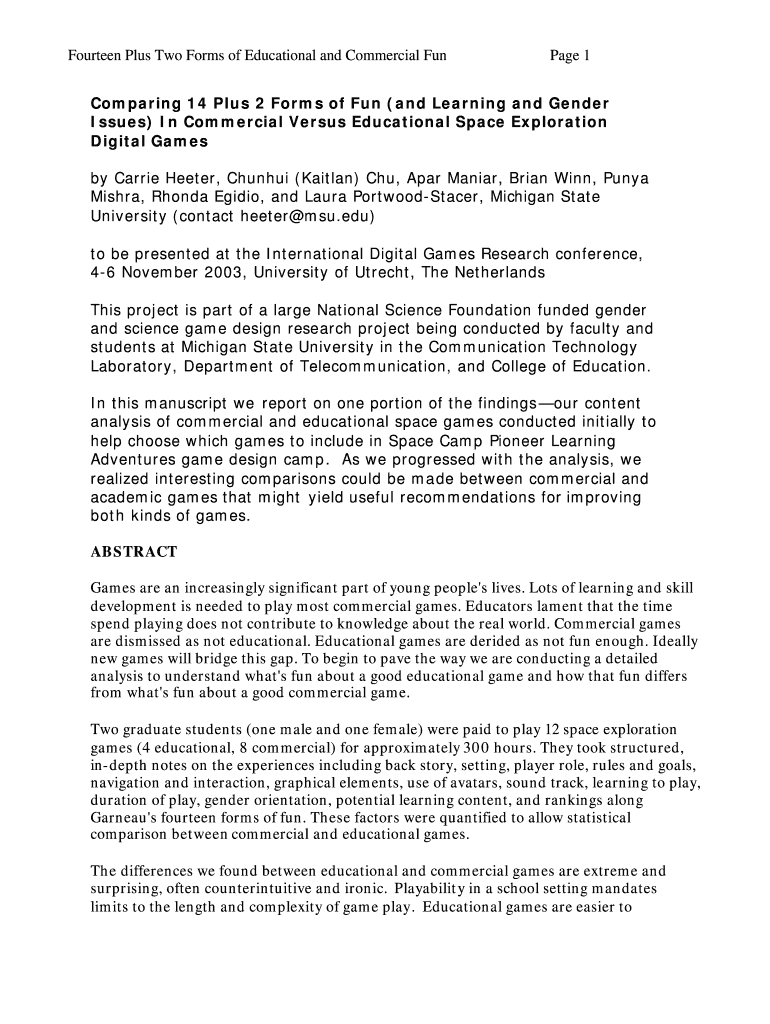
The form titled "Comparing 14 Forms of Fun In Commercial Versus Educational" serves as a comprehensive analysis tool to differentiate between educational and commercial digital games based on their entertainment and educational value. The focus is to evaluate various elements such as playability, complexity, and the types of fun offered. Researchers use this form to explore the potential of games to engage users while enhancing their learning experience.
Key Elements of Analysis
- Playability: Assesses how easy or difficult it is to begin and continue playing the games.
- Complexity: Evaluates the intricacy of game mechanics and the depth of challenges presented to players.
- Forms of Fun: Identifies 14 distinct types of fun, including discovery, narrative, and social interaction, highlighting how each type is utilized differently in commercial versus educational games.
How to Use the Comparing 14 Forms of Fun In Commercial Versus Educational
Using this form involves a systematic approach to examine digital games. Users should categorize the games into educational and commercial groups before assessing each game's features. This helps in identifying strengths and weaknesses related to their utility in professional or classroom settings.
Steps for Assessment
- Categorize games into educational or commercial.
- Evaluate each game based on the 14 forms of fun.
- Document findings regarding playability and complexity.
- Compare the results to identify opportunities for improvement in both game types.
Steps to Complete the Comparing 14 Forms of Fun In Commercial Versus Educational
To effectively complete this form, follow these steps:
- Gather Information on the games being analyzed. Understand their objectives and target audience.
- Play Each Game for a designated amount of time to experience all core features and gameplay mechanics.
- Analyze Features and apply the 14 forms of fun criteria to each game, noting how these elements enhance or detract from their educational value or entertainment appeal.
- Record Observations systematically under each heading provided in the form.
Key Elements of the Comparing 14 Forms of Fun In Commercial Versus Educational
Understanding the 14 Forms of Fun
- Sensation: The aesthetic appeal and sensory stimulation of the game.
- Fantasy: The immersive quality and storyline depth.
- Narrative: The plot and character development.
- Challenge: The difficulty level and skill required.
- Fellowship: Social interaction and community involvement.
- Discovery: The exploratory aspect and content surprises.
Each form is assessed to determine how well it is represented in the games and its impact on player engagement and learning outcomes.
Examples of Using the Comparing 14 Forms of Fun In Commercial Versus Educational
Real-World Scenario
In a classroom setting, an educator utilizes the form to gauge which game would best enhance a lesson plan. By comparing a math-focused educational game with a strategy-based commercial game, the educator identifies which offers a more engaging challenge that reinforces critical thinking and problem-solving skills.
Case Study
A game developer seeks to create an educational game that incorporates competitive elements common in commercial games. By using this form, the developer can pinpoint which commercial game features can be adapted to maintain both educational value and entertainment.
Software Compatibility
For those looking to analyze forms digitally, the "Comparing 14 Forms of Fun In Commercial Versus Educational" can be integrated with tools like DocHub. This allows users to edit, annotate, and fill out forms in various file formats directly from their Google Drive or other cloud-based storage, ensuring a seamless workflow.
Digital vs. Paper Version
An online platform like DocHub ensures the form is easily accessible and shareable, facilitating collaboration among multiple users. The digital version supports interactive elements, allowing for more dynamic data entry and real-time updates compared to the static nature of a paper form.
Business Types that Benefit Most from Comparing 14 Forms of Fun In Commercial Versus Educational
Educational Institutions
Schools and universities can leverage this form to evaluate potential games for curriculum integration. It assists in selecting games that align with educational objectives while maintaining student interest.
Game Development Companies
Developers looking to innovate their product offerings can use this form to identify successful elements of fun in educational contexts, tailoring their games to meet diverse audience needs while enhancing educational impact.