Definition and Meaning
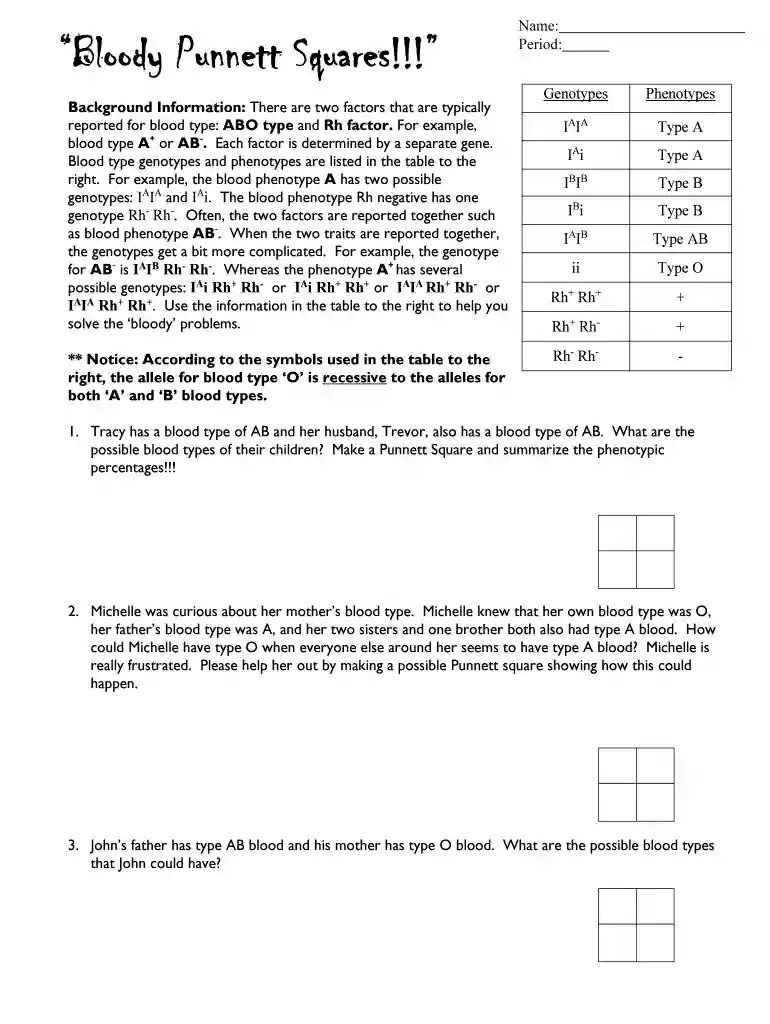
The blood type Punnett square is a genetic tool used to predict the inheritance of blood types based on parental genotypes. This diagrammatic tool illustrates how alleles from parents combine to form the possible genotypes of their offspring. The blood type is determined by the presence of antigens on the surface of red blood cells, specifically, the A and B antigens for the ABO blood group system, and the presence or absence of the Rh factor.
- Genotype vs. Phenotype: The genotype is the genetic makeup, represented by two alleles (e.g., AA, AO), while the phenotype is the observable characteristic (e.g., blood type A).
- ABO Groups: In this system, the blood type is based on the combination of A, B, and O alleles.
- Rh Factor: Denoted as positive or negative, affecting overall blood type (e.g., A+ or A-).
How to Use the Blood Type Punnett Square
The blood type Punnett square is a practical method for predicting the potential blood types of offspring based on the alleles contributed by each parent.
- Identify Parent Genotypes: Determine the blood type of both parents. Remember, types O, A, and B can be homozygous or heterozygous, while type AB is always heterozygous.
- Setup the Square: Write the alleles contributed by one parent along the top row and the other parent along the side.
- Fill the Square: Combine each allele pair in the grid to identify potential genotypes of the offspring.
- Determine Phenotypes: Use genotype combinations to understand possible phenotypes, considering both ABO and Rh factors.
Example
For a parent genotype of AO and BO:
- Square Setup:
- Top: A, O
- Side: B, O
- Possible Genotypes: AB, AO, BO, OO
- Phenotypes: A, B, AB, and O
Steps to Complete the Blood Type Punnett Square
To create a blood type Punnett square, follow these steps for accuracy and clarity.
- Identify Blood Type Alleles: Each parent contributes one ABO allele and an Rh factor allele.
- Draw the Punnett Square: A basic structure is a grid, generally 2x2 for ABO and separate for Rh determination.
- Label Rows and Columns: The top and the sides of the grid would be the possible alleles from one parent and another.
- Combine Alleles: Fill each box by writing the allele from each margin, which represents the potential allele pair of the child.
- Interpret Results: Translate allele pairs to possible blood types of the offspring.
Important Terms Related to Blood Type Punnett Square
A comprehensive understanding of terms is crucial when working with Punnett squares related to blood types.
- Allele: A variant form of a gene at a particular locus.
- Homozygous: Having two identical alleles (e.g., AA or OO).
- Heterozygous: Having two different alleles (e.g., AO or BO).
- Dominant/Recessive Relationship: In ABO, A and B are dominant over O.
- Rh factor: An antigen present in those with Rh-positive blood; absence denotes Rh-negative status.
Key Elements of the Blood Type Punnett Square
Understanding the key elements is vital for accurate predictions:
- Parental Genotypes: Integral for setting up the Punnett square correctly.
- ABO Alleles: These determine the basic blood type category.
- Rh Factors: A significant component in determining the complete blood type of an offspring.
- Grid Layout: Ensures structured and clear combination of alleles for accurate genotype outcomes.
Examples of Using the Blood Type Punnett Square
Consider these examples to observe the practical use of a blood type Punnett square:
- Example 1: If both parents are heterozygous (AO), possible offspring phenotypes are A or O.
- Example 2: Parent genotypes AB (AB) and O (OO), offspring could only be phenotype A or B.
- Real-World Application: Predicting blood type compatibility for transfusions or understanding inheritance patterns in genetics counseling.
Legal Use of the Blood Type Punnett Square
In certain legal contexts, the blood type Punnett square can be valuable:
- Paternity Cases: It might be used in exclusion tests to rule out potential parents.
- Medical Decision-Making: Helps in understanding inherited conditions or genetic counseling.
- Ethical Considerations: Should be used alongside comprehensive genetic counseling to guide individuals accurately.
Who Typically Uses the Blood Type Punnett Square
Various professionals and individuals use the Punnett square for blood type predictions:
- Genetics Researchers: To study inheritance patterns.
- Doctors: Assess genetic risks and blood type compatibilities.
- Biology Educators: Teach fundamental inheritance principles.
- Prospective Parents: Understand potential blood types of their offspring.
This comprehensive understanding of the blood type Punnett square demonstrates its practical application in predicting and understanding blood type inheritance, making it a valuable tool in genetics, medicine, and education.