01. Edit your form online
Type text, add images, blackout confidential details, add comments, highlights and more.

Type text, add images, blackout confidential details, add comments, highlights and more.

Draw your signature, type it, upload its image, or use your mobile device as a signature pad.

Send it via email, link, or fax. You can also download it, export it or print it out.
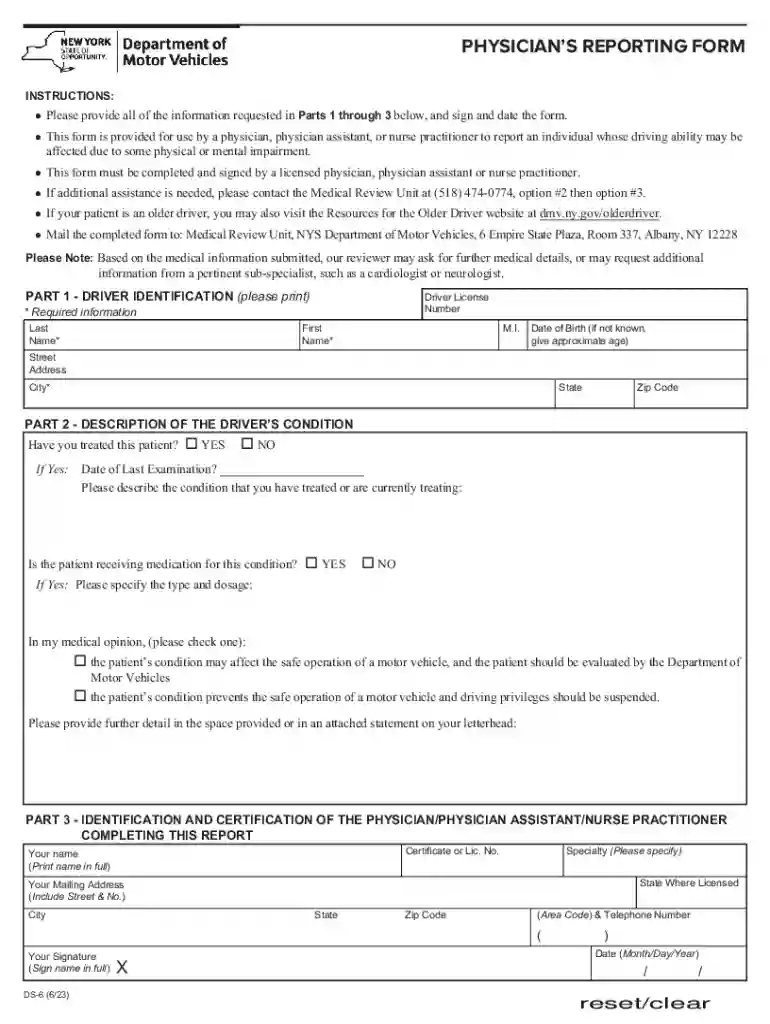
The Physician's Reporting Form is a specialized document used by healthcare professionals in the United States to report individuals whose physical or mental health conditions could impair their ability to drive safely. This form plays a critical role in ensuring road safety by providing necessary medical evaluations to the relevant authorities, such as the New York State Department of Motor Vehicles. By detailing a patient's condition, the physician's assessment aids in making informed decisions about a person's eligibility to operate a vehicle.
To appropriately utilize the Physician's Reporting Form, medical professionals need to meticulously document the patient's medical condition. Here are the key steps:
Collect Patient Information: Start with gathering comprehensive information, including the patient's full name, contact details, and medical history.
Describe the Medical Condition: Provide a thorough description of the physical or mental condition affecting the patient’s driving capabilities.
Assessment and Recommendations: Include a detailed assessment of how the condition impacts the patient's ability to drive, along with any recommendations for restrictions or further evaluations.
Sign and Date the Form: The form must be signed and dated by the licensed medical professional to authenticate the evaluation.
The completed form is then submitted to the appropriate state authority for further action.
Completing the Physician's Reporting Form involves a series of critical steps to ensure all necessary information is captured accurately:
Obtain Consent: Secure the patient's consent before filling out the form to comply with confidentiality and ethical standards.
Review Medical Records: Inspect relevant medical records to provide a complete picture of the patient’s health and its implications on driving.
Conduct an Evaluation: Perform a comprehensive evaluation focusing on aspects that affect driving ability, such as vision, reflexes, or cognitive function.
Document Findings: Clearly record the patient's condition, including any changes or improvements over time.
Each entry on the form must be precise and backed by medical evidence to provide clear guidance for decision-making.
The form consists of several sections, each requiring specific information to ensure a thorough report is made:
Patient Identification Section: Personal details such as name, age, and contact information.
Medical Assessment Section: Detailed insight into the specific condition and its effect on driving ability.
Prognosis and Recommendations: Expert opinions on whether the patient should drive, potential restrictions, or need for alternative transportation solutions.
These elements ensure comprehensive coverage of a patient's medical status relevant to their driving capabilities.
The significance of the Physician's Reporting Form lies in its ability to prevent accidents and enhance public safety. By acting as a formal communication between healthcare providers and state authorities, it allows for:
Informed Decision-Making: Authorities can make better decisions regarding the issuance or suspension of a driver’s license based on sound medical advice.
Public Protection: Helps in safeguarding other road users by ensuring only medically fit individuals are permitted to drive.
Patient Care: Provides a framework for discussing the impacts of medical conditions on patients’ everyday activities, including driving.
Ultimately, it serves as a preventive measure against potential road risks arising from impaired driving.
Each U.S. state may have distinct regulations and protocols pertaining to the Physician's Reporting Form. Here are several points to consider:
Submission Requirements: Some states allow online submissions while others might require physical mailing of the form.
Assessment Criteria: The medical conditions considered reportable can vary significantly between states.
Follow-UP Protocols: After submission, state authorities may have different procedures for follow-up assessments or hearings.
It is essential for medical professionals to be aware of these variations to ensure compliance with local legal requirements.
Below are some practical scenarios that illustrate the utility of the Physician’s Reporting Form:
Case of Vision Impairment: A patient with significant visual deterioration may be reported if the condition affects their peripheral vision, crucial for safe driving.
Cognitive Decline: In instances where cognitive disorders like Alzheimer's disease are suspected, the form helps document the impaired decision-making ability.
Post-Surgical Recovery: Patients recovering from extensive surgery that might temporarily impede driving abilities can be assessed and reported accordingly.
These examples underscore how the form is used in varied circumstances to maintain safety standards.
Legal compliance when using the Physician’s Reporting Form is paramount. Medical professionals must adhere to the following:
Confidentiality: Ensure patient information is handled confidentially, sharing details only with authorized personnel.
Accurate Reporting: Physicians are legally obligated to provide truthful and thorough medical evaluations.
Liability Awareness: Professionals should be aware of their legal responsibilities and liabilities associated with reporting or omitting significant medical conditions.
Adhering to these legal elements safeguards medical professionals against legal repercussions and reinforces ethical medical practices.
We've got more versions of the Physician s Reporting Form form. Select the right Physician s Reporting Form version from the list and start editing it straight away!
At DocHub, your data security is our priority. We follow HIPAA, SOC2, GDPR, and other standards, so you can work on your documents with confidence.