




01. Edit your form online
Type text, add images, blackout confidential details, add comments, highlights and more.

Type text, add images, blackout confidential details, add comments, highlights and more.

Draw your signature, type it, upload its image, or use your mobile device as a signature pad.

Send it via email, link, or fax. You can also download it, export it or print it out.
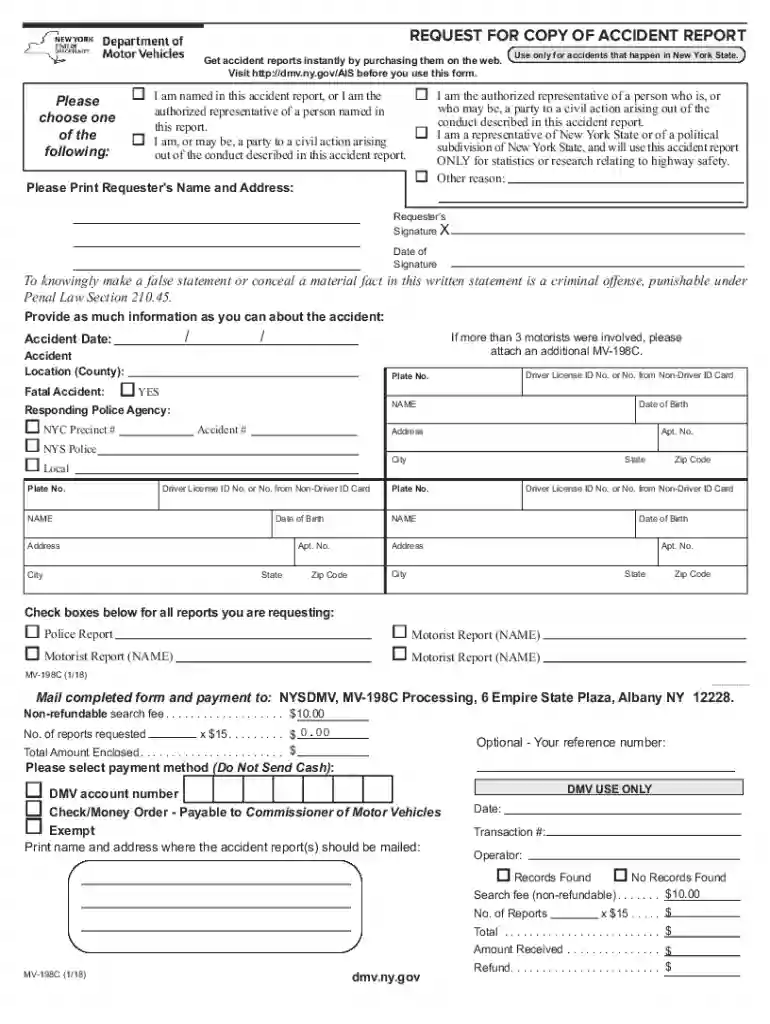
The Mv-198c (7 23) form is a request document utilized in New York State to obtain a copy of an accident report. These reports are essential for insurance claims, legal investigations, and maintaining traffic safety records. The form is part of a standardized process to ensure that only authorized individuals or entities can access these sensitive documents. Understanding the various components of the Mv-198c (7 23) is crucial for efficiently managing accident-related legal and insurance matters.
When using the Mv-198c (7 23), it is essential to provide all necessary information accurately. This includes personal details of the requester, specifics of the accident (such as date, location, and parties involved), and the intended purpose for obtaining the report. Incorrect or incomplete information can delay the processing of your request. It's also important to adhere to any specific filing requirements indicated on the form, such as signature verifications and accompanying identification documents.
Obtaining the Mv-198c (7 23) form is straightforward. Individuals can access it through New York State’s official websites or physical offices. The form can usually be downloaded, filled out, and submitted online, reducing the need for in-person visits. For those preferring physical copies, forms can also be mailed upon request from related state offices or picked up in person.
Accessing an accident report via the Mv-198c (7 23) form is necessary for obtaining definitive records post-incident. These reports can be crucial when determining fault, settling insurance claims, or presenting evidence during legal proceedings. For individuals engaged in research or statistical analysis, such forms provide credible and lawfully obtained data pertinent to highway safety studies.
Typical users of the Mv-198c (7 23) form include insurance companies, legal professionals, and individuals directly involved in an accident. Law enforcement agencies and private investigators may also use these forms when investigating accidents. Researchers focusing on traffic safety and state agencies involved in analyzing accident statistics are regular users as well.


The Mv-198c (7 23) form must be used in accordance with state laws and regulations. Misuse or unauthorized access can lead to legal penalties, underscoring the importance of ensuring that only entitled parties perform requests. The ESIGN Act and related legal frameworks also highlight the form's role in a formal request process set up to balance privacy with public safety needs.
Key elements include personal and accident information that must be entirely accurate. The declaration of purpose serves to clarify the intent behind the request, ensuring transparency and adherence to legal standards. Additionally, clear indications of authorization or representation are vital to protect the rights and privacy of all involved parties.
State-specific rules necessitate that users adhere to the procedures established by New York State. These involve specific eligibility criteria for accessing accident reports, fee structures, and processing timelines. Understanding these rules can preempt common challenges related to form approval and fulfillment processes.
We've got more versions of the Mv-198c (7 23) form. Select the right Mv-198c (7 23) version from the list and start editing it straight away!
At DocHub, your data security is our priority. We follow HIPAA, SOC2, GDPR, and other standards, so you can work on your documents with confidence.


