




01. Edit your form online
Type text, add images, blackout confidential details, add comments, highlights and more.

Type text, add images, blackout confidential details, add comments, highlights and more.

Draw your signature, type it, upload its image, or use your mobile device as a signature pad.

Send it via email, link, or fax. You can also download it, export it or print it out.
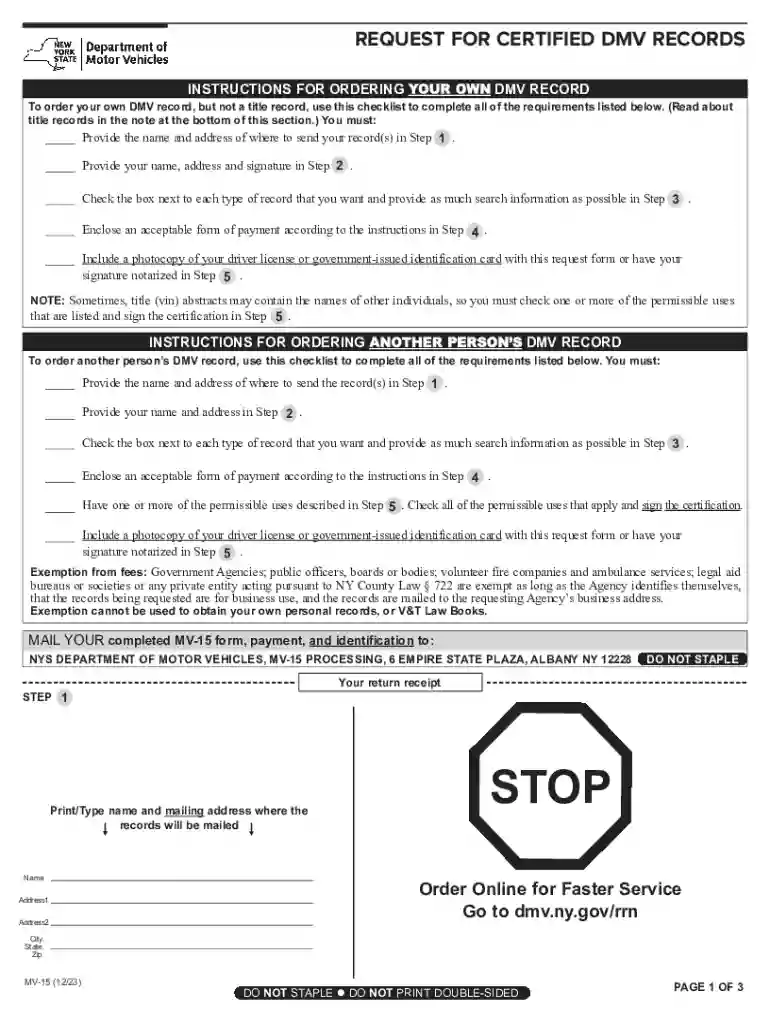
The Request for Certified DMV Records is a formal document utilized primarily within the United States to access comprehensive vehicle and driver information. This form is critical for individuals seeking detailed and authenticated data about their own or another individual's driving record, vehicle history, or other related information maintained by the Department of Motor Vehicles (DMV). It serves significant purposes in various professional and personal domains, offering vital insights necessary for legal, insurance, and employment verification processes.
To effectively use the Request for Certified DMV Records, one must adhere to specific steps to ensure accurate data retrieval. This typically involves:
Ensuring correct and complete information enhances the efficiency and success of the request process.
Completing the Request for Certified DMV Records involves several critical steps to guarantee submission accuracy and compliance:
The legal use of the Request for Certified DMV Records is governed by the Driver Privacy Protection Act (DPPA), which ensures the confidentiality of personal information contained in DMV records. Acceptable uses include:
Understanding these permissible uses is crucial for compliance with legal standards and avoiding penalties.
Different states may have unique regulations and processes surrounding the Request for Certified DMV Records. Key variables might include:
Users must familiarize themselves with their specific state's requirements to ensure a smooth request process.
Understanding key terms helps streamline the process of requesting DMV records:
Comprehending these terms ensures users accurately interpret and complete the request process.
The Request for Certified DMV Records is commonly used by:
Understandably, these users rely on the form for authentic data that influences critical decisions.


To successfully obtain certified DMV records, certain documents might be necessary:
Having these documents ready can facilitate a smoother application process, eliminating unnecessary hold-ups.
Various submission methods are available for the Request for Certified DMV Records, catering to different preferences and requirements:
Choosing the appropriate submission method based on urgency and individual preferences can optimize the request process.
We've got more versions of the Request for Certified Dmv Records form. Select the right Request for Certified Dmv Records version from the list and start editing it straight away!
At DocHub, your data security is our priority. We follow HIPAA, SOC2, GDPR, and other standards, so you can work on your documents with confidence.
Any individual who will be driving/transporting students must complete a request to review their motor vehicle driving record annually.Read more
If you would like a certified copy mailed to you, complete the INF 1125 (PDF) form and mail it with the required fee to the DMV Headquarters address listed onRead more
May 14, 2024 View your voter registration information, track your ballot and read about the contests on your ballot. To log in, please input a combination


