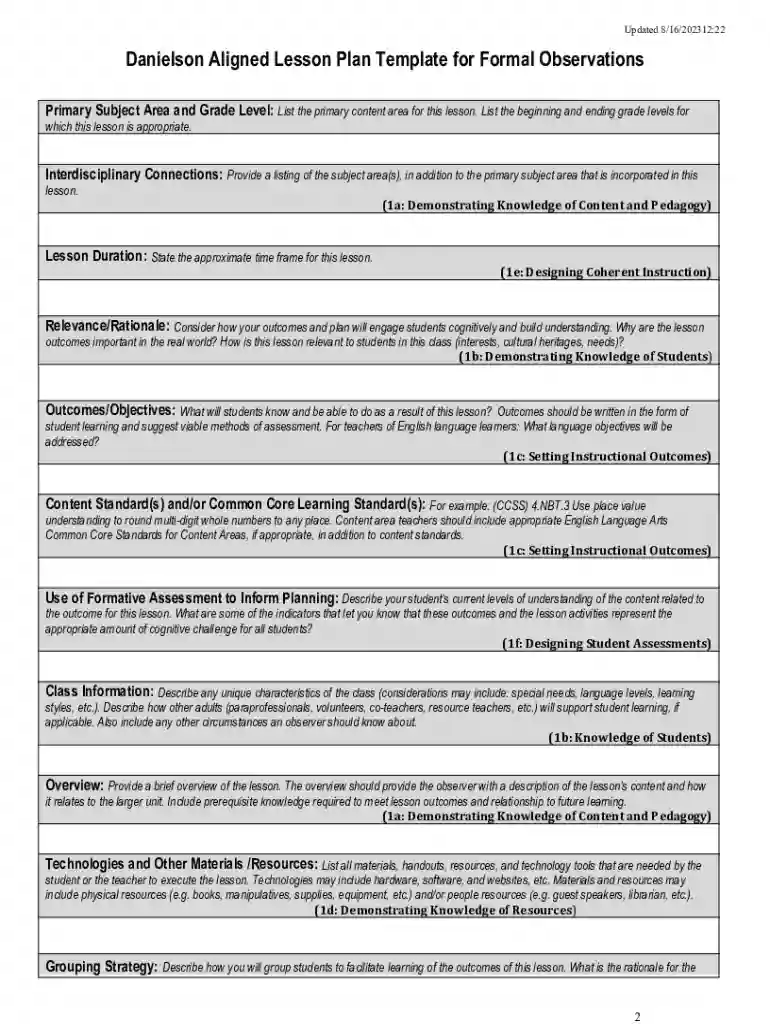
Danielson Aligned Lesson Plan Template for Formal Observations 2026

Get Form
Danielson Aligned Lesson Plan Template for Formal Observations Preview on Page 1

Here's how it works

01. Edit your form online
Type text, add images, blackout confidential details, add comments, highlights and more.

02. Sign it in a few clicks
Draw your signature, type it, upload its image, or use your mobile device as a signature pad.

03. Share your form with others
Send it via email, link, or fax. You can also download it, export it or print it out.

Definition & Meaning

The "Danielson Aligned Lesson Plan Template for Formal Observations" is a structured format designed to align classroom activities and educational plans with the Danielson Framework for Teaching. This framework emphasizes the importance of components such as lesson objectives, student engagement, and educational standards, ensuring that educators can provide comprehensive, structured, and effective teaching plans that meet specific educational goals.


Key Elements of the Danielson Aligned Lesson Plan Template

  • Subject Area and Lesson Duration: Identifying the subject area and defining the length of the lesson helps in organizing the curriculum to meet the learning goals efficiently.
  • Lesson Objectives: Clearly stated goals ensure that both the teacher and students understand the expected outcomes of the lesson.
  • Educational Standards: Aligns educational objectives with state or district standards, ensuring that the content meets specific educational requirements.
  • Materials Needed: A comprehensive list of resources required for the lesson ensures thorough preparation and smooth execution.
  • Procedures and Activities: Step-by-step procedures and planned activities provide a structured approach to delivering the lesson content effectively.
  • Differentiation Methods: Strategies to accommodate diverse learning needs and styles, ensuring all students have access to the curriculum.
  • Assessment Strategies: Methods for evaluating student progress and understanding, crucial for adjusting teaching strategies as needed.

How to Use the Danielson Aligned Lesson Plan Template

  1. Identify the Objective: Start by outlining the lesson objectives. Use clear and measurable terms that align with the overall curriculum goals.
  2. Plan Activities: Develop a series of activities that engage students and facilitate the attainment of the lesson objectives.
  3. Select Materials: Identify and gather the necessary materials and resources before the lesson.
  4. Create Procedures: Write detailed procedures to guide the lesson from introduction to conclusion.
  5. Consider Differentiation: Plan variations in instructional methods to cater to various learning needs within the classroom.
  6. Prepare Assessment Criteria: Establish metrics and tools for measuring student success and understanding.

Who Typically Uses the Danielson Aligned Lesson Plan Template

  • Teachers and Educators: Primarily employed by teachers in K-12 and higher education to plan and structure their lessons according to educational standards.
  • School Administrators: Utilize the template to ensure teaching aligns with school objectives during formal observations.
  • Student Teachers: Helpful for those in teacher training programs to develop structured lesson plans that meet educational prerequisites.
decoration image ratings of Dochub

Why Use the Danielson Aligned Lesson Plan Template for Formal Observations

  • Enhances Teaching Quality: Provides a structured format that aligns with recognized educational frameworks, improving the overall quality of instruction.
  • Facilitates Formal Assessments: Aids administrators and observers in evaluating instruction quality through standardized criteria.
  • Encourages Reflective Practice: Promotes reflective teaching by allowing educators to analyze the effectiveness of their lesson plans and make necessary adjustments.

Important Terms Related to the Danielson Aligned Lesson Plan Template

  • Educational Standards: Benchmarks necessary for measuring student learning and instructional effectiveness.
  • Assessment Criteria: Predefined metrics for evaluating and measuring student performance against lesson objectives.
  • Differentiation: Instructional adaptations made to engage students with varying learning needs and abilities.

Steps to Complete the Danielson Aligned Lesson Plan Template

  1. Define Lesson Components: Input all necessary lesson details, including objectives, materials, and procedures.
  2. Alignment to Standards: Match learning objectives to district or state educational standards.
  3. Plan for Assessment: Determine the methods for assessing student progress during and after instruction.
  4. Prepare Reflective Questions: Develop questions that encourage self-assessment and reflection on teaching effectiveness post-lesson.

Examples of Using the Danielson Aligned Lesson Plan Template

  • An elementary school teacher aligns a science lesson with state standards by including hands-on experiments and collaborative discussions.
  • A high school math teacher develops differentiated exercises to support varied student proficiency levels, assessed through quizzes and group activities.
be ready to get more

Complete this form in 5 minutes or less

Get form

Got questions?

We have answers to the most popular questions from our customers. If you can't find an answer to your question, please contact us.
Contact us
The 5E lesson plan is based on an instructional model that consists of five phases or steps: Engage, Explore, Explain, Elaborate, and Evaluate. This model enables teachers to create cohesive and engaging lessons that build up from one section to the next.
Assessments should reveal how well students have learned what we want them to learn while instruction ensures that they learn it. For this to occur, assessments, learning objectives, and instructional strategies need to be closely aligned so that they reinforce one another.
A lesson plan is the instructors road map of what students need to learn and how it will be done effectively during the class time. Then, you can design appropriate learning activities and develop strategies to obtain feedback on student learning.
Rodger Bybee, co-creator of the model, explains, The 5E Model of Instruction includes five phases: Engage, Explore, Explain, Elaborate, and Evaluate. It provides a carefully planned sequence of instruction that places students at the center of learning.
Be sure to use a Workshop Model as your template for the lesson. Describe how your instruction will be differentiated to meet the needs, interests, and abilities of your students. Identify the questions you will use to promote higher order thinking and encourage discussions.

Security and compliance

At DocHub, your data security is our priority. We follow HIPAA, SOC2, GDPR, and other standards, so you can work on your documents with confidence.
Learn more
ccpa2
pci-dss
gdpr-compliance
hipaa
soc-compliance

People also ask

The five practices are the follow- ing: (1) Anticipating, (2) Monitoring, (3) Selecting, (4) Sequencing, and (5) Connecting. Smith and Stein contend that Planning/Goal Setting could be called Practice 0, as this is some- thing teachers need to do before orchestrating a productive discussion.
Before Class: Steps for preparing a lesson plan Identify the learning objectives. Plan the specific learning activities. Plan to assess student understanding. Plan to sequence the lesson in an engaging and meaningful manner. Create a realistic timeline. Plan for a lesson closure.

Related links