




01. Edit your form online
Type text, add images, blackout confidential details, add comments, highlights and more.

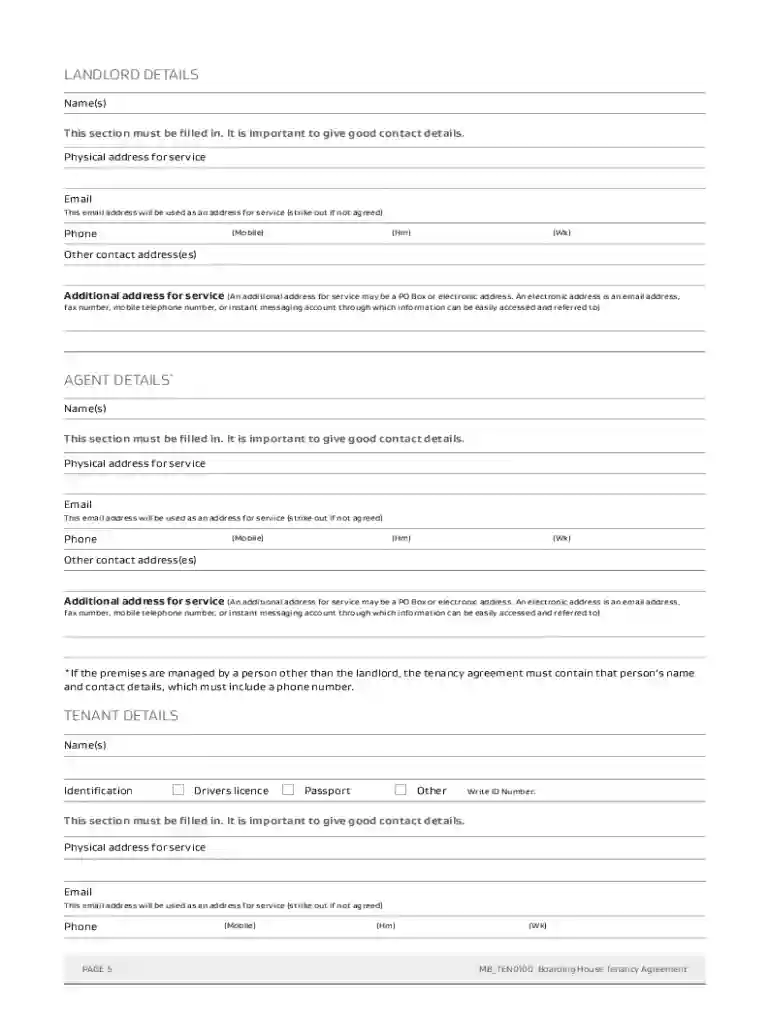
Type text, add images, blackout confidential details, add comments, highlights and more.

Draw your signature, type it, upload its image, or use your mobile device as a signature pad.

Send it via email, link, or fax. You can also download it, export it or print it out.
A Boarding House Tenancy Agreement is a formal, legally binding contract between the landlord and tenants of a boarding house. It outlines the mutual rights and responsibilities, aiming to ensure a harmonious living environment. The agreement typically includes compliance with healthy homes standards, tenant rights, and landlord obligations. Central to this contract is the adherence to the Residential Tenancies Act 1986, which governs tenant-landlord relationships in the United States. This ensures both parties understand their legal standing and obligations.
The Boarding House Tenancy Agreement encompasses several critical elements to ensure transparency and protect the interests of all involved.
These elements aim to clarify the expectations and responsibilities for both parties within the governing legal framework.
The Boarding House Tenancy Agreement serves a legal function, ensuring both parties operate within the law. Landlords and tenants must adhere to all provisions, including tenant rights and landlord duties as per the Residential Tenancies Act 1986. Failure to comply can result in legal disputes, which could be costly and time-consuming. The agreement also outlines procedures for resolving disputes, protecting both party interests. In the event of non-compliance, each party can refer to the agreement as a legal document to guide resolution processes.
Completing a Boarding House Tenancy Agreement involves several steps to ensure accuracy and legality.
Careful attention to these steps avoids potential legal issues and fosters a smooth rental arrangement.
Understanding specific terms within the Boarding House Tenancy Agreement is essential for both landlords and tenants.
Knowledge of these terms enhances comprehension of the agreement and ensures compliance with legal standards.
While the Boarding House Tenancy Agreement generally follows national standards, specific state regulations might affect certain clauses:
It is crucial for landlords and tenants to explore their specific state's legal requirements to ensure the agreement's validity and enforceability.
The Boarding House Tenancy Agreement is predominantly utilized by property owners and managers of boarding houses and tenants seeking temporary or shared housing solutions. It is especially common in scenarios where multiple tenants share communal areas, such as kitchens or bathrooms, while maintaining private living spaces. Boarding house owners often use this agreement to set clear expectations and legal rental terms. Tenants, on the other hand, use it to ensure their rights are protected and that they comprehend their responsibilities during their stay.


Consider the case of a student renting a room in a boarding house near their university. Here, a tenancy agreement outlines how students can use common areas, what utilities are included in rent, and compliance with house rules. For another example, consider a business professional who opts for a boarding house for short-term accommodation. The tenancy agreement provides clear terms on notice period for vacating, room maintenance expectations, and shared resource usage. These scenarios highlight the agreement's adaptability to various living arrangements and needs.
Using a Boarding House Tenancy Agreement establishes a clear, mutually understood arrangement between landlords and tenants. It ensures:
The agreement not only safeguards legal interests but also contributes to a harmonious living environment.
We've got more versions of the Boarding House Tenancy Agreement form. Select the right Boarding House Tenancy Agreement version from the list and start editing it straight away!
At DocHub, your data security is our priority. We follow HIPAA, SOC2, GDPR, and other standards, so you can work on your documents with confidence.


