




01. Edit your form online
Type text, add images, blackout confidential details, add comments, highlights and more.

Type text, add images, blackout confidential details, add comments, highlights and more.

Draw your signature, type it, upload its image, or use your mobile device as a signature pad.

Send it via email, link, or fax. You can also download it, export it or print it out.
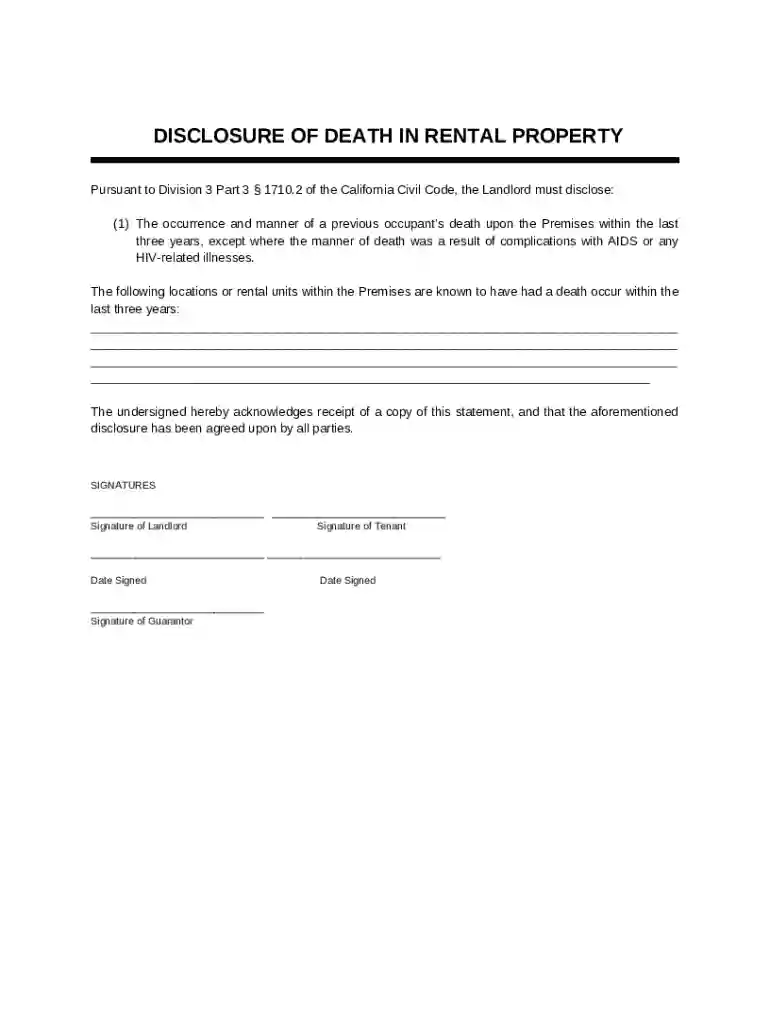
The "California Death on Premises Disclosure" is a mandatory legal document required for landlords to inform prospective tenants about any deaths that have occurred on a rental property within the past three years. This disclosure is designed to ensure transparency between landlords and tenants, providing incoming residents with full awareness of any potentially sensitive history associated with the property. The form contributes to informed decision-making and helps establish trust between the involved parties. Importantly, the disclosure excludes deaths connected to AIDS or HIV, aligning with California’s privacy regulations.
Obtain the Latest Form: Ensure you have the most up-to-date version of the California Death on Premises Disclosure form, as legal requirements may change.
Gather Information: Collect relevant details about any deaths that have occurred on the premises, including dates and circumstances.
Fill Out Landlord Information: Enter the landlord’s contact details to ensure transparency and accountability.
Document Incident Details: Accurately describe the incidents, ensuring all pertinent information is clearly communicated.
Signature Section: Both the landlord and prospective tenant need to sign the form. The tenant’s signature acknowledges the receipt and understanding of the disclosure.
Retain a Copy: Keep a signed copy for your records, which can serve as a reference for future transactions or legal inquiries.
In California, this form plays a crucial role in real estate transactions, particularly in rental agreements. Legal use involves providing the disclosure in a manner compliant with state law, ensuring all potential tenants receive this information before signing a lease. The form aims to prevent miscommunication or potential disputes that might arise if tenants discover such history post-occupancy. By adhering to these legal obligations, landlords mitigate risks of legal action and foster trust, maintaining their reputation and credibility.
Landlord and Tenant Information: Essential contact details and signatures, verifying the acknowledgment of the disclosure.
Incident Description: Detailed account of any deaths on the property, including the time frame within the past three years.
Exclusions for AIDS or HIV: A section noting that deaths from these causes are not required to be disclosed, respecting privacy laws.
Date of Disclosure: The document must clearly show when the information was passed to prospective tenants to ensure compliance with legal time frames.
California mandates greater transparency in rental agreements than many other states, primarily due to its diverse population and cultural considerations. This form must reflect accurate, truthful information, and omitting details can lead to severe penalties. Unlike other states, California’s real estate laws focus intensely on tenant rights, meaning landlords should remain vigilant regarding updates to disclosure requirements. These specifications ensure that California’s renters receive fair and comprehensive information about their prospective homes.
Consider a scenario where a landlord in Los Angeles has a rental property where a natural death occurred two years prior. This information must be disclosed before finalizing any rental agreement. In another case, a property in San Francisco might have witnessed an untimely demise four years ago; here, disclosure isn’t legally required. These examples illustrate how landlords must tailor their approach according to exact legal guidelines, ensuring they disclose or withhold information accurately based on time frames and circumstances.
Failure to provide a California Death on Premises Disclosure when required can lead to substantial penalties. Landlords might face legal action from tenants, resulting in fines or, in severe cases, a lawsuit for damages associated with non-compliance. This underscores the importance of adhering to the disclosure protocol, emphasizing the need not only for transparency but also for protection from legal repercussions.
The California Death on Premises Disclosure can be completed using either digital or paper formats. Digital versions offer ease of sharing and storage, often featuring integration with systems like Google Drive for efficiency and accessibility. Conversely, paper forms provide a tangible record, useful for individuals less comfortable with digital platforms. Regardless of the medium, ensuring the validity of the form and maintaining a copy for records is essential. The choice between digital and paper often depends on personal or organizational preference and technological capability.
At DocHub, your data security is our priority. We follow HIPAA, SOC2, GDPR, and other standards, so you can work on your documents with confidence.


