






Definition & Meaning
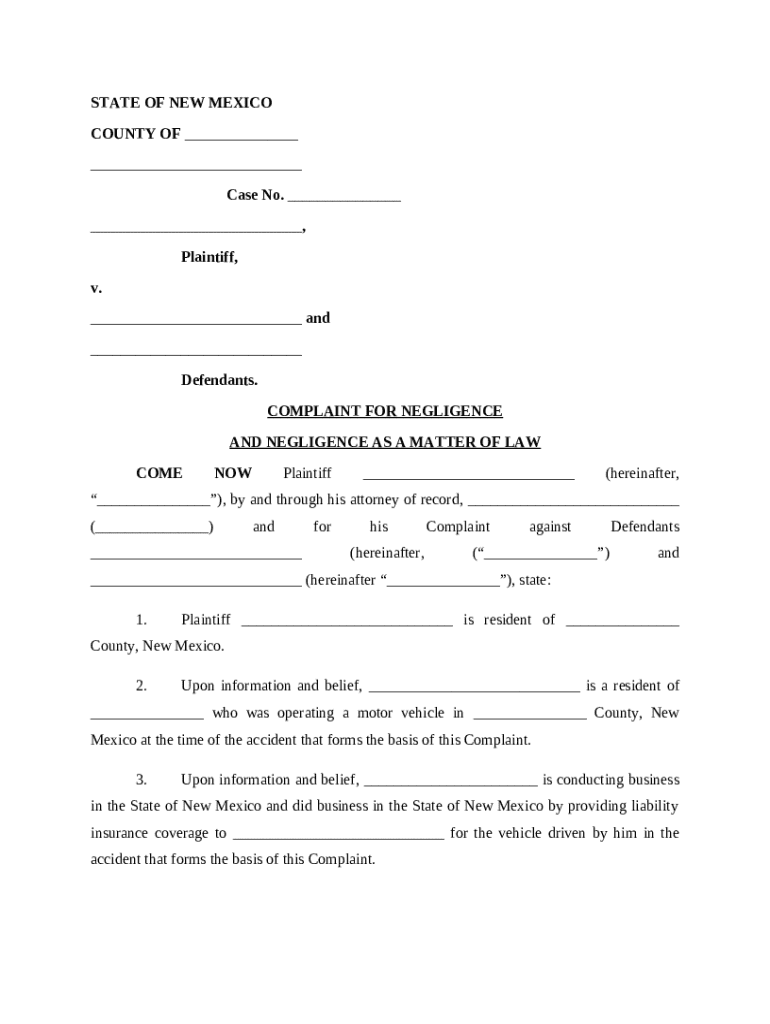
A "Complaint for Negligence" is a legal document filed in civil court to initiate a lawsuit alleging that another party's failure to exercise reasonable care resulted in harm. This form is a fundamental element in personal injury cases, where the plaintiff seeks compensation for damages sustained due to the defendant's actions or inactions. The complaint outlines the specific incidents and grounds for the claim, serving as the initial step in the litigation process.
Breakdown of Key Components
- Plaintiff Identification: The party alleging harm and filing the complaint.
- Defendant Identification: The party being accused of negligence.
- Incident Description: Detailed account of the events leading to the alleged negligence.
- Claim for Damages: Specification of the types and amounts of compensation sought.
Real-World Example
- In a case involving a motor vehicle accident, the plaintiff might file a complaint asserting the defendant failed to stop at a red light, resulting in the collision and subsequent personal injuries.
Key Elements of the Complaint for Negligence
A well-structured Complaint for Negligence must include several critical elements to be legally sufficient.
Essential Components
- Duty of Care: Establishing that the defendant owed the plaintiff a legal duty to exercise reasonable care.
- Breach of Duty: Demonstrating that the defendant breached this duty through action or inaction.
- Causation: Linking the breach directly to the harm suffered by the plaintiff.
- Damages: Quantifying the injury or loss in terms of medical expenses, pain and suffering, or other financial implications.
Practical Scenario
- Consider a slip-and-fall accident in a grocery store: the plaintiff needs to prove that the store had a duty to maintain safe premises, breached this duty by not addressing a spill, leading directly to the plaintiff's injury.
Steps to Complete the Complaint for Negligence
Filing a Complaint for Negligence involves several crucial steps, requiring attention to specificity and evidence.
Step-by-Step Instructions
- Determine Jurisdiction: Identify the appropriate court where the case should be filed.
- Draft the Document: Include all required elements such as parties involved, factual background, legal claims, and requested relief.
- Gather Supporting Evidence: Collect documents, witness statements, and reports that substantiate the claims.
- File with Court: Submit the completed form and any necessary attachments to the court clerk.
- Serve the Complaint: Ensure that the defendant receives a copy through an approved method of service like personal delivery or certified mail.
Detailed Example
- In a medical malpractice case, it may be beneficial to include expert testimony in the complaint to substantiate claims of negligence by the healthcare provider.
Legal Use of the Complaint for Negligence
The "Complaint for Negligence" is designed to uphold individual rights when harm occurs due to another's failure to adhere to standard care obligations.
Important Considerations
- Statute of Limitations: Most jurisdictions impose a time limit within which a negligence lawsuit must be filed.
- Standard of Proof: The burden is typically on the plaintiff to prove the case by a preponderance of the evidence.
Example
- Filing a complaint within two years of a motor vehicle accident is crucial to preserving the legal right to seek compensation under typical state laws.
State-Specific Rules for the Complaint for Negligence
While the fundamental principles of filing a Complaint for Negligence are consistent across the United States, regulations may vary by state.
Notable Differences
- Filing Fees: Costs can differ significantly, impacting accessibility to the court system.
- Specific Local Forms: Some states require specific templates or additional documentation.
- Variations in Statute of Limitations: Each state sets its own time limits for filing, affecting the timeline for legal action.
Example
- New Mexico may have different rules on expert witness requirements in negligence claims compared to California, impacting how cases are structured and proven.
Important Terms Related to Complaint for Negligence
Understanding the legal terminologies within the context of a negligence case is crucial for any plaintiff or practitioner.
Glossary of Terms
- Negligence: Failure to exercise appropriate care resulting in harm to another.
- Plaintiff: The individual or entity bringing the lawsuit.
- Defendant: The individual or entity being sued for negligence.
- Relief Sought: Legal term for the compensation or remedy requested in the lawsuit.
Contextual Application
- A plaintiff may seek "compensatory damages" to cover medical expenses, which is a common relief sought in negligence cases.
Why File a Complaint for Negligence
Filing a Complaint for Negligence is a vital legal recourse for obtaining justice and remediation after experiencing harm.
Reasons to File
- Restitution for Harm: Enables recovery of expenses incurred due to another's negligence.
- Legal Accountability: Holds the negligent party responsible, potentially preventing future incidents.
- Moral Victory: Provides emotional satisfaction by addressing wrongdoing legally.
Real-World Motivation
- Victims of workplace injuries might pursue a complaint to not only address personal injuries but also to enforce safer working conditions for others.
Examples of Using the Complaint for Negligence
Real-life cases help illustrate the application and strategic utility of the Complaint for Negligence.
Case Studies
- Automobile Accidents: Often involve claims against a driver or company for failure to follow traffic laws.
- Product Liability: Involves manufacturers or sellers when defective products cause harm.
- Medical Malpractice: Targets healthcare providers who fail to meet the accepted standard of care.
Practical Insight
- A successful automotive negligence case might involve a plaintiff proving the defendant's speeding led to a collision causing extensive damages.
Through careful preparation and adherence to specific legal procedures, the Complaint for Negligence functions as a powerful tool in civil litigation, upholding justice and securing necessary compensation for those wronged by negligent actions.