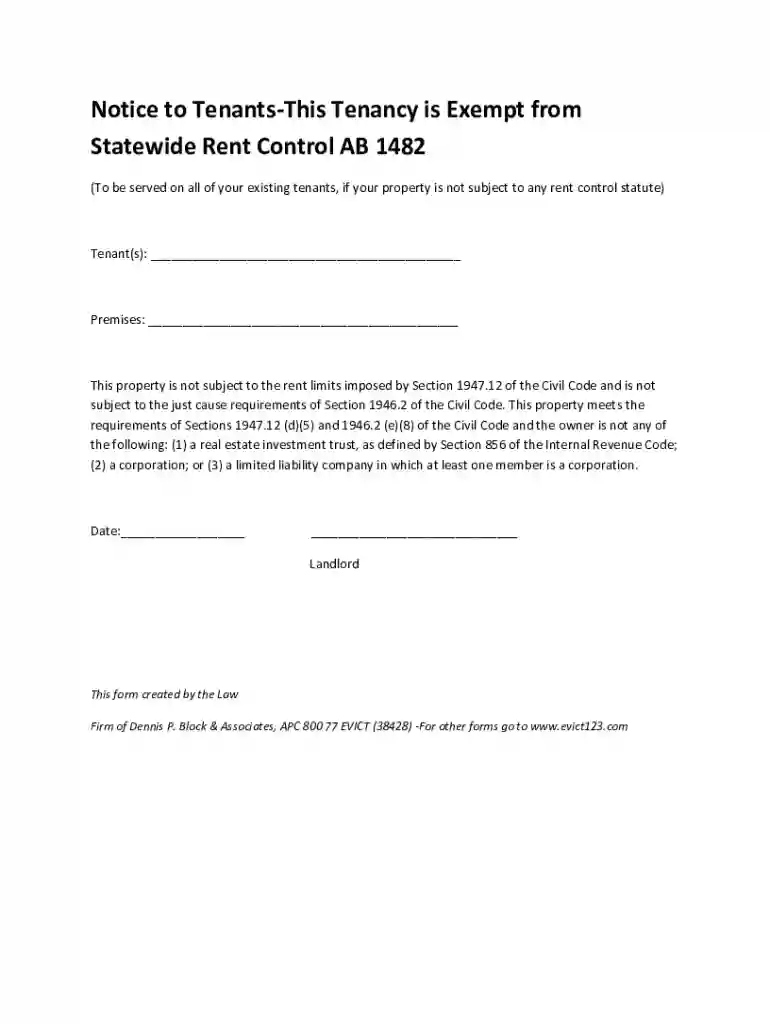
Notice of Exemption From AB 1482 Service - Fast EvictNotice of Exemption From AB 1482 Service - Fast-2026

Get Form
Notice of Exemption From AB 1482 Service - Fast EvictNotice of Exemption From AB 1482 Service - Fast Preview on Page 1

Here's how it works

01. Edit your form online
Type text, add images, blackout confidential details, add comments, highlights and more.

02. Sign it in a few clicks
Draw your signature, type it, upload its image, or use your mobile device as a signature pad.

03. Share your form with others
Send it via email, link, or fax. You can also download it, export it or print it out.

Definition and Meaning

A Notice of Exemption from AB 1482 Service is a document utilized primarily in California to inform tenants that a particular property is not subject to the state’s rent control law, AB 1482. AB 1482, or the "Tenant Protection Act of 2019," establishes limits on rent increases and outlines just cause eviction requirements for many rental properties. However, certain properties are exempt from these regulations, and a Notice of Exemption serves to clarify this exemption to tenants, ensuring transparency in rental agreements.

  • AB 1482: Establishes statewide rent control, limiting rent increases and providing eviction protections.
  • Exemption Criteria: Includes properties like single-family homes, provided specific ownership criteria are met, such as the property being owned by individual owners rather than corporations.

Key Elements of the Notice

The Notice of Exemption must contain several critical components to be legally valid and effective. Each section serves a specific purpose in conveying necessary information to the tenant.

  • Property Information: Details about the property, including address and description.
  • Owner Declaration: A statement from the property owner declaring the exemption status and detailing the applicable criteria.
  • Legal References: Citations from the California Civil Code relating to AB 1482 and any pertinent exemption criteria.
  • Signature Section: Space for both landlord and tenant to sign and acknowledge the notice, ensuring all parties are informed and in agreement.

Legal Use and Relevance

The legal utilization of a Notice of Exemption extends beyond simply notifying tenants. It plays a vital role in real estate compliance and tenant-landlord relationships by ensuring that both parties understand the legal framework governing the rental property.

  • Tenant Protection: While exempt from AB 1482, other local rent control laws might apply.
  • Owner Assurance: Clarifies landlord rights, helping to manage expectations and reduce disputes.

How to Use the Notice

Using the Notice of Exemption from AB 1482 involves a specific procedure to ensure it is properly integrated into the rental agreement process.

  1. Draft the Notice: Include necessary information, ensuring compliance with legal standards.
  2. Distribute to Tenants: Provide copies to all current and prospective tenants.
  3. Secure Signatures: Obtain necessary acknowledgments from tenants to confirm receipt and understanding.

State-Specific Rules

The application and implications of a Notice of Exemption from AB 1482 can vary significantly depending on local regulations and interpretations across different regions in California.

  • Local Ordinances: Some cities have their own rent control measures that may override or supplement state exemptions.
  • Compliance: Failure to adhere to both state and local requirements can result in legal repercussions for landlords.

Steps to Complete the Notice

Completing a Notice of Exemption requires attention to detail and adherence to procedural guidelines to ensure legal enforcement and tenant compliance.

  1. Gather Property Details: Assemble required property and ownership documentation.
  2. Draft Notice Language: Incorporate legally approved phrasing, citing specific sections of the law.
  3. Review Legal Compliance: Confirm that the notice aligns with both state and local regulations.
  4. Distribute and Document: Track distribution and retain copies for legal records.

Who Typically Uses the Notice

The Notice of Exemption is predominantly employed by property owners and managers who meet the specific criteria for exemption as defined under AB 1482.


  • Property Owners: Those owning single-family homes or other exempt properties.
  • Real Estate Managers: Professionals handling rental agreements for owners, ensuring compliance with state laws.
decoration image ratings of Dochub

Important Terms Related to the Notice

Understanding the terminology associated with the Notice of Exemption from AB 1482 can help both landlords and tenants navigate its implications.

  • Exemption: The condition in which a property is not subject to AB 1482 regulations.
  • Just Cause: Legal grounds required for initiating evictions under AB 1482.
  • Vacancy Decontrol: A concept involving changes in rent control status when a unit becomes vacant.

Examples of Using the Notice

Practical examples can illustrate the varied contexts in which a Notice of Exemption might be used, emphasizing its role in property management.

  • Single-Family Rental Property: A homeowner rents out a standalone property and issues a Notice of Exemption because it is not subject to AB 1482 due to ownership conditions.
  • New Developments: A newly built multi-unit complex that falls under statutory exemptions uses the notice to inform initial tenants of exemption status.

Penalties for Non-Compliance

Failing to properly issue a Notice of Exemption can have legal and financial consequences. Landlords risk facing penalties if tenants are not informed about exemption status.

  • Fines and Legal Action: Potential charges for violating tenant rights under state laws.
  • Void Lease Provisions: Non-compliance may lead to certain lease terms being deemed unenforceable.
be ready to get more

Complete this form in 5 minutes or less

Get form

Got questions?

We have answers to the most popular questions from our customers. If you can't find an answer to your question, please contact us.
Contact us
However, the just cause eviction requirements do not apply to tenants who have lived in their unit for less than one year. The TPA also does not apply to certain specific types of housing, such as housing built in the last 15 years (calculated on a rolling basis). 1 (Civil Code, 1946.2(a), (e); 1947.12(e).)
Types of housing covered Units that were constructed within the last 15 years (this applies on a rolling basis - i.e.. a unit constructed on January 1, 2006 is not covered as of January 1, 2020, but is covered on and after January 1, 2021).
This new legislation provides statewide tenant protections including limits on rent increases, protections from evictions without cause, and relocation fees for no-fault evictions. AB 1482 does not effect units subject to the RSO.
Keep in mind that certain properties are exempt from California rent control law. These types of properties include: Condos and single family-homes not owned by a real estate investment trust (REIT), corporation, or corporation-owned LLC. Mobile homes.

Security and compliance

At DocHub, your data security is our priority. We follow HIPAA, SOC2, GDPR, and other standards, so you can work on your documents with confidence.
Learn more
ccpa2
pci-dss
gdpr-compliance
hipaa
soc-compliance
be ready to get more

Complete this form in 5 minutes or less

Get form