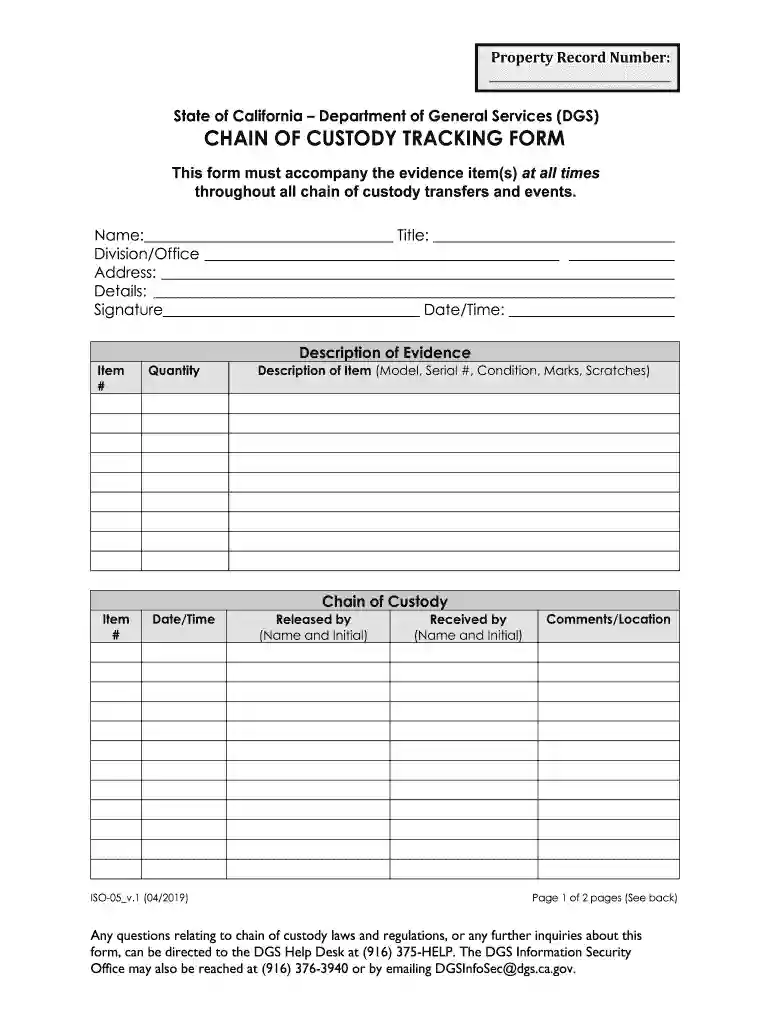
Chain of custody tracking form - CA 2026

Get Form
chain of custody tracking form - CA Preview on Page 1

Here's how it works

01. Edit your form online
Type text, add images, blackout confidential details, add comments, highlights and more.

02. Sign it in a few clicks
Draw your signature, type it, upload its image, or use your mobile device as a signature pad.

03. Share your form with others
Send it via email, link, or fax. You can also download it, export it or print it out.

Definition and Meaning

The chain of custody tracking form - CA is a critical document that aids in maintaining accurate records of evidence during transfer or storage. Primarily used by the California Department of General Services, this form serves to establish an unbroken timeline of possession by detailing who has handled the evidence at every stage. The primary goal is to prevent unauthorized access or tampering, ensuring that each item remains authentic and legally admissible in court. This form emphasizes clear communication between all parties involved to uphold its integrity.

Steps to Complete the Chain of Custody Tracking Form - CA

  1. Gather Necessary Information: Begin by collecting all required details about the evidence, including Description, Date of Collection, and Source.
  2. Document Evidence Details: Thoroughly fill out the fields related to the evidence items, noting key metadata such as case numbers or unique identifiers.
  3. Identify All Custodians: List each individual involved in the chain of custody, ensuring their contact information and signatures are present. This validates their roles in handling the evidence.
  4. Record Transfer Dates and Times: Accurately input the dates and times for each instance the evidence changes hands. This ensures a precise timeline is maintained throughout the process.
  5. Authorize Relevant Actions: Provide the necessary approvals for actions such as disposal or release of evidence to lawful owners, ensuring proper protocol is followed.

Key Elements of the Chain of Custody Tracking Form - CA

  • Item Description: Precise details about the evidence, such as physical characteristics or quantities.
  • Custodian Details: Comprehensive information about each party handling the evidence, including their role and contact information.
  • Transfer Log: A chronological record detailing each custody transfer with accompanying dates, times, and signatures.
  • Authorization Section: A dedicated space for authorization signatures regarding evidence actions, ensuring that every change follows legal procedures.

Legal Use of the Chain of Custody Tracking Form - CA

The form is utilized primarily within legal and law enforcement contexts to guarantee the admissibility of evidence in court. By maintaining immaculate records of who accessed the evidence and when it was transferred, the form supports the legal process by substantiating the authenticity and integrity of the materials. It is an essential document for defense attorneys, prosecutors, and judicial officials in California involved in cases requiring evidence validation.


Who Typically Uses the Chain of Custody Tracking Form - CA

  • Law Enforcement Officials: Police officers and detectives often initiate this form when evidence is collected during investigations.
  • Legal Professionals: Attorneys and paralegals use the form to validate the preservation and handling of evidence across legal proceedings.
  • Forensics Experts: Analysts involved in analyzing evidence often consult this form to verify that their findings are based on uncontaminated evidence.
decoration image ratings of Dochub

Examples of Using the Chain of Custody Tracking Form - CA

A typical example is a police detective documenting a seized piece of digital evidence. The form will detail each individual who accessed the digital item, note when the evidence was transferred to forensic analysts, and include when it was eventually presented in court. Another example involves laboratory settings where a sample must be transferred between multiple specialists for various tests. At each stage, the form is updated to reflect these transactions, ensuring all authenticity measures are upheld.

State-Specific Rules for the Chain of Custody Tracking Form - CA

California law imposes strict regulations on maintaining a clear and intact chain of custody for all evidence processed within the state. This includes mandates on the accuracy of recording details, frequency of updates, and procedural protocols for storage and handling. Legal practitioners must be familiar with these specifics to ensure compliance with California's evidence management standards.

Form Submission Methods: Online and In-Person

While traditionally submitted in physical form, modern practices may allow for electronic completion and submission through secure channels. This digital option provides enhanced accessibility to law enforcement and legal representatives, streamlining the process via encrypted platforms to maintain data integrity and security.

Penalties for Non-Compliance

Failure to adequately complete and maintain a chain of custody tracking form can severely impact a legal case. Evidence dismissed due to custody breaches may lead to charges being dropped or verdicts being affected. Custodians who fail in their duties might face professional disciplinary actions or legal repercussions.

Form Variants: Related or Older Versions

Over time, variations of the chain of custody tracking form may have been developed to accommodate new legal standards or technological advancements in how evidence is managed. Users must ensure they are using the most current version stipulated by the California Department of General Services or the respective legal body overseeing the proceedings.

be ready to get more

Complete this form in 5 minutes or less

Get form

Got questions?

We have answers to the most popular questions from our customers. If you can't find an answer to your question, please contact us.
Contact us
Chain of custody refers to the movement and location of evidence from the moment it was collected to the time it is presented at trial.
The chain of custody form shall at least include the following information: Unique identifier. Name and signature of the sample collector. Official address and contact number. Name of the recipient. Laboratorys address. Details of each sample, including: Unique identifier and matrix.
The Relevance of the Chain of Custody Documentation Each sample container label must receive a unique identification code and other relevant information such as location, date and time of collection, the name and signature of the person who collected the sample, and the signature of the witness(es).
An example of chain of custody would be the recovery of a bloody knife at a scene: Officer Andrew collects the knife and places it into a container, then gives it to forensics technician Bill. Forensics technician Bill takes the knife to the lab and collects fingerprints and other evidence from the knife.
What Information Should be Included in a Chain of Custody Document? Date and time of collection. Location of collection. Name of investigator(s) Name or owner of the media or computer. Reason for collection. Matter name or case number. Type of media. Serial number of media if available.

Security and compliance

At DocHub, your data security is our priority. We follow HIPAA, SOC2, GDPR, and other standards, so you can work on your documents with confidence.

Learn more
ccpa2
pci-dss
gdpr-compliance
hipaa
soc-compliance

People also ask

There are usually five copies to a federal chain of custody form, listed as: Copy 1 Test Facility. Copy 2 MRO. Copy 3 Collector. Copy 4 Employer. Copy 5 Donor.

Related links