




01. Edit your form online
Type text, add images, blackout confidential details, add comments, highlights and more.

Type text, add images, blackout confidential details, add comments, highlights and more.

Draw your signature, type it, upload its image, or use your mobile device as a signature pad.

Send it via email, link, or fax. You can also download it, export it or print it out.
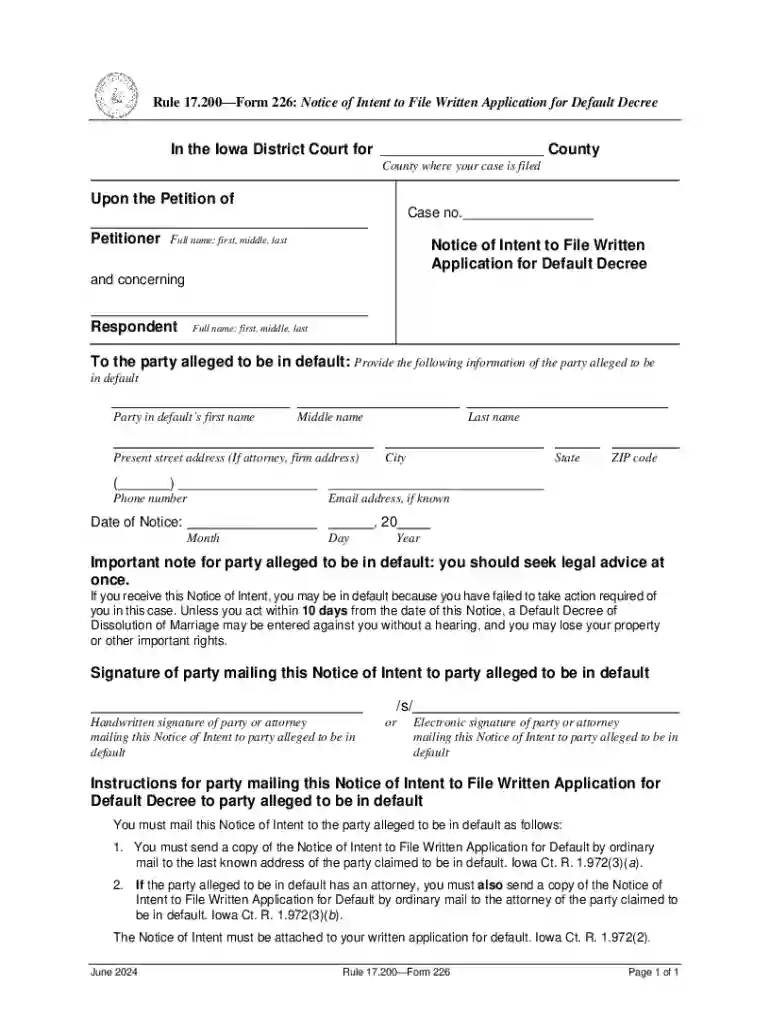
The "Notice of Intent to File Written Application for Default Decree" is a legal document primarily used within the Iowa District Court system. This notice serves the purpose of informing a respondent in a legal case, often involving the dissolution of marriage, that they are in default for failing to take necessary actions within the stipulated timeframe. The document acts as a formal warning that, due to inaction, a Default Decree might be entered without any further hearings. It is a critical component in legal proceedings, marking the shift from a contested to a potentially uncontested situation due to the non-responsive party's lack of engagement.
To effectively use this notice, a petitioner must ensure that it is served to the respondent in accordance with legal requirements. This includes providing adequate time for the respondent to take action, as stipulated within the document itself. Generally, the notice should clearly outline the consequences of non-compliance, emphasizing the potential for a Default Decree if no response is forthcoming. Legal professionals often recommend drafting this notice with precision, ensuring all legal grounds are covered to prevent any future contestations based on procedural errors.
The notice of intent includes several essential elements that must be accurately completed for the document to be legally binding:
Different states might have varying regulations regarding the use of this notice. In Iowa, for example, the rules might specify a precise method of service and a fixed period within which the respondent must act. It's crucial to consult with a legal expert familiar with Iowa’s legal procedures to ensure compliance with all state-specific requirements. Failure to adhere to these guidelines might render the notice ineffective or delay proceedings.
The application of this notice is strictly legal and should be executed with attention to detail. Lawyers or individuals using the notice must ensure it complies with appropriate procedural and substantive requirements, reinforcing its use as a definitive legal action against a defaulting party. While it primarily appears in family law cases, particularly divorces, it can also be useful in other civil matters where a party has failed to respond appropriately to court requirements.
To accompany a Notice of Intent to File Written Application for Default Decree, additional documents might be required, such as:
Consider a divorce case where one spouse has been non-compliant in responding to subpoenas or attending court-mandated sessions. In such scenarios, the compliant spouse might file a Notice of Intent to ensure proceedings can continue. The notice serves as both a reminder and a final legal recourse that allows the court to move forward in finalizing judgments regarding asset division or custody, reinforcing actions that can be taken when one party is non-cooperative.
If the respondent ignores the Notice of Intent, the court may proceed to issue a Default Decree, which might not consider their interests or claims. This decree could affect financial settlements, asset division, or child custody without their input, creating potentially unfavorable conditions for the non-compliant party.
We've got more versions of the Notice of Intent to File Written Application for Default Decree form. Select the right Notice of Intent to File Written Application for Default Decree version from the list and start editing it straight away!
At DocHub, your data security is our priority. We follow HIPAA, SOC2, GDPR, and other standards, so you can work on your documents with confidence.


