






Definition & Meaning
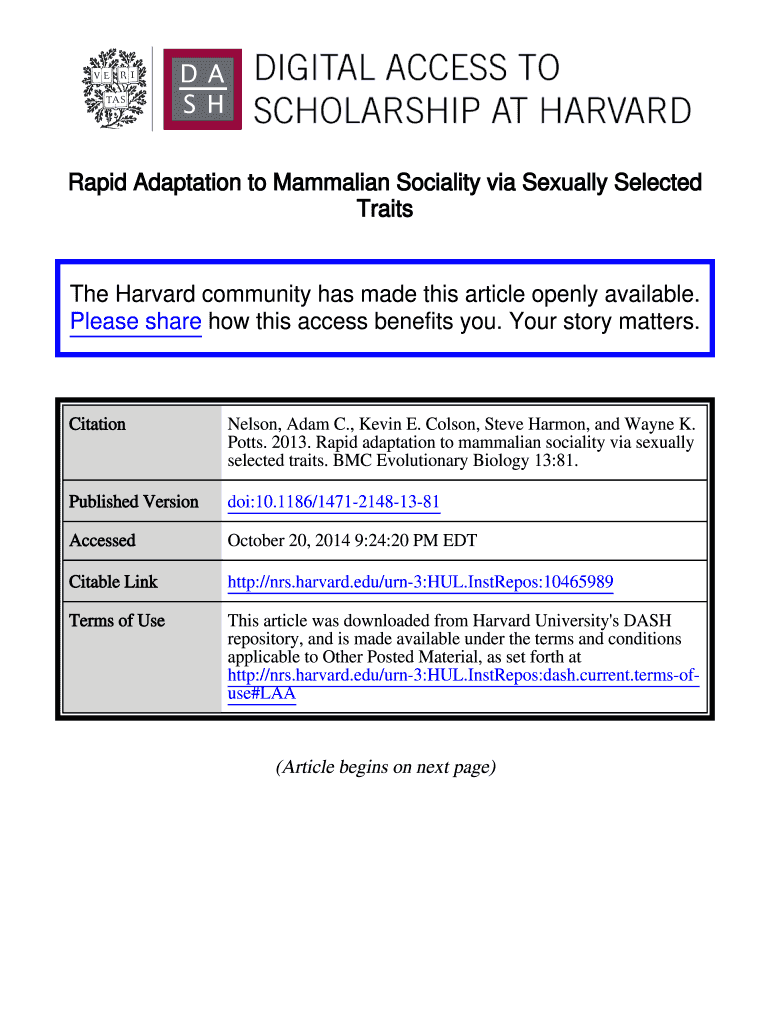
The study titled "Rapid Adaptation to Mammalian Sociality via Sexually Selected - dash harvard" examines how wild-derived mice adapt to social environments through traits that are sexually selected. This involves a detailed analysis of two distinct breeding lineages: one promiscuous with exposure to social competition and another monogamous with random mate assignment. The research explores the impact of sexual selection on reproductive success and mortality, presenting a comprehensive understanding of how these evolutionary mechanisms affect mice behavior and social structures.
How to Use the Form
Using the "Rapid Adaptation to Mammalian Sociality via Sexually Selected - dash harvard" form involves utilizing its findings in research or academic settings. Researchers can apply knowledge from the study to compare breeding behaviors in other mammalian species or explore the influence of social structures on evolutionary adaptation. The information serves as a critical tool for designing future experiments or comparative studies in sexual selection and sociality.
Key Elements of the Study
- Breeding Lineages: Exploration of promiscuous versus monogamous breeding lines.
- Reproductive Success: Analysis of males' success in fathering offspring.
- Mortality Rates: Consideration of how different breeding behaviors affect survival.
- Female Preferences: Investigation of female selection for certain male traits.
- Fitness Trade-offs: Examination of reproductive benefits against mortality costs.
- Transgenerational Effects: Potential impact on future generations' traits and behaviors.
Steps to Complete the Study
- Select Breeding Groups: Identify and separate promiscuous and monogamous groups.
- Implement Social Competition: Introduce elements that represent social competition for promiscuous lines.
- Assess Reproductive Outcomes: Track and record reproductive success in males.
- Measure Mortality: Document mortality differences between the two breeding lineages.
- Analyze Female Preferences: Study female behavior in mate selection scenarios.
- Evaluate Fitness Trade-offs: Compare reproductive gains against heightened mortality.
Why Study This Topic
Understanding the rapid adaptation to mammalian sociality via sexually selected traits provides profound insights into evolutionary biology. This study highlights the dynamics of sexual and social selection, offering clarity on how organisms adapt behaviorally and genetically in response to competitive pressures. Such knowledge is instrumental for biologists focusing on evolutionary patterns, wildlife conservation, and ecological interactions.
Who Typically Uses This Research
This research is widely used by evolutionary biologists, geneticists, ecologists, and conservationists. Academics analyzing behavioral ecology or studying evolutionary strategies often reference this study due to its robust examination of sexual selection's role in adaptation. Additionally, those in educational sectors may use the findings to teach principles of evolutionary biology and genetics.
Important Terms Related to the Study
- Sexual Selection: A natural selection process where traits are favored based on reproductive advantage.
- Social Competition: Interactions among individuals over access to resources, mates, or social status.
- Promiscuous Lineage: A breeding line with no permanent mates, engaging in multiple mating.
- Monogamous Lineage: A breeding line with one mate or little variation in mate choice.
- Fitness Trade-off: Balancing benefits of a trait against potential negative consequences.
Examples of Using the Study's Findings
- Comparative Studies: Use the findings to compare mammalian adaptation in different environments or species.
- Behavioral Analysis: Apply the conclusions to investigate animal behavior in natural habitats.
- Conservation Efforts: Support wildlife preservation strategies by understanding social structure influences.
- Educational Materials: Create curriculum content for biology courses at colleges and universities.
Legal Use of the Study
While the study serves primarily an academic purpose, legal considerations include correctly citing the study when used in publications or presentations. Ethical standards should be maintained in research following the reported methods to avoid misrepresentation. Proper use ensures integrity and respect for the authorship of the study.