






Definition & Meaning
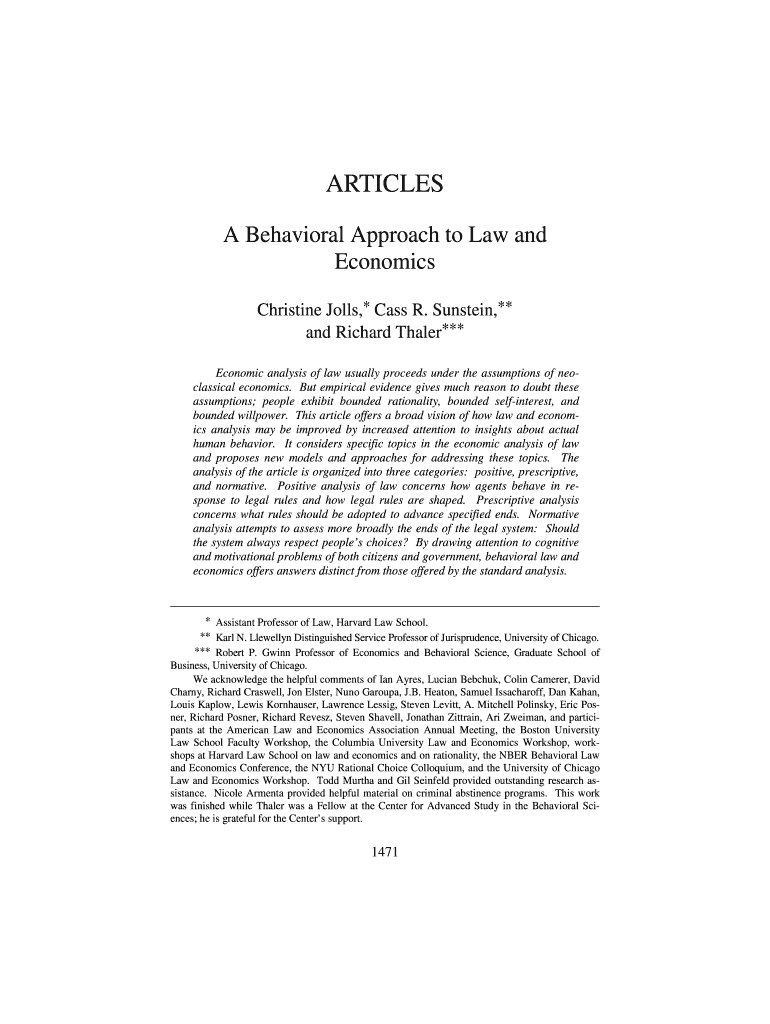
A Behavioral Approach to Law and Economics is an analytical approach that incorporates psychological insights into the legal framework, challenging traditional economic models that assume fully rational actors. By integrating concepts such as bounded rationality, self-interest, and willpower, this approach acknowledges that human behavior often deviates from pure economic predictions. This perspective aims to enhance legal predictions and policymaking, considering how people actually behave rather than relying solely on theoretical models. This approach is particularly relevant in areas like contract negotiations, liability assessments, and consumer protection laws.
Key Elements of the A Behavioral Approach
The A Behavioral Approach to Law and Economics comprises several key elements borrowed from psychology and real-world behavior studies. Bounded rationality acknowledges that individuals have limitations in processing and understanding information, leading to decisions that may not align with economic theory. Bounded self-interest considers that people's actions are influenced by fairness and reciprocity, not just personal gain. Bounded willpower recognizes that individuals may make time-inconsistent choices, struggling to adhere to long-term plans. These elements collectively foster a more accurate representation of human behavior in legal contexts.
Steps to Complete the Application of a Behavioral Approach
Employing a Behavioral Approach to Law and Economics involves several critical steps:
- Identify the Legal Issue: Determine the area of law or regulation impacted by human behavior.
- Analyze Behavioral Insights: Study empirical data and research on how psychological factors affect decisions within this legal context.
- Formulate Policies: Develop legal guidelines or policies that account for deviations from expected rational behavior.
- Test and Validate: Use empirical research methods to validate whether these behaviorally-informed policies perform better than traditional approaches.
- Implement and Monitor: Roll out the policies and continuously monitor their effectiveness and adjust as necessary.
Examples of Using a Behavioral Approach
The Behavioral Approach has been utilized effectively in several legal areas. For instance, in negligence law, it provides a framework for determining liability by considering how actual people assess risks and make safety decisions—a complex synthesis of behavioral insights and legal standards. In consumer markets, regulations designed using this approach take into account how consumers often misjudge product risks or benefits, leading to enhanced consumer protection standards that better serve the public interest.
Important Terms Related to the Approach
Understanding this approach involves familiarizing oneself with key terms:
- Anchoring: The cognitive bias where individuals rely too heavily on the first piece of information they encounter.
- Loss Aversion: The tendency for people to prefer avoiding losses over acquiring equivalent gains.
- Overconfidence Bias: When individuals overestimate their own abilities or the precision of their information.
- Prospect Theory: A behavioral economic theory that describes how people choose between probabilistic alternatives.
Legal Use of the Behavioral Approach in Economics
The integration of behavioral insights into economics and law advances the practical application of rules and policies. For instance, rather than presuming that all contractual parties equally understand terms and consequences, this approach informs more equitable contract law by considering cognitive biases that lead to misunderstandings. It also enriches regulatory frameworks, ensuring policies align more closely with societal norms and fairness in markets.
Business Types that Benefit Most from This Approach
Businesses involved in industries where consumer behavior significantly impacts outcomes can benefit enormously from this approach. These may include:
- Insurance Companies: By understanding how clients perceive risk and uncertainty, insurers can create more tailored products.
- Retail Sector: Insights into shopping behavior can optimize marketing strategies.
- Financial Services: Adapt policies to account for investor behavior and decision-making anomalies.
State-by-State Differences in Behavioral Law Applications
While the fundamental principles of the Behavioral Approach to Law and Economics are universally applicable, the specific application can vary across states. State laws may incorporate different behavioral insights based on regional economic conditions and cultural factors. For example, states with laws heavily influenced by consumer protection might adopt this approach more comprehensively to safeguard consumer rights better.
Software Compatibility for Document Management
DocHub facilitates the document workflow necessary when dealing with behavioral law elements, supporting various file types essential for such tasks. Integrating with platforms like Google Workspace enables seamless management of complex legal documents. In this context, ensuring compatibility with legal document management software like TurboTax or QuickBooks can streamline processes that require combining complex legal elements with standard economic analysis.