






Definition of Eugenic Feminism: Mental Hygiene
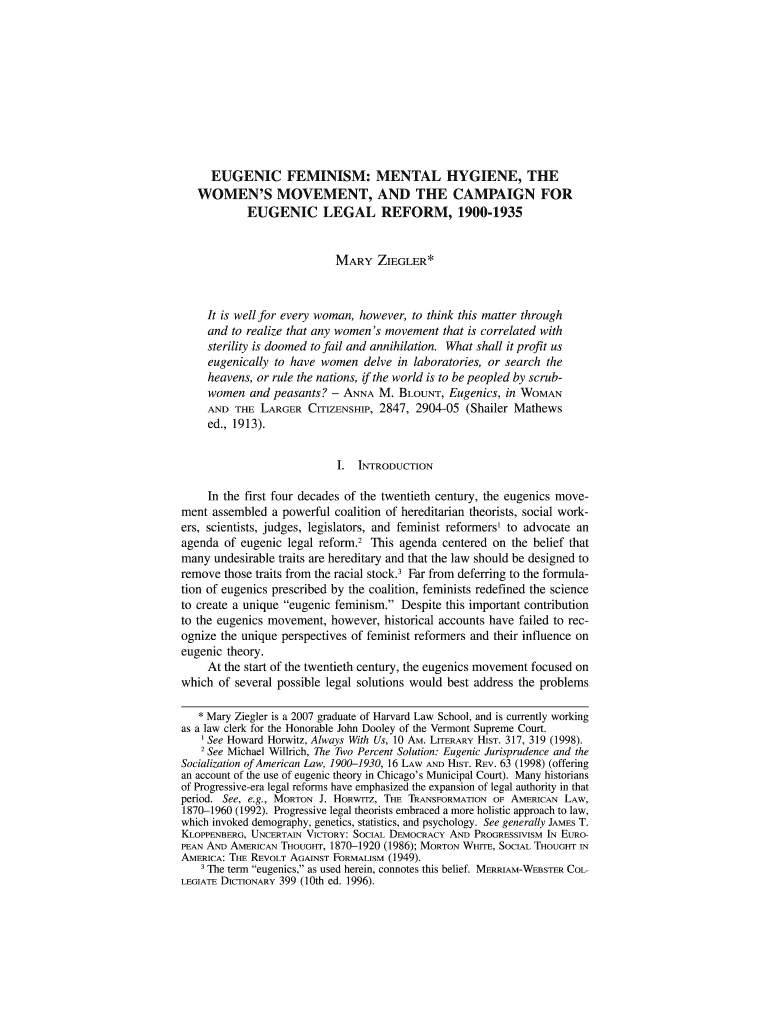
Eugenic feminism is a historical concept referring to a fusion of feminist ideals and eugenics principles prevalent from 1900 to 1935. It was characterized by efforts to align women's rights with the goals of improving societal conditions through reproductive control. Feminist reformers like Victoria Woodhull and Margaret Sanger advocated for legal reforms that employed eugenic principles, aiming to encourage reproduction among those deemed 'fit' and discourage it among those considered 'unfit.'
Key Elements
The key elements of eugenic feminism included:
- Reproductive Control: Advocating for women's rights to control reproduction as a means of improving societal health.
- Legal Reforms: Pushing for laws that incorporated eugenic ideals to legally regulate who should reproduce.
- Women's Rights Alignment: Engaging feminist ideals with eugenic principles to promote gender equality in society.
Historical Context and Evolution
Eugenic feminism developed during a time when both the feminist movement and the eugenics movement were gaining traction. Despite the common goal of societal improvement, these movements often had opposing ideals, particularly concerning sexual autonomy and gender equality.
Transition and Decline
- Contradictions: The inherent contradictions between feminist ideals and mainstream eugenics led to the decline of eugenic feminism.
- Scientific Changes: Evolving scientific perspectives on genetics questioned the validity of eugenic theories.
- Negative Associations: Association with negative historical events, such as Nazi sterilization policies, further tainted eugenic feminism.
How to Obtain Eugenic Feminism: Mental Hygiene
For researchers and historians, obtaining comprehensive information about eugenic feminism involves accessing a variety of archives and libraries. Key sources include:
- Historical Journals: Journals from the early 20th century provide primary accounts of the movement.
- Library Archives: University and public libraries often house collections of related documents.
- Digital Repositories: Online databases may offer collections of digitized materials and historical records.
Examples
- Accessing articles written by prominent figures like Margaret Sanger from archives.
- Reviewing case studies from feminist reformists who implemented eugenic policies.
Who Typically Uses the Concept
The exploration of eugenic feminism is primarily undertaken by:
- Historians: Analyzing the interplay between feminist movements and eugenics.
- Sociologists: Studying the societal impacts of eugenic policies.
- Legal Scholars: Reviewing the legal implications and reforms influenced by the movement.


Typical Uses
- Academic Research: In-depth studies evaluating the success and failures of eugenic feminism.
- Cultural Studies: Exploring the cultural narratives and social norms influenced by these historical movements.
Legal Implications and Use
The legal system interacted with eugenic feminism through the enactment of policies aimed at controlling reproduction and societal well-being. While such policies were initially promoted under feminist guises, they often limited individual freedoms, particularly concerning reproductive rights.
Legal Challenges
- Autonomy vs. Control: Balancing individual rights with societal control.
- Equity Issues: Segregating who could reproduce based on subjective criteria.
Examples of Historical Applications
Throughout its history, eugenic feminism manifested in various ways:
- Educational Campaigns: Promoting eugenics-based education to inform reproductive decisions.
- Health Initiatives: Campaigns aimed at controlling diseases through selective breeding.
Real-World Instances
- Victoria Woodhull propagating free love coupled with eugenic principles.
- Margaret Sanger advocating birth control as a method to prevent the propagation of undesirable traits.
Important Terms Associated with Eugenic Feminism
Understanding eugenic feminism also requires familiarity with key terms and ideas that were central to the movement:
- Eugenics: The science of improving a human population by controlled breeding.
- Feminism: The advocacy of women's rights on the basis of equality of the sexes.
- Reproductive Control: Regulation or control of reproduction for societal betterment.
Definitions
- Mental Hygiene: Refers to the practice of maintaining mental health through societal, educational, and personal efforts, often influenced by eugenic principles during the era.
Critiques and Controversies
Despite its historical significance, eugenic feminism faced critiques due to:
- Ethical Issues: Boundaries of ethics in reproductive control and the autonomy of individuals.
- Social Impact: Long-term negative effects on certain populations marginalized by eugenic policies.
Case Studies
- Analyzing policies in specific U.S. states that implemented eugenics-based reproductive regulations.
- Studying the societal backlash and eventual dismantling of eugenic policies in feminist discourse.