






Definition & Meaning
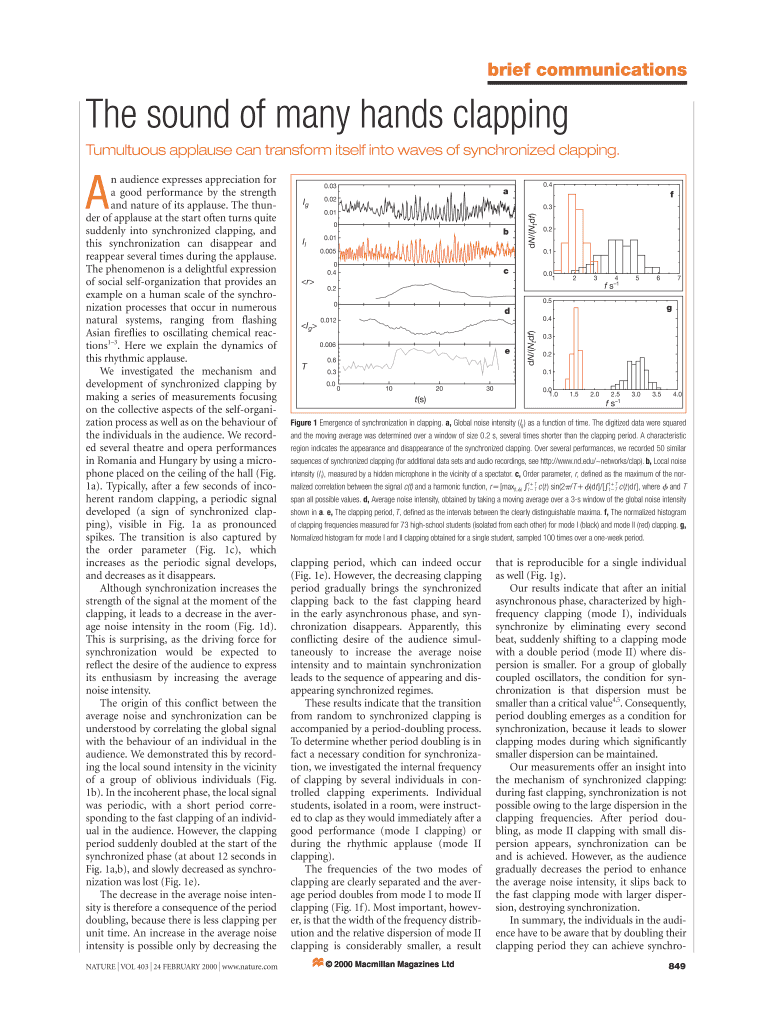
"The Sound of Many Hands Clapping - Erzs bet Ravasz Regan - regan med harvard" refers to a form or concept related to the dynamics and mechanisms of synchronized clapping in audiences. This phenomenon explores how random applause transitions into synchronized patterns, revealing social self-organization aspects akin to biological systems. The form specifically looks at how audience behavior and sound intensity interact in performances, particularly in locations like Romania and Hungary. Through this lens, one can understand how synchronization impacts noise levels and signal strength during collective audience responses.
How to Use the Form
To effectively utilize the form titled "The Sound of Many Hands Clapping - Erzs bet Ravasz Regan - regan med harvard," individuals should focus on capturing the dynamics of audience applause. This involves setting up the environment to record and analyze clapping patterns. Use tools to measure sound intensity and track transition moments from random to synchronized clapping. Compare these data points to understand social organization mechanisms. Importantly, assess how these findings can contribute to broader academic and practical applications, such as improving performance acoustics or enhancing crowd management in various settings.
How to Obtain the Form
Obtaining the form involves accessing platforms or research databases that focus on social dynamics and crowd behavior studies. It may be available through institutions that conducted studies on audience synchronization, like universities with relevant research departments, including Harvard. Researchers or enthusiasts can also contact authors or publishers of related studies directly. While specifics about acquisition may depend on academic or professional access levels, the overall goal is to procure resources that delve into audience behavior analytics.
Steps to Complete the Form
-
Initial Setup: Set up necessary recording equipment to capture audience sounds during events. Ensure it is sensitive enough to distinguish between random and synchronized clapping.
-
Data Collection: Record multiple instances of audience clapping at different events to gather a broad dataset reflecting various conditions.
-
Clapping Analysis: Analyze recordings focusing on transition points from chaotic to synchronized applause, paying close attention to the mechanisms that may trigger synchronization.
-
Sound Intensity Evaluation: Measure sound intensity levels during different clapping phases to assess the impact of synchronization on noise levels.
-
Comparative Study: Compare findings with existing studies or biological systems to draw parallels or identify unique characteristics.
Key Elements of the Form
-
Clapping Patterns: Examination of the transition from random to synchronized applause within audience settings.
-
Sound Intensity Measurements: Involves detailed evaluation of noise levels associated with different phases of audience clapping.
-
Synchronization Mechanisms: Focused study on how coordination occurs socially within groups, with possible parallels to natural phenomena.
-
Cross-Cultural Dynamics: Studies conducted in Romania and Hungary provide a cross-cultural perspective on audience behavior.
Important Terms Related to the Form
-
Synchronization: The process through which initially random activities become orderly and coordinated.
-
Sound Intensity: A measure of the pressure change produced by sound waves, indicating noise levels in a given environment.
-
Period-Doubling Process: A concept from chaos theory describing how systems can transition into synchronized states.
-
Social Self-Organization: The phenomenon where order and coordination emerge naturally from initially uncoordinated groups without centralized control.
Examples of Using the Form
-
Academic Research: Universities studying crowd dynamics may utilize the form for experiments on social synchronization in auditorium settings.
-
Event Management: Professionals designing acoustics or crowd control measures can use findings from this form to enhance performance environments or design better space layouts.
Who Typically Uses the Form
Researchers in social psychology, communication studies, and acoustics are primary users of this form. It appeals to those interested in the intersection of social behavior and scientific principles. Additionally, cultural analysts examining regional differences in audience engagement and artists seeking to integrate scientific principles into live performance experiences may find this form invaluable.