






Definition & Meaning
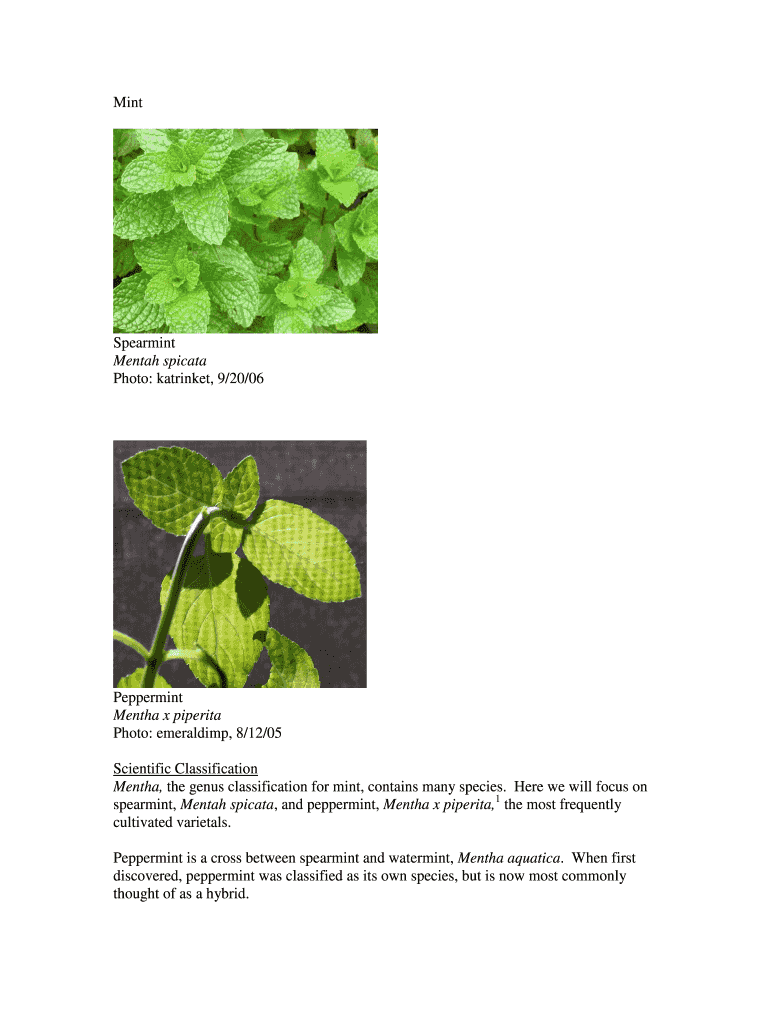
The term "Mint Spearmint Mentah spicata Photo: katrinket, 9 20 - Academics" appears to refer to a specific type of image or record connected to spearmint, and it may be used within an academic or educational context. "Mint" generally refers to a group of aromatic plants of which spearmint (Mentha spicata) is a well-known variety, prized for its culinary, medicinal, and cultural significance. The inclusion of "Photo: katrinket, 9 20" might indicate a photograph identifier or creator credit, often used in academic publications to ensure proper attribution of visual resources.
Importance and Uses in Academics
In academic settings, visual references like photos are crucial for supporting research, demonstrating concepts, and providing empirical evidence. Photos of mint species, particularly spearmint, can be used in botanical studies, culinary arts programs, and therapeutic research on the plant's beneficial properties. Spearmint images can help students and researchers identify plant structures and discuss their biological or pharmacological applications.
How to Use Mint Spearmint Mentah spicata Photo
-
Assign Appropriate Attribution: Ensure any use of the photo adheres to the original attribution requirements. Mention "Photo: katrinket" as specified.
-
Integrate into Presentations: Use the image in presentations discussing plant properties, cultivation, or species differentiation. Visual aids can enhance understanding and engagement.
-
Incorporate into Publications: Photos are useful in academic papers to illustrate research findings related to botanical studies, offering a visual depiction of study subjects.
-
Educational Modules: Use within lecture materials or laboratory manuals to demonstrate plant parts, growth habits, or other relevant educational content.
Obtaining Mint Spearmint Mentah spicata Photo
- Digital Academic Repositories: Search through online databases and digital collections that cater to educational and botanical research for licensed or public-domain images.
- University Libraries: Many academic institutions provide access to expansive archives where such photos might be available for registered students or faculty members.
- Collaboration Networks: Leverage academic networks to request images. Connect with other scholars or departments focusing on botany or plant sciences.
Steps to Complete the Academic Usage Process
- Verify Copyright Status: Ensure legal usage is permitted by checking licensing terms associated with the image.
- Download Image: Obtain a high-resolution version suitable for academic purposes.
- Integrate and Cite: Properly insert the image into your work, ensuring correct placement and annotation.
- Review Context: Ensure the image is contextually integrated to support or clarify the academic material discussed.
Legal Use and Compliance
Educational settings often have specific guidelines regarding image use to adhere to copyright laws. Photos like Mint Spearmint Mentah spicata should be used in compliance with academic licensing agreements to avoid infringement. Fair use policies typically allow for educational use, but clear citation is necessary.
Key Elements in Academic Context
-
Species Identification: Visual clarity of the plant's distinguishing features, assisting with accurate classification in botanical studies.
-
Research Relevance: Illustrates ongoing research topics, such as the study of aromatic properties or hybridization impacts.
-
Cultural Connections: Historical representations of mint use in traditional practices could be contextualized with such photos.
State-Specific Rules and Considerations
-
Usage Permissions: Different states may have varying rules regarding educational resource usage. Institutions within different states might adhere or contribute to state-specific repositories.
-
Library and Archive Access: Access to image collections might differ, with certain state universities offering unique collections that incorporate cultural and botanical resources relevant to local ecological studies.