






Definition & Meaning
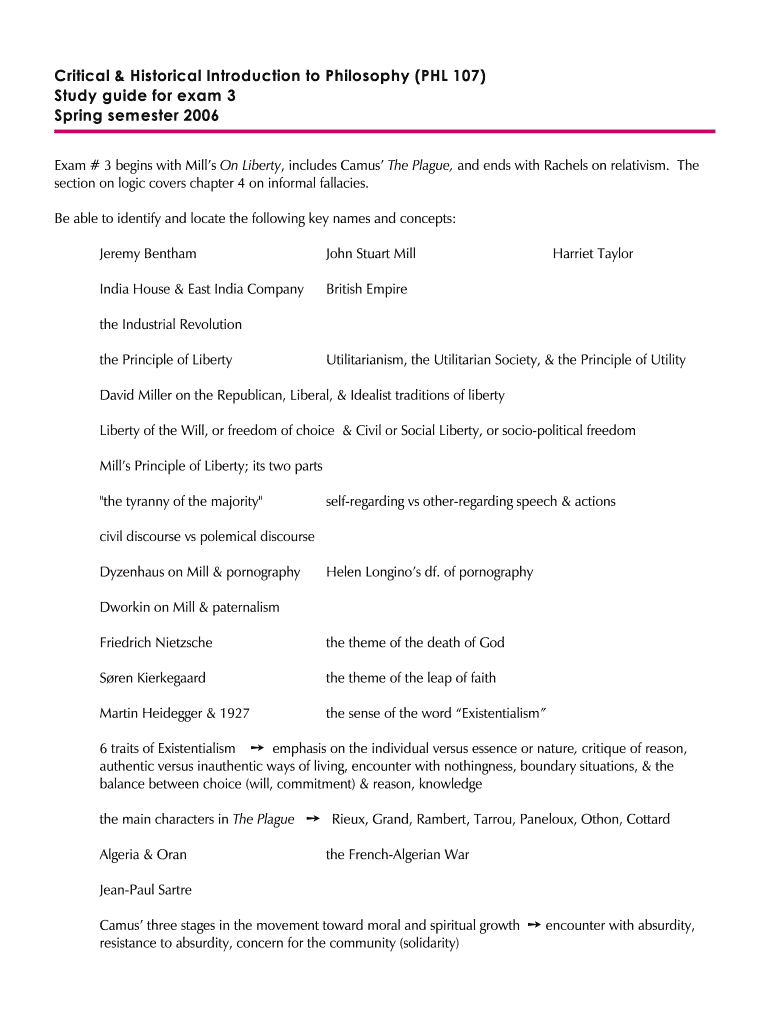
Exam # 3, as part of the Critical & Historical Introduction to Philosophy course (PHL 107) for Spring 2006, begins with Mills' "On Liberty", a key philosophical text that champions individual freedom and defines the bounds of government authority. Moving to Camus' "The Plague", the exam explores existentialist themes through the narrative of a town grappling with an epidemic, addressing human resilience and moral choices in times of crisis. It then concludes with Rachels' perspectives on cultural relativism, probing the controversies and implications of relativism in moral philosophy. The exam assesses understanding of these texts by focusing on principles like Utilitarianism, the Principle of Liberty, existentialism, and cultural relativism.
How to Use the Exam Study Guide
To effectively utilize the study guide for Exam # 3, students should approach the material in a methodical manner:
- Familiarize with Key Texts: Begin by reading the primary texts—Mills' "On Liberty", Camus' "The Plague", and Rachels on relativism.
- Understand Philosophical Principles: Focus on grasping major philosophies such as Utilitarianism and the Principle of Liberty, and their application in different contexts.
- Identify Informal Fallacies: Recognize and analyze various informal fallacies within the texts to sharpen logical reasoning skills.
- Practice Sample Questions: Engage with provided logic and essay question samples to test comprehension and ability to articulate philosophical arguments.
Practical Strategies
- Annotate Texts: Highlight important passages and annotate to track key concepts and arguments.
- Discussion Groups: Join study groups to discuss interpretations and challenge your understanding with peers.
- Essay Writing: Practice writing essays focusing on topics of liberty, existentialism, and cultural relativism to develop coherent and persuasive arguments.
Important Terms Related to Exam # 3
Familiarity with specific terms is crucial for success:
- Utilitarianism: An ethical theory that promotes actions that maximize happiness and well-being for the majority.
- Principle of Liberty: A concept advocating for individual freedoms, primarily articulated in Mills' work.
- Cultural Relativism: A theory positing that moral values and systems are defined by cultural context.
- Existentialism: A philosophy concerned with individual freedom and choice in an indifferent or absurd world.
Key Concepts Explained
- Utilitarianism:
- Originates from Jeremy Bentham and John Stuart Mill, emphasizing outcomes that produce the greatest good.
- Existentialism in "The Plague":
- Illustrates human confrontation with mortality and meaningful existence during a crisis.
- Cultural Challenges:
- Encountered in Rachels' discussions on relativism, challenging objective notions of morality.
Key Elements of the Exam
The exam evaluates comprehension of major themes and the ability to critically engage with philosophical texts:
- Comparative Analysis: Contrast the ideas of freedom and government intervention in Mills' work against existential struggles in Camus'.
- Critical Essays: Formulating arguments around the implications of cultural relativism based on moral scenarios.
- Logical Reasoning: Identifying and analyzing informal fallacies to strengthen logical argumentation.
Exam Structure
- Section One: Multiple-choice and short answer questions on Mills' "On Liberty".
- Section Two: Essay questions dissecting themes in Camus' "The Plague".
- Section Three: Critical analysis of Rachels' perspective on relativism.
Examples of Exam Content
- Mills' "On Liberty": Discourse on the limits of society's authority over the individual and the importance of liberty for human progress.
- Camus' "The Plague": Allegorical storytelling highlighting existential questions about human purpose amid uncontrollable events.
- Rachels on Relativism: Exploration of cultural norms shaping moral decisions, and debate over absolute vs. relative truths.
Steps to Prepare for Exam # 3
- Schedule Regular Study Sessions: Create a study timetable to cover all texts and themes comprehensively.
- Review Past Papers: Analyze previous exams to identify patterns in questions and expected essay structures.
- Engage with Supplementary Materials: Use additional resources such as online lectures or philosophical discussions to broaden understanding.
- Seek Feedback: Draft essays and seek feedback from professors or peers to refine critical thinking and writing skills.
Application Process & Approval Time for Study Guide
While there is no formal application process to access the study guide, ensuring early preparation and consistent study habits are akin to following an application procedure:
- Initiate Early Access: Begin early in the semester to leverage the full utility of the guide.
- Ongoing Usage: Regularly refer to the guide throughout the course for sustained comprehension and retention.
Longevity of Study Plan
Commit to a continuous review cycle beyond immediate exam preparation to reinforce long-term understanding of philosophical concepts and arguments.