Does the Threat of Insurer Liability for Bad Faith - Sharon Tennyson 2026

Get Form
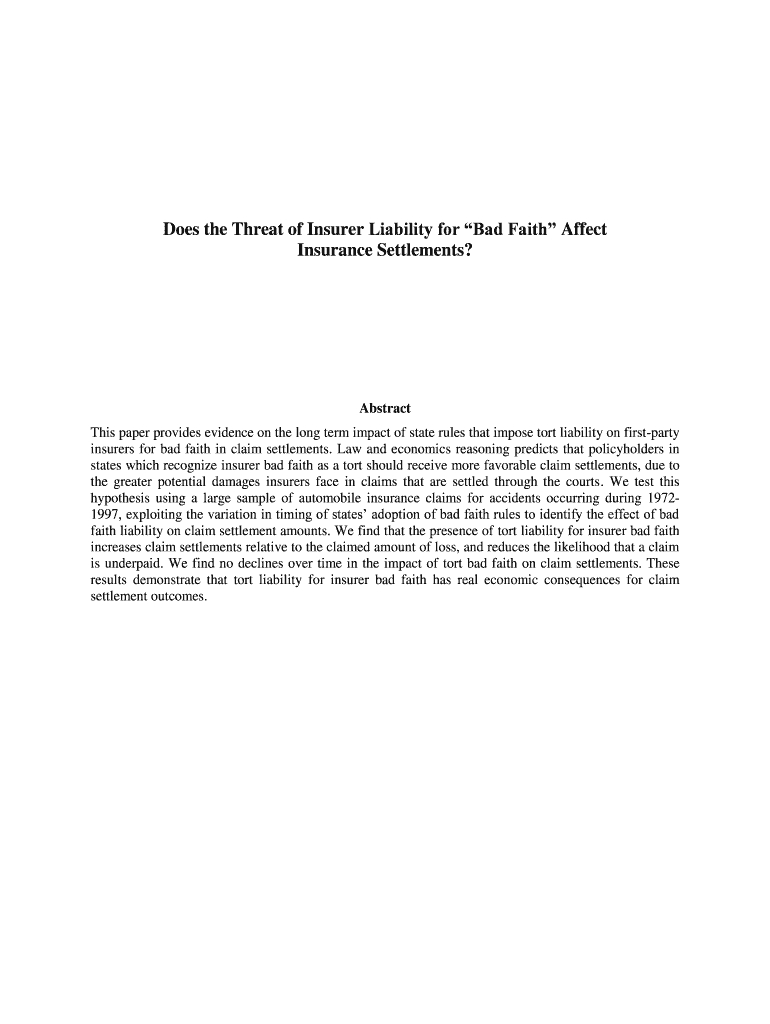
Does the Threat of Insurer Liability for Bad Faith - Sharon Tennyson Preview on Page 1

Here's how it works

01. Edit your form online
Type text, add images, blackout confidential details, add comments, highlights and more.
02. Sign it in a few clicks
Draw your signature, type it, upload its image, or use your mobile device as a signature pad.
03. Share your form with others
Send it via email, link, or fax. You can also download it, export it or print it out.

How to use or fill out Does the Threat of Insurer Liability for Bad Faith - Sharon Tennyson with our platform

Form edit decoration
9.5
Ease of Setup
DocHub User Ratings on G2
9.0
Ease of Use
DocHub User Ratings on G2
  1. Click ‘Get Form’ to open it in the editor.
  2. Begin by reviewing the abstract section, which outlines the key findings and implications of the research. This will provide context as you fill out the form.
  3. Move to the introduction section. Here, you can add your personal notes or comments regarding how insurer bad faith impacts claim settlements based on your understanding.
  4. In the background section, highlight any relevant state laws that apply to your situation. Use text boxes to summarize these laws succinctly.
  5. As you progress through each section, utilize our platform's commenting feature to annotate important points or questions that arise while reading.
  6. Once you've completed filling out all sections, review your entries for clarity and completeness before saving or sharing your document.

Start using our platform today for free to streamline your document editing and ensure a smooth workflow!

be ready to get more

Complete this form in 5 minutes or less

Get form

Got questions?

We have answers to the most popular questions from our customers. If you can't find an answer to your question, please contact us.
Contact us
What is needed to prove bad faith in court? You generally need to show clear evidence of intentional misconduct, lack of justification, and that the actions caused you harm.
Bad faith refers to dishonesty or fraud in a transaction. Depending on the exact setting, bad faith may mean a dishonest belief or purpose, untrustworthy performance of duties, neglect of fair dealing standards, or a fraudulent intent.
Misrepresentation. One of the most egregious forms of bad faith is misrepresentation. This could involve misrepresenting the policys coverage or even aspects of the law itself. You should be aware of New Yorks Unfair Claims Practices Act, which provides protections against such tactics.
Types of Compensation You Can Recover for Bad Faith You can seek compensation in the form of contractual damages, extracontractual damages, punitive or exemplary damages, and attorneys fees.
First-Party Bad Faith Claims In a first-party bad faith claim, an insurance company unreasonably denies or devalues the claims made by its policyholders. This often occurs in health, life, and disability insurance contexts.

Security and compliance

At DocHub, your data security is our priority. We follow HIPAA, SOC2, GDPR, and other standards, so you can work on your documents with confidence.

Learn more
ccpa2
pci-dss
gdpr-compliance
hipaa
soc-compliance
be ready to get more

Complete this form in 5 minutes or less

Get form

People also ask

Bad faith (Latin: mala fides) is a sustained form of deception which consists of entertaining or pretending to entertain one set of feelings while acting as if influenced by another. It is associated with hypocrisy, bdocHub of contract, affectation, and lip service.

Related links