






Definition & Meaning
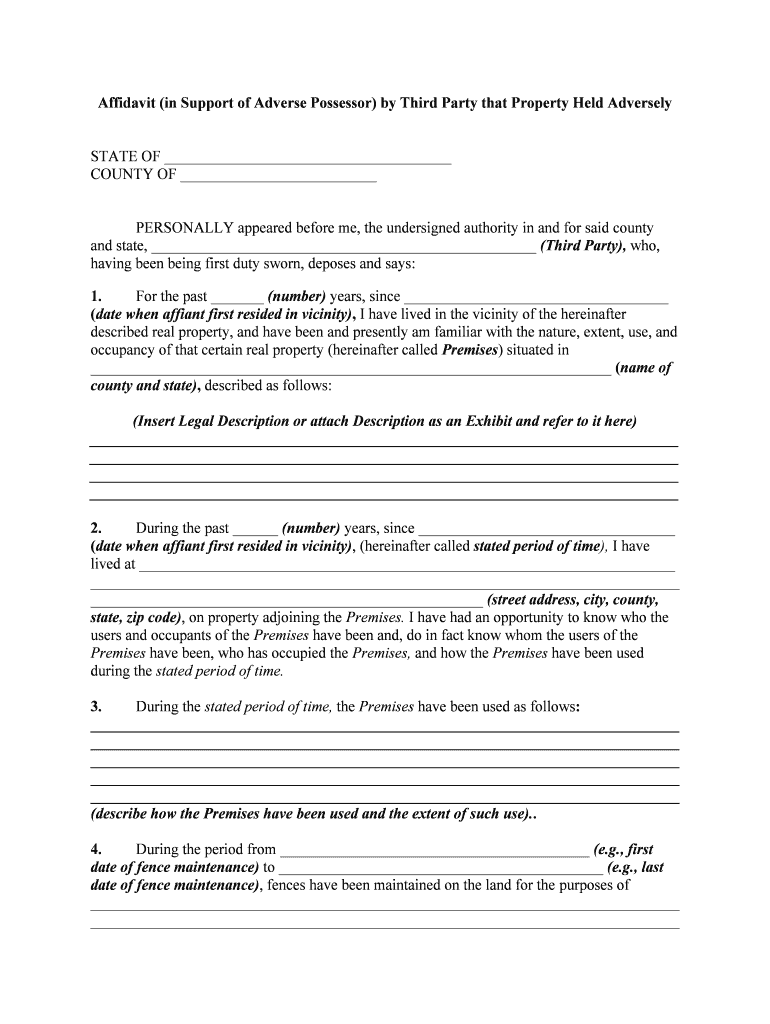
The "opposing affidavit rejecting the adverse possessor's claim format in Texas" is a legal document used to contest a claim of adverse possession. Adverse possession is a legal principle that allows a person to claim ownership of land under certain conditions without compensation, as long as they have occupied it openly and continuously for a period, typically ten years in Texas. The opposing affidavit serves to present facts and evidence that challenge the adverse possessor's claim, asserting that the conditions for adverse possession have not been met.
How to Use the Opposing Affidavit Format
To use the opposing affidavit effectively, it is crucial to provide detailed evidence and statements that dispute the adverse possessor's claim. Key components include:
- A statement of facts supporting the original property owner's claim, contrasting with the adverse possessor's narrative.
- Documentation that counters the adverse possession elements, such as proof of payment of taxes by the original owner, evidence of entry or use with permission, or periods when the property was not occupied by the possessor.
- Sworn testimony or declarations from credible witnesses, such as neighbors or occupants, who can attest to the property conditions contrary to the possessor's claims.
Steps to Complete the Opposing Affidavit
- Gather Supporting Documents: Collect all relevant documents, such as property deeds, tax records, and any correspondence that disputes the possessor's claim.
- Draft the Affidavit: Structure the affidavit to include the personal details of the affiant, a clear statement rejecting the adverse possession, and the supporting evidence.
- Detail the Disputes: Clearly outline each point of dispute, providing evidence and examples that challenge the possessor's claim of continuous, exclusive, open, and hostile occupation.
- Swear the Affidavit: Have the affidavit signed in the presence of a notary public to ensure it is legally binding.
- File the Affidavit: Submit the completed affidavit to the appropriate legal jurisdiction, such as a court or a county recorder's office, according to Texas law.
Key Elements of the Opposing Affidavit
The affidavit should include several essential elements that ensure its effectiveness:
- Personal Identification: Information about the affiant, including name, address, and relation to the property.
- Property Description: Precise legal description of the property in question.
- Factual Assertions: Detailed account of the reasons for rejecting the adverse possessor's claim, with supporting evidence.
- Witness Statements: If applicable, incorporate testimonies from witnesses to reinforce the affidavit's content.
- Notarization: Official notarization to validate the affidavit legally.
Legal Use of the Opposing Affidavit
Legally, this affidavit provides a defense mechanism for property owners against adverse possession claims. It is used to assert that the statutory requirements for adverse possession, such as continuous and exclusive use, have not been satisfied by the claimant. This document becomes a critical piece of evidence in legal proceedings to defend ownership rights.
State-Specific Rules for Texas
In Texas, the law sets forth specific criteria for adverse possession, known as the "statutory period," typically ten years. Property owners can use the opposing affidavit to contend that they maintained the right to the property through various means, such as paying property taxes. Additionally, Texas law requires the possessor to provide clear evidence of an overt claim of ownership, which the affidavit should directly refute.
Important Terms Related to Opposing Affidavit
Understanding key terms helps in drafting a precise affidavit:
- Adverse Possession: Legal doctrine allowing acquisition of property ownership through continuous occupation under specific conditions.
- Statutory Period: Minimum duration for which the adverse possessor must occupy the property to claim ownership, generally ten years in Texas.
- Tacking: Combining successive periods of possession by different possessors to meet the statutory period requirement. The affidavit can contend that such tacking lacks continuity.
- Hostile Claim: Requirement that possession be without the owner's permission, which the affidavit can counter with evidence of consent.
Examples of Using the Opposing Affidavit
Illustrative examples in real-world scenarios include:
- A property owner openly disputes an adverse possession claim by presenting evidence of recent property tax payments and contractual agreements with tenants, asserting rightful ownership.
- A neighboring property owner uses the affidavit to support a fellow landowner's dispute against an adverse possessor by providing testimony that contradicts the possessor's claims of continuous use.
These examples highlight the diverse applications of the affidavit in maintaining legal property ownership, demonstrating its strategic use in legal disputes over adverse possession claims.