
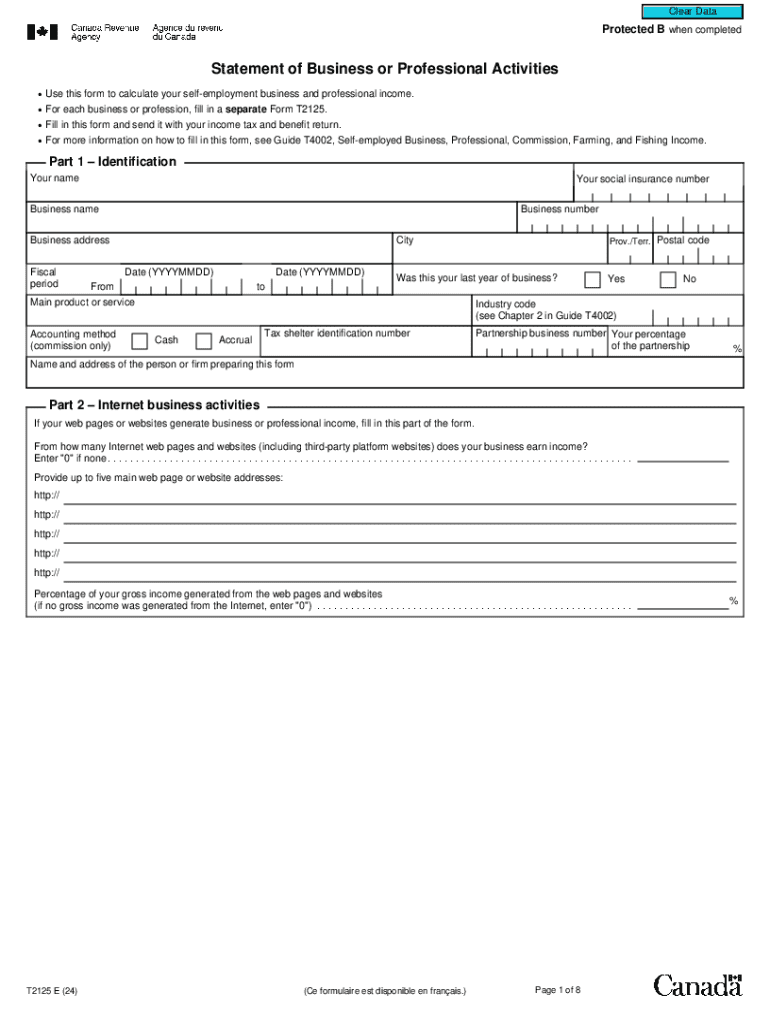







Definition and Purpose of the Statement of Business or Professional Activities
The Statement of Business or Professional Activities is often referred to as Form T2125 in Canada and is used for reporting income and expenses from self-employment. For U.S. taxpayers, similar reporting might involve Schedule C (Form 1040) for sole proprietors. This document captures essential financial details, enabling business owners to calculate their net income or loss for tax purposes. It includes sections for identifying the business, detailing income from various sources, and itemizing allowable expenses. Understanding how to accurately complete this form is crucial for meeting tax obligations and ensuring compliance with the Internal Revenue Service (IRS).
Key Elements of the Statement
A thorough breakdown of the Statement of Business or Professional Activities involves distinct sections that address various financial components:
- Business Identification: This section captures the basic information about the business, such as name, address, and the type of business activities conducted.
- Income Reporting: Users must list all sources of their business income, which typically includes sales revenue and any other earnings related to business operations.
- Expense Details: This area allows for the documentation of business expenses. Common categories include office supplies, travel expenses, and advertising costs.
- Net Profit/Loss Calculation: By subtracting total expenses from total income, the form calculates the net business profit or loss—a critical figure needed for tax filing.
- Specific Instructions for Online Operations: Businesses conducting activities online may have unique requirements for reporting income and expenses.
Steps to Complete the Statement
Completing the Statement of Business or Professional Activities involves several key steps:
- Gather Necessary Information: Collect all relevant documents related to your business operations, including income statements, receipts for expenses, and financial records.
- Fill Out Business Identification: Enter all required business information, ensuring accuracy for each detail.
- Report Gross Business Income: List all income generated through business activities, including sales and services provided.
- Detail Business Expenses: Accurately report all deductible business expenses, categorizing them appropriately as outlined in the form instructions.
- Calculate Net Income or Loss: Subtract total expenses from total income to determine your business's net profit or loss.
- Review and Submit: Double-check all entries for accuracy before submitting the form via the method of your choice—either online, by mail, or in person.
Important Terminology
Understanding key terms is essential for accurately completing the form:
- Gross Income: The total amount of money earned from business activities before deducting expenses.
- Allowable Deductions: Expenses that can be subtracted from gross income to reduce taxable income.
- Net Income: The amount remaining after all allowable deductions have been subtracted from gross income.
Who Typically Uses the Statement
This form is most commonly used by:
- Self-Employed Individuals: Freelancers, contractors, and other self-employed professionals utilize this form to detail their earnings and expenses.
- Small Business Owners: Owners of unincorporated businesses require this form to report income and calculate tax liabilities.
- Partnerships: Although partnerships generally file a separate return, individual partners may use this form to report their share of income and expenses.


Examples of Using the Statement
Consider several real-world scenarios that illustrate the use of the Statement of Business or Professional Activities:
- Freelance Graphic Designer: A designer uses the form to report income earned from various clients and deducts expenses such as design software subscriptions and office supplies.
- Online Retailer: By documenting income from e-commerce sales and related deductions like shipping costs and advertising, a retailer can calculate the net profit.
- Consultant: A business consultant details earnings from consulting fees and subtracts travel and promotional expenses to determine net income.
IRS Guidelines and Filing Requirements
According to IRS guidelines, individuals must accurately report all income and related expenses to ensure compliance. Key points include:
- Schedule C (Form 1040): U.S. taxpayers use this form to report income or loss from a business they operated or a profession they practiced as a sole proprietor.
- Tax Filing Deadlines: Ensure the form is submitted by the tax filing deadline to avoid penalties. For most taxpayers, this deadline is April 15.
- Record-keeping: Maintain all supporting documentation for a minimum of three years in case of an audit.
State-Specific Rules and Differences
Regulations may vary between states, influencing how businesses record and report income:
- California: Requires adherence to specific state guidelines that may differ from federal instructions, notably in areas of allowable deductions.
- New York: Offers additional state credits and deductions that businesses must be aware of to maximize benefits.
- Texas: With no state income tax, emphasis is placed on accurate federal reporting, but businesses must meet state sales tax obligations.
Adhering to both federal and state-specific requirements ensures compliance and optimizes tax benefits for business owners.


