




01. Edit your form online
Type text, add images, blackout confidential details, add comments, highlights and more.

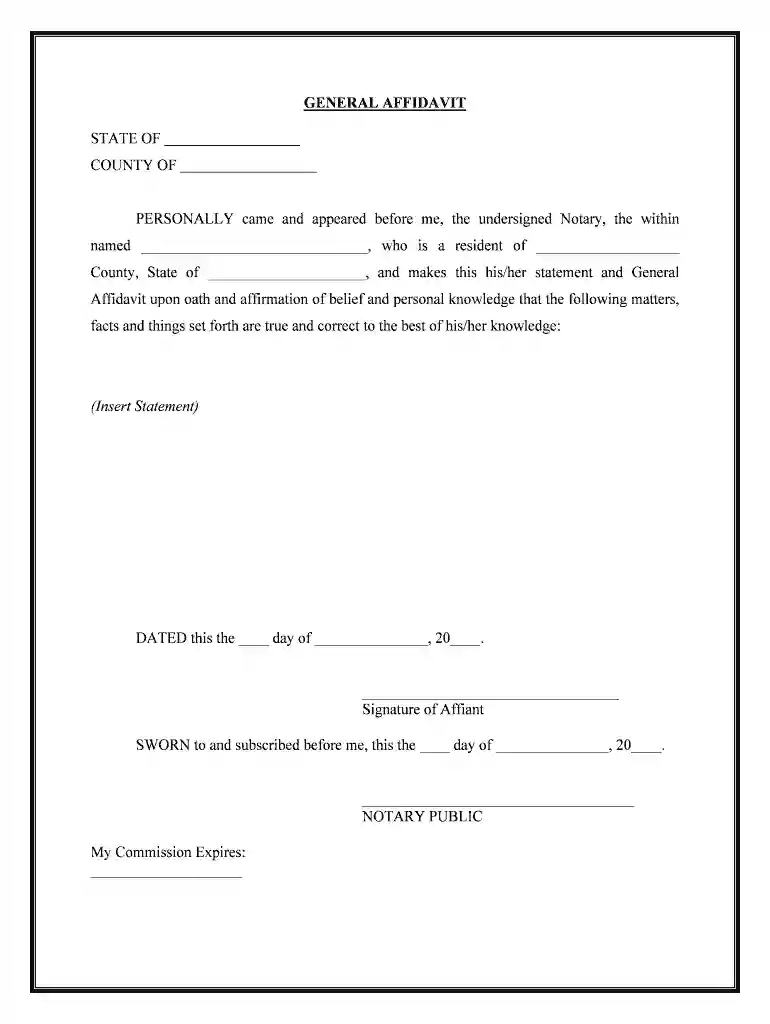
Type text, add images, blackout confidential details, add comments, highlights and more.

Draw your signature, type it, upload its image, or use your mobile device as a signature pad.

Send it via email, link, or fax. You can also download it, export it or print it out.
A general affidavit is a legal document in which an individual, referred to as the affiant, declares specific facts under oath. The affidavit serves as a formal statement of truthfulness concerning the assertions made within the document. In the United States, this document is often employed in legal and administrative proceedings to confirm details that require official validation without appearing in court. The affidavit becomes legally binding once it is signed in the presence of a notary public, who notarizes the document. This notarial act underscores the solemnity and veracity of the affiant's declaration.
An affidavit can be utilized in various contexts where evidence needs to be provided under oath. To effectively use a general affidavit:
By adhering to these steps, an affidavit can serve as a strong testament of the affiant’s facts and assertions, reinforcing their credibility in the eyes of legal or administrative authorities.
Completing a general affidavit involves several crucial steps that ensure its validity and compliance:
Gather Information: Collect all pertinent facts you intend to include in the affidavit. Organize these details logically and coherently.
Draft the Document: Use clear and concise language to state your facts. Each point should be relevant to the purpose of the affidavit.
Include Personal Details: At the beginning, state your full name, address, and any other identifying information.
Oath Statement: Include a statement swearing or affirming the truthfulness of the content.
Notary Section: Leave space for the notary public to sign and affix their seal.
Review and Edit: Check for grammatical mistakes and accuracy of facts. Any errors can render the affidavit invalid.
Notarization: Visit a notary public with a valid ID to complete the notarization process. The notary will confirm your identity and witness your signing of the affidavit under oath.
Completing these steps ensures that the affidavit is properly formatted, legally binding, and acceptable for its intended use.
A general affidavit must include specific components to be considered valid:
Affiant Information: The complete name, address, and contact information of the affiant.
Statement of Facts: Clear description of facts or details pertinent to the situation. These should be honest and specific.
Oath or Affirmation: A formal assertion of truthfulness, indicating the content’s validity under penalty of perjury.
Signature Line: A designated area for the affiant to sign the document.
Notary Acknowledgment: A section for the notary public’s signature and seal confirming the affiant's identity and conscious acknowledgment of the affidavit.
Each element serves its purpose and collectively ensures the legal acceptability and enforceability of the affidavit in various proceedings.
General affidavits play a vital role in various legal contexts within the United States. They are commonly used to:
Affidavits help streamline these procedures by offering a clear, sworn testimony that can be referenced during legal evaluations or inquiries.
In the U.S., several individuals and entities frequently use general affidavits:
This broad applicability makes general affidavits a flexible tool for attestation across diverse sectors.


Each state in the U.S. may have distinct rules regarding the use and format of general affidavits. Key variations include:
Familiarizing yourself with the specific laws and regulations in your state ensures that your affidavit adheres to local legal standards, preventing potential administrative setbacks.
General affidavits are utilized in a variety of real-world scenarios:
These examples illustrate the affidavit’s versatility in personal, legal, and administrative contexts, highlighting its importance as a legal instrument.
We've got more versions of the Affidavit - General form. Select the right Affidavit - General version from the list and start editing it straight away!
| Versions | Form popularity | Fillable & printable |
|---|---|---|
| 2020 | 4.9 Satisfied (32 Votes) |
At DocHub, your data security is our priority. We follow HIPAA, SOC2, GDPR, and other standards, so you can work on your documents with confidence.
Instructions on Trade Secret Certification (with Affidavit) - Office of the General Counsel Office. T: (305) 348-2103. E: generalcounsel@fiu.edu
For a flood or fire, a general diary entry, a non-traceable report, or a notarised loss affidavit is usually accepted instead of a full FIR. Confirm your board
To notify the Department of Revenue that a transfer of ownership has occurred for a motor vehicle, trailer, all-terrain vehicle (ATV), motorcycle, motortricycleRead more


