






Definition and Meaning of COM 321
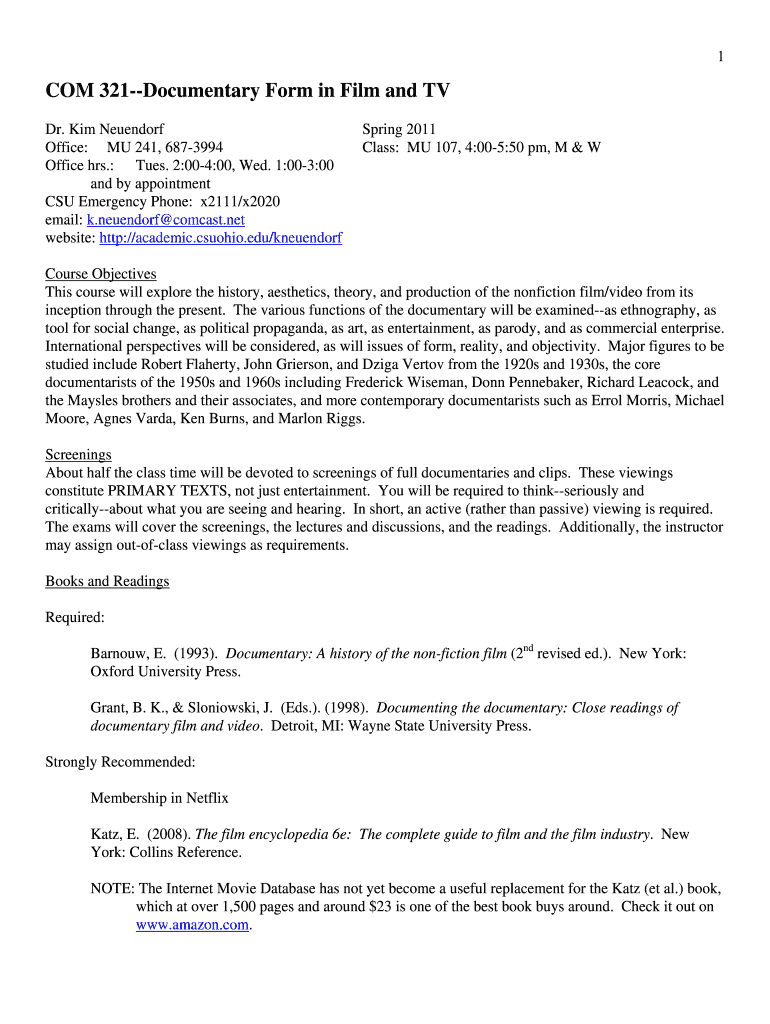
The COM 321 course at Cleveland State University, titled "Documentary Form in Film and TV," focuses on the exploration of documentary film and television. It covers the historical evolution, aesthetic principles, theoretical frameworks, and production techniques of documentaries. This academic program is crafted to engage students with the critical examination of documentaries as primary texts, enabling them to understand the power of visual storytelling in conveying real-world issues and narratives.
How to Use the Documentary Form Course
Participating in COM 321 requires active engagement with the course materials. Students are expected to complete required readings, attend scheduled screenings, and participate in discussions. Written assignments are integral for evaluating students' understanding and interpretation of the material. Additionally, students are encouraged to attend events such as the Cleveland International Film Festival to further immerse themselves in documentary culture and practice.
Steps to Complete the COM 321 Course
- Attend Lectures and Screenings: Regular attendance is crucial to grasp the theoretical and practical aspects of documentary filmmaking.
- Engage with Course Readings: Stay updated with assigned texts to support your understanding of the historical and contemporary documentary landscapes.
- Participate in Discussions: Active class participation is encouraged to explore diverse perspectives and deepen analytical thinking.
- Complete Assignments: Timely submission of written assignments, including essays and reflective journals, is necessary to demonstrate learning progress.
- Attend Related Events: Participation in film festivals and related events enhances practical exposure and understanding of documentary forms.
- Submit Final Projects: Depending on the course structure, a final project or paper may be required to showcase a culmination of acquired knowledge.
Key Elements of the Course
- Historical Context: Understanding the evolution of documentary films and television.
- Aesthetic Techniques: Exploration of visual and narrative styles unique to documentaries.
- Theoretical Approaches: Examination of various theories and frameworks essential for analyzing documentaries.
- Practical Application: Opportunities to engage with production tools and techniques.
- Critical Viewing: Developing the skill to critically assess documentaries as a form of storytelling.
Important Terms Related to COM 321
- Documentary: A genre of film and television that provides factual records or reports.
- Aesthetics: The branch of philosophy dealing with the nature and expression of beauty.
- Theory: A system of ideas intended to explain a particular subject.
- Production: The process of creating film and television content.
- Screenings: Organized showings of films for an audience.
Examples of Using the Documentary Form Course
- Student Projects: Students may create short documentaries as part of the curriculum.
- Film Analysis: Writing analytical essays on viewed documentaries.
- Classroom Discussions: Engaging in debates and discussions on documentary subjects and techniques.
- Festival Participation: Involvement in film festivals to observe the latest in documentary filmmaking.
Why Enroll in COM 321
Enrolling in COM 321 benefits students interested in media studies, film production, and cultural analysis. The course equips students with the theoretical and practical skills required to analyze and create documentary content. It is suitable for those pursuing careers in filmmaking, journalism, cultural anthropology, or media criticism.
Who Typically Uses the COM 321 Course
The course is tailored for undergraduate students in communication, media studies, journalism, and related fields. It also attracts students from other disciplines interested in understanding the documentary genre and its impact on society. The course can also benefit aspiring filmmakers and visual storytellers seeking to deepen their knowledge of documentary forms.


Legal Use of Course Materials
The materials provided in COM 321 are intended for educational purposes. Students are expected to use these resources ethically and in compliance with educational standards. Unauthorized distribution or reproduction of course materials is prohibited. Students should also adhere to privacy policies when attending film screenings or participating in external events related to the course.