






Definition and Meaning of "Be a Random Sample from an Exponential"
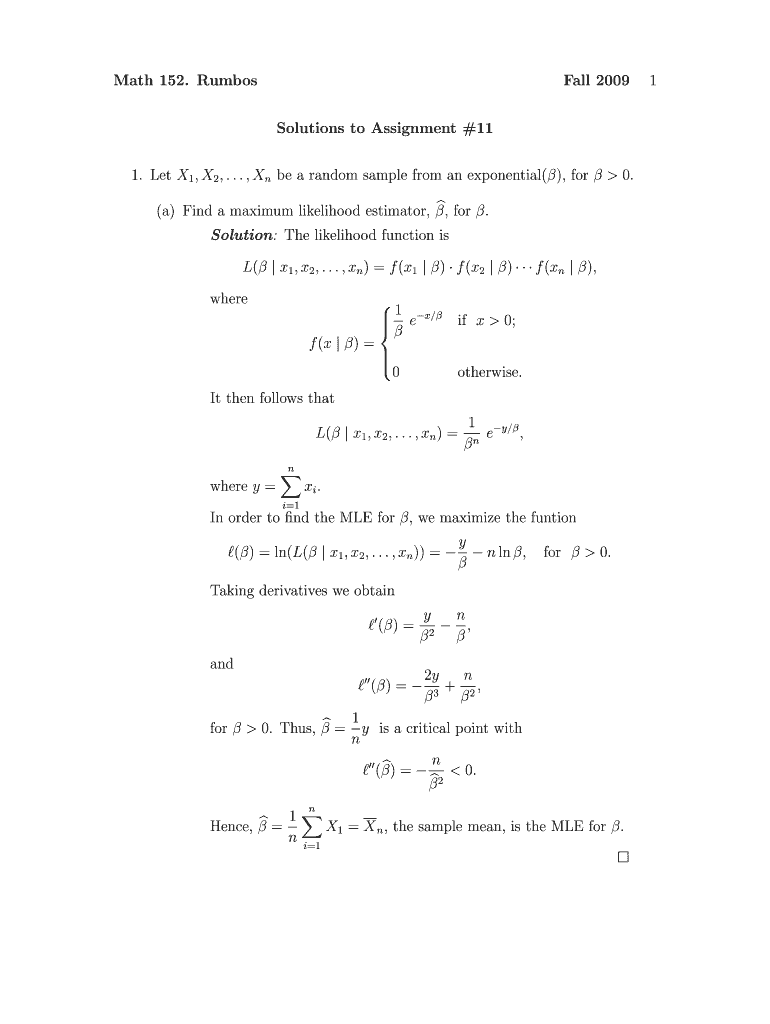
The concept "be a random sample from an exponential" refers to a statistical term involving a set of observations drawn from an exponential distribution. This distribution is often used in reliability analysis and queueing theory because of its memoryless property, which means the probability of an event occurring in the next time period is the same regardless of how much time has already elapsed. In more practical terms, when a sample is drawn from this distribution, it typically involves lifetimes of objects, time until the next event, or failure rates in both mechanical and biological systems.
Characteristics of Exponential Distribution
- Memoryless Property: The probability distribution of the time until a new event occurs is independent of any previous events.
- Continuous Distribution: It models the time between events in a continuous and memoryless process.
- Rate Parameter (λ): This parameter dictates the average rate of occurrence. A higher rate indicates a greater likelihood of quickly occurring events.
How to Use an Exponential Sample
Understanding how to use a set of samples from an exponential distribution is crucial in various statistical analyses. This knowledge helps in estimating parameters, making predictions, and conducting hypothesis tests.
Practical Applications
- Reliability Engineering: Estimating the lifespan of products.
- Risk Analysis: Assessing the time until the next system failure.
- Queue Theory: Analyzing the waiting times between arrivals.
Steps to Complete Random Sample Analysis
Conducting a thorough analysis requires several key steps. These steps ensure accurate parameter estimation and reliable inferences about the data.
- Identify Your Data: Determine if your dataset aligns with an exponential model, often involving lifetime or waiting time data.
- Parameter Estimation: Use methods like Maximum Likelihood Estimation (MLE) to determine the distribution's rate parameter.
- Hypothesis Testing: Apply tests such as the likelihood ratio test to validate your model assumptions.
- Model Verification: Check the fitting of exponential distribution using graphical methods like Q-Q plots.
Who Typically Uses Samples from Exponential Distributions
Exponential samples find their usage across various professional fields. Each brings its unique set of requirements and variations.
Key User Groups
- Statisticians: To analyze life data and time until event data.
- Engineers: In reliability and failure rate analyses.
- Economists: For time-based models in financial data analysis.
Important Terms Related to the Exponential Sample
Understanding related terminology is critical to navigating the statistical domain effectively.
- Rate (λ): A key parameter indicating the average number of events in a time period.
- Hazard Function: The rate of failure at any given time.
- Expected Value: Mean of the distribution, given by 1/λ.
Legal Use and Compliance
While not typically subject to direct legal regulations like other document forms, correctly using exponential sampling in regulated industries ensures compliance with safety and reliability standards.
Examples of Using Exponential Samples
Many industries benefit from the exponential model by applying it to solve real-world problems.
Use Cases
- Telecommunications: Analyzing the time between call arrivals.
- Healthcare: Predicting patient wait times in emergency departments.
- Manufacturing: Estimating the failure times of machinery.
Software Compatibility for Exponential Analysis
Several statistical software platforms provide tools to perform exponential sample analyses efficiently.
- R: Libraries like
statsprovide exponential functions. - Python: Packages such as SciPy and numpy support exponential calculations.
- MATLAB: Functions for fitting exponential models are readily available.
Software Compatibility (TurboTax, QuickBooks, etc.)
When dealing with statistical computations, especially those involving exponential samples, it is important to utilize compatible software that can handle such analysis. Though applications like TurboTax or QuickBooks are not directly used for statistical analysis, they can be integrated with data processing software like:
- R and RStudio: Known for its comprehensive packages supporting statistical calculations.
- Python (with libraries like SciPy and NumPy): Offers robust solutions for numerical computations.
- MATLAB: Preferred by engineers and scientists for its built-in functions that cater to exponential functions and probability distributions.
Selecting the appropriate software ensures that calculating parameters like the rate (( \lambda )) or simulating random samples from the exponential distribution can be conducted efficiently and accurately. The choice of tool can significantly impact the ease and precision of your analysis, making it vital to consider software that meets both your analytical needs and your proficiency level with the technology.