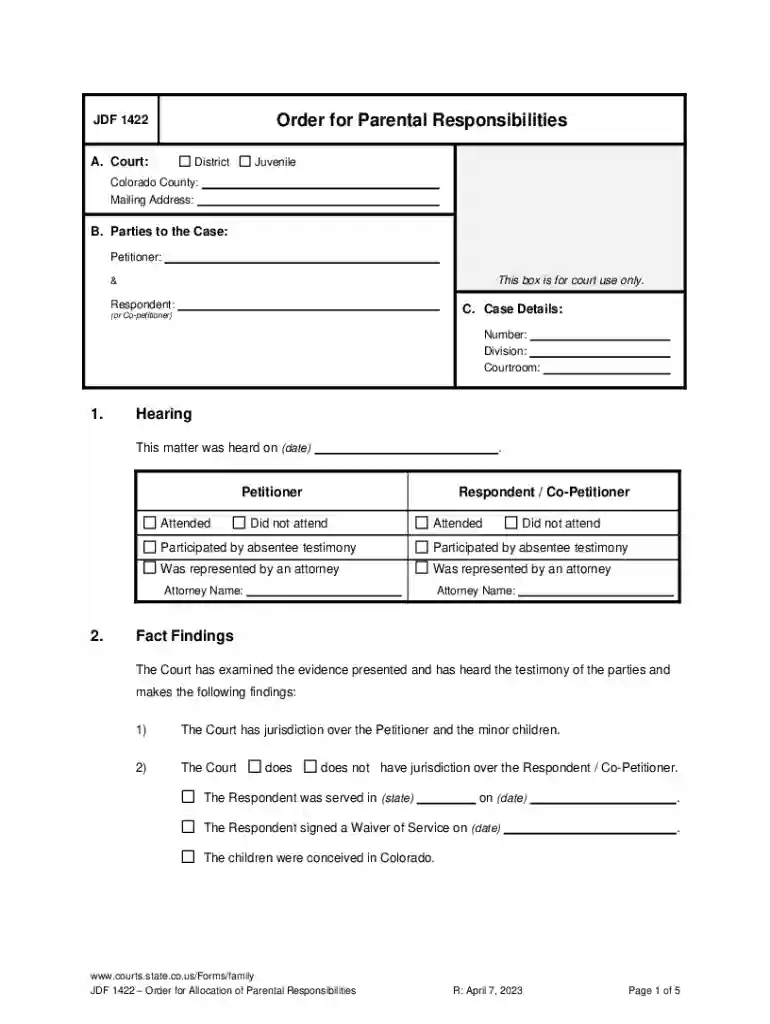
Order for Parental Responsibilities 2026

Get Form
Order for Parental Responsibilities Preview on Page 1

Here's how it works

01. Edit your form online
Type text, add images, blackout confidential details, add comments, highlights and more.

02. Sign it in a few clicks
Draw your signature, type it, upload its image, or use your mobile device as a signature pad.

03. Share your form with others
Send it via email, link, or fax. You can also download it, export it or print it out.

Definition & Meaning

The "Order for Parental Responsibilities" is a legal document issued by courts typically involved in custody or family law cases. This order outlines the allocation of responsibilities and rights concerning a child's upbringing. The core elements of this order include specifying who has the decision-making authority about the child’s education, health care, and general welfare, as well as the parenting time schedule, which determines when and where a child spends time with each parent.

Components of the Order

  • Decision-making responsibilities: Defines who will hold the authority to make significant decisions in the child’s life, which can be joint or sole to one parent.
  • Parenting time (custody): Schedules detailing when the child will stay with each parent, ensuring a balanced emotional development for the child.
  • Child support requirements: Includes financial obligations each parent must meet to provide for the child's basic needs.
  • Additional provisions: May include terms regarding communication between parents, allowable relocations, or restraining orders if necessary.

How to Use the Order for Parental Responsibilities

Using the "Order for Parental Responsibilities" involves understanding and adhering to the terms set forth in the document. This legal instrument becomes your guide in managing parental duties and rights.

Practical Implementation

  1. Reading and Interpreting: Ensure that you and potentially involved parties fully understand the outlined responsibilities and schedules.
  2. Adhering to Timelines: Follow the visitation or custody schedules as stipulated to avoid potential legal conflicts.
  3. Maintaining Communication: Use the order as a basis for discussions about any changes or adjustments needed, focusing on the child’s best interests.
  4. Documenting Compliance: Keep records of actions and decisions, as they might be needed in future legal proceedings or adjustments to the order.

Steps to Complete the Order for Parental Responsibilities

Filling out and completing the Order for Parental Responsibilities requires precision and attention to detail. This process ensures the document is legally binding and enforceable.

Step-by-Step Guide

  1. Gather Necessary Information: Collect all details about involved parties, including names, addresses, and the child’s information.
  2. Detail Decision-Making Protocols: Specify how decisions will be made regarding key aspects of the child’s life.
  3. Set Parenting Schedules: Work collaboratively to create a balanced visitation schedule, stipulating any exchange procedures.
  4. Identify Support Obligations: Clearly define who is responsible for child support and the mechanism for payment.
  5. Include Health Care Directives: Outline responsibilities for health care decisions and insurance provisions for the child.
  6. File with Appropriate Court: Submit the completed form to the appropriate family court for approval and legal validation.

Key Elements of the Order for Parental Responsibilities

Understanding the key elements of the order helps ensure compliance and effectiveness in protecting the child’s welfare.

Core Components

  • Jurisdiction: The specific court that has sanctioned the order, critical for any future modifications.
  • Parties Involved: Full details of child, parents, and others entitled to rights or responsibility.
  • Decision-Making Authorities: Statements about who will make what types of decisions, with joint or sole authority.
  • Support and Financial Duties: Clear financial obligations that each parent must fulfill.

Who Typically Uses the Order for Parental Responsibilities

The use of an Order for Parental Responsibilities is common among individuals involved in family law proceedings, notably in cases of divorce, separation, or custody disputes.


decoration image ratings of Dochub

Typical Users

  • Parents undergoing separation: To establish clear parenting roles and prevent conflicts.
  • Legal guardians or third parties: When involved in a child’s life as appointed by a court.
  • Mediators and family lawyers: To facilitate agreements and smooth transitions in family dynamics.

State-Specific Rules for the Order for Parental Responsibilities

While the fundamental purpose of the order remains consistent, specific rules can vary significantly from state to state, impacting how it is applied.

Variations Across States

  • Standardized Forms: Some states use unique templates that must be adhered to precisely.
  • Court Jurisdictional Rules: Variations in who enforces and interprets the order.
  • Filing Requirements: Differences in how orders are submitted and processed, as well as costs involved.

Legal Use of the Order for Parental Responsibilities

This order holds significant legal weight and can be enforced through court systems to protect children's best interests.

Juridical Significance

  • Enforceability: Provides a clear legal framework for parenting expectations.
  • Modification Process: Outlines legal avenues for modifications to the order if circumstances change.
  • Protection Ends: Offers a means of enforcement against non-compliance by either parent.

Important Terms Related to Order for Parental Responsibilities

Understanding crucial terms associated with this order facilitates better comprehension and smoother implementation.

Common Terminology

  • Custodial Parent: The parent with whom the child lives the majority of the time.
  • Non-custodial Parent: A parent with visitation rights as stipulated in the order.
  • Joint Custody: Shared responsibilities and decision-making between parents.
  • Sole Custody: One parent holds the majority or entirety of decision-making authority.
  • Parenting Plan: The schedule and guidelines established by the court for child-rearing.

By following these structured guidelines, individuals can effectively manage parental responsibilities as defined in legal terms to ensure children receive the appropriate care and attention they require.

be ready to get more

Complete this form in 5 minutes or less

Get form

Got questions?

We have answers to the most popular questions from our customers. If you can't find an answer to your question, please contact us.
Contact us
This could be shown in the form of having your name on the childs birth certificate, but it could also be a consent letter that has been signed and dated by the parent of the child.
Parental responsibilities can be allocated between each parent, dividing up which parents make which decisions about the child. For example, one parent might be allowed to make all the day-to-day decisions about the child, such as choosing after-school activities and making decisions about when to go to the doctor.
Under California law, parents are held responsible for the willful actions of their children under the age of 18 that result in injury, property damage, or even death. Each category has its own specific liability limit.
The Illinois Parental Responsibility Statute (740 ILCS 115/) is intended to hold parents legally accountable for certain actions of their children. Specifically, this statute outlines the financial and legal responsibilities that parents may bear if their child causes damage or harm.
The Duration of Parents Legal Obligations: The Basics In most states, parental obligations typically end when a child docHubes the age of majority, 18 years old. But, check the laws of your state, as the age of majority can be different from one state to the next.

Security and compliance

At DocHub, your data security is our priority. We follow HIPAA, SOC2, GDPR, and other standards, so you can work on your documents with confidence.
Learn more
ccpa2
pci-dss
gdpr-compliance
hipaa
soc-compliance
be ready to get more

Complete this form in 5 minutes or less

Get form

People also ask

In Illinois, an unmarried mother has sole custody of a child until paternity is legally established. Once paternity is confirmed by the court, custody rights are equal for both parents. The assumption is that both are fit to parent, so both will receive parenting time.

Related links