01. Edit your form online
Type text, add images, blackout confidential details, add comments, highlights and more.

Type text, add images, blackout confidential details, add comments, highlights and more.

Draw your signature, type it, upload its image, or use your mobile device as a signature pad.

Send it via email, link, or fax. You can also download it, export it or print it out.
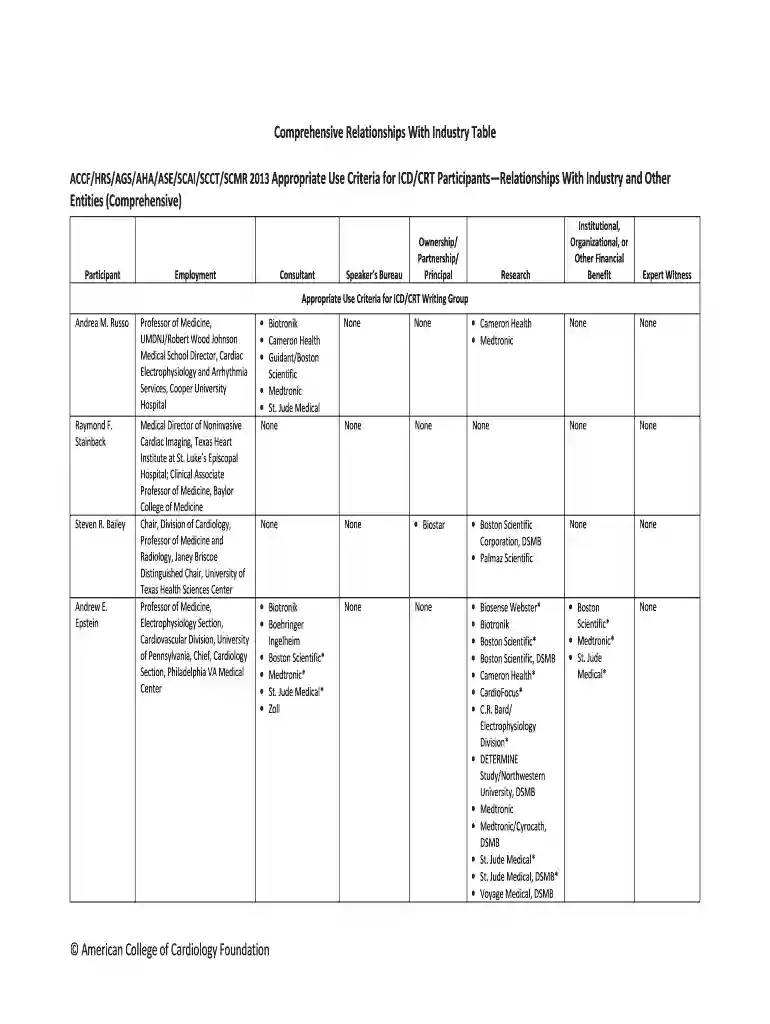
The Comprehensive Relationships With Industry Table ACCFHRS serves as a standardized framework aimed at clarifying the relationships between medical professionals and industries. This table is part of the documentation for the 2013 Appropriate Use Criteria for ICD/CRT and compiles critical information about the affiliations of participants, detailing aspects such as employment, consultancy roles, and financial interests. The goal is to provide transparency and prevent conflicts of interest in medical recommendations and industry partnerships.
To effectively utilize this table, first, understand the categories outlined within it. Each row corresponds to a different participant and delineates their affiliations with industries or other entities, whether through employment or consultancy. The categorization of relationships – whether significant or modest – is based on ownership stakes and income levels. Review each section carefully, ensuring a comprehensive understanding of how each participant's affiliations might impact their contributions to the medical criteria.
Completing the table involves compiling and organizing data that captures various affiliations accurately. Start by collecting comprehensive participant information — their organizational roles, consulting services, research ties, and any financial benefits from industry relationships.
The table includes several crucial elements necessary for conveying detailed information about industry relationships:
The legal framework governing the usage of this table emphasizes transparency and ethical standards in participant-industry relationships. As per U.S. regulations, it helps identify potential conflicts of interest. The data compiled in the table must be handled in compliance with privacy and confidentiality laws to protect the sensitive commercial and financial information disclosed by participants.
Primarily, the table is used by healthcare organizations, research institutions, and regulatory bodies to ensure transparency in guidelines and decision-making processes. Medical professionals and their support staff also rely on this documentation to uphold integrity and ethical standards in their professional engagements.


To accurately complete the table, gather several essential documents:
Utilization of this table is imperative for maintaining the integrity of Clinical practice guidelines. It helps identify potential biases that could arise from commercial influences. For the end user, including regulatory agencies and medical institutions, it provides a clear view of possible conflicts, ensuring that medical guidelines remain unbiased and patient-centered.
We've got more versions of the Comprehensive Relationships With Industry Table ACCFHRS form. Select the right Comprehensive Relationships With Industry Table ACCFHRS version from the list and start editing it straight away!
| Versions | Form popularity | Fillable & printable |
|---|---|---|
| 2013 | 4.9 Satisfied (60 Votes) |
At DocHub, your data security is our priority. We follow HIPAA, SOC2, GDPR, and other standards, so you can work on your documents with confidence.