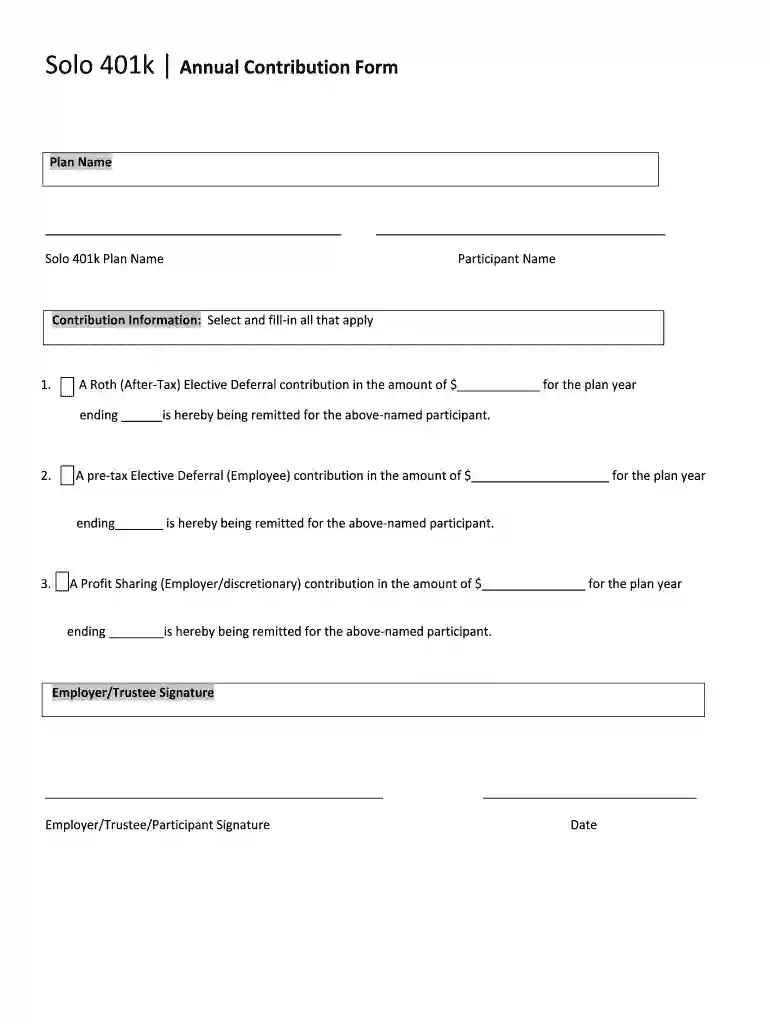
Solo 401k Contribution Form 2026

Get Form
Solo 401k Contribution Form Preview on Page 1

Here's how it works

01. Edit your form online
Type text, add images, blackout confidential details, add comments, highlights and more.

02. Sign it in a few clicks
Draw your signature, type it, upload its image, or use your mobile device as a signature pad.

03. Share your form with others
Send it via email, link, or fax. You can also download it, export it or print it out.

Definition & Meaning

The Solo 401k Contribution Form is a critical document used by individuals with Solo 401k plans to specify their annual contributions. It caters to self-employed individuals or small business owners without full-time employees, except for a spouse. This form encompasses various aspects of the plan, allowing participants to enter details such as Roth and pre-tax elective deferrals and profit-sharing contributions.

The significance of this form lies in its role in facilitating the management of permissible contributions to the Solo 401k plan, ensuring compliance with tax regulations while maximizing retirement savings. It provides a structured framework for recording contributions, serving as an essential part of tax documentation and financial planning.

How to Use the Solo 401k Contribution Form

To accurately utilize the Solo 401k Contribution Form, follow these steps. Begin by ensuring the form is up-to-date and adheres to current IRS guidelines. Next, identify the contribution type — Roth, pre-tax, or profit-sharing — that aligns with your retirement strategy. Enter the participant's details, including name and employment data, to establish identification.

Calculate your contributions based on the eligible percentage of your earnings. For pre-tax and Roth, evaluate the contributions allowed up to the IRS maximum for the year. Ensure accurate calculation by considering current income levels and prior contributions. Then, input your data into the appropriate fields on the form. Confirm all figures twice for accuracy, especially ensuring that total contributions do not exceed the allowable limits. After verification, keep a copy for personal records and submit it according to the specified procedures.

Steps to Complete the Solo 401k Contribution Form

  1. Gather Required Information:

    • Collect personal information, including your name, address, and plan details.
    • Ensure access to recent financial records for accurate income figures.
  2. Determine Contribution Type:

    • Elect between Roth contributions for after-tax, tax-free growth, or pre-tax for a current year tax deduction.
  3. Calculate Maximum Contributions:

    • Use current IRS limits to guide your annual maximum contribution, which considers your self-employment income.
  4. Fill Out the Form:

    • Insert all relevant data, paying extra attention to accuracy, in their designated sections on the form.
  5. Review the Form:

    • Cross-check all entries with your records for consistency and compliance with current guidelines.
  6. Submit the Form:

    • Send through the designated channel, whether digitally via an integrated tool, by mail, or through a secure platform.

Key Elements of the Solo 401k Contribution Form

  • Participant Information:

    • Details like name and SSN for identification.
  • Contribution Breakdown:

    • Fields for specifying Roth contributions, employer matches, and profit-sharing allocations.
  • Signatures:

    • Signature space for the participant and possibly the plan trustee or employer to confirm authenticity.
  • Certification Statement:

    • A declaration confirming the accuracy and adherence to contribution limits.

Important Terms Related to the Solo 401k Contribution Form

  • Elective Deferral: The amount a participant chooses to direct from their salary into the 401k plan.
  • Roth Contribution: After-tax contribution allowing for tax-free growth.
  • Pre-tax Contribution: Deduction reducing current taxable income.
  • Profit-Sharing Contribution: Employer contributions subject to plan terms, maximizing retirement benefits.
  • Contribution Limit: The IRS-set cap on annual contributions.

IRS Guidelines

The IRS guidelines dictate the implementation of contribution limits and deadlines that affect Solo 401k plans. Participants must align with these regulations to hold the tax-advantaged status of contributions. For 2023, the limit is set at $66,000 for those under the age of 50. Abiding by these limits is critical for maintaining compliance and avoiding penalties.

Furthermore, IRS guidelines specify the tax treatment for different contribution types, demanding accurate categorization and record-keeping within the Solo 401k Contribution Form to ensure seamless reporting and audits.

Filing Deadlines / Important Dates

  • Contribution Submission Deadline:

    • Deferrals and contributions must comply with the IRS deadlines, typically December 31 for elective deferrals.
  • Correction Window:

    • Adjustments to contributions are permissible within IRS-specified windows after the fiscal year ends if discrepancies are identified.
  • Annual Form Revisions:

    • Ensuring use of the most current form iteration by the start of a new calendar year for accuracy.

Form Submission Methods

  • Digital Submission:

    • Many platforms, including DocHub, facilitate a seamless online submission, ensuring immediate processing.
  • Mail:

    • Traditional mailing offers an alternative, although ensuring the postal service meets deadlines is crucial.
  • In-Person:

    • Less common, but possible with financial advisors or plan administrators directly servicing Solo 401k plans.
be ready to get more

Complete this form in 5 minutes or less

Get form

Got questions?

We have answers to the most popular questions from our customers. If you can't find an answer to your question, please contact us.
Contact us
Elective Deferrals The IRS allows you to funnel up to 100% of earned income into your solo 401(k) on a pre-tax or Roth basis up to the annual contribution limits for 401(k)s and similar accounts. In 2025, the IRS permits you to save up to $23,500 in a 401(k) and $31,000 if youre age 50 or older.
A one-participant 401(k) plan is generally required to file an annual report on Form 5500-EZ if it has $250,000 or more in assets at the end of the year. A one-participant plan with fewer assets may be exempt from the annual filing requirement.
Solo 401(k) Cons In order to qualify for a Solo 401(k), you cannot have any employees (other than your spouse), so if you have employees or want to have employees in the future, this plan is not for you.
You can fund your Individual 401(k) as both the employer and the employee. - Employer Contribution Limit: Elective annual profit-sharing contributions of up to 25% of your compensation or 20% of your net self-employment income. - Employee Contribution Limit: Elective salary deferral plus catch-up contributions.
Report your total contributions on line 16 of Schedule 1 (Form 1040), which is then attached to your Form 1040. Self-employed taxpayers report contributions to retirement plans, including SEP, SIMPLE, and solo 401(k)s, on line 16 of Schedule 1 (Form 1040).

Security and compliance

At DocHub, your data security is our priority. We follow HIPAA, SOC2, GDPR, and other standards, so you can work on your documents with confidence.
Learn more
ccpa2
pci-dss
gdpr-compliance
hipaa
soc-compliance

People also ask

Contributions to a Solo 401k must come from earned income directly tied to your business or self-employment activity. Eligible income includes business income, W-2 wages or salary you pay yourself from the business, profit-sharing income, and tips or commissions earned through the business.

Related links