
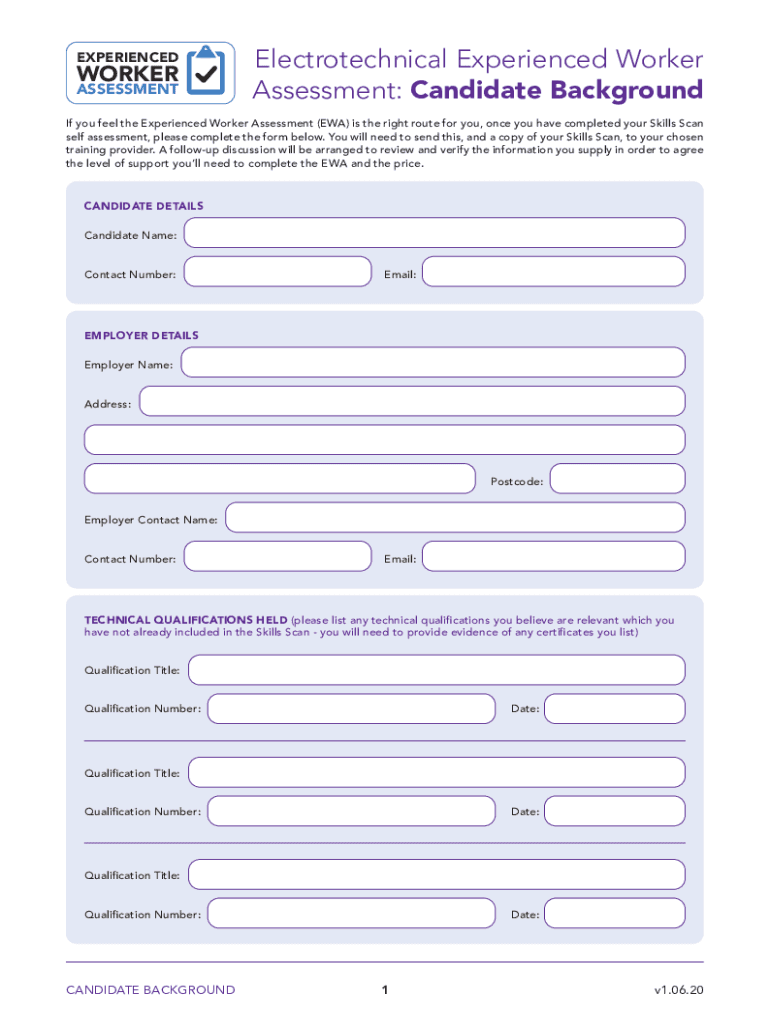







Definition and Purpose of the Electrotechnical Experienced Worker Assessment
The Electrotechnical Experienced Worker Assessment (EWA) is designed for professionals in the electrotechnical field who wish to demonstrate their expertise and experience. This assessment forms part of a certification process that recognizes a worker's competence and experience in electrical installation work, often required to qualify for further training or credentials. The EWA serves as a structured process to verify that candidates possess the necessary skill set required for advanced roles in the industry. It evaluates various aspects of a worker's experience, qualifications, and technical understanding, ensuring that they meet established standards in the electrotechnical industry.
Eligibility Criteria for Electrotechnical Experienced Worker Assessment
Eligibility to undertake the Electrotechnical Experienced Worker Assessment usually requires a specific set of professional criteria. Candidates typically must demonstrate significant experience in the electrical field, which may include years of practical work history, completion of certain training programs, and possession of relevant technical qualifications. Many providers also require candidates to complete a preliminary Skills Scan to assess baseline competencies. Employers may play a role in verifying the candidate's work history, often by providing employer attestations or endorsements as part of the application process.


Steps to Complete the Electrotechnical Experienced Worker Assessment
-
Initial Application: Candidates begin by completing an application form, which includes personal details and proof of electrotechnical experience and qualifications.
-
Skills Scan: This step involves a self-assessment and a review by a training provider or assessor to confirm that the candidate is ready for the assessment.
-
Submission of Supporting Documents: Candidates must gather and submit documentation such as certificates of qualifications, detailed work history, and employer references to support their application.
-
Assessment Process: The assessment typically involves practical and theoretical evaluations where candidates are tested on their technical skills, problem-solving abilities, and compliance with industry standards.
-
Feedback and Result: Upon completion, candidates receive feedback on their performance. Successful candidates may gain certification or qualify for more advanced roles.
Required Documents for the Electrotechnical Experienced Worker Assessment
-
Proof of Identity: Government-issued identification such as a driver's license or passport.
-
Technical Qualifications: Certificates or transcripts evidencing completed courses or qualifications in the electrotechnical field.
-
Work Experience Documentation: Detailed resumes, employment letters, and any official documentation verifying work history in electrotechnical roles.
-
Employer Endorsements: Letters or forms completed by current or past employers attesting to the candidate's experience and competencies.
Key Elements of the Electrotechnical Experienced Worker Assessment
The major components evaluated during the Electrotechnical Experienced Worker Assessment include:
-
Technical Skills: Candidates must demonstrate their ability to safely and correctly install, maintain, and repair electrical systems.
-
Compliance Knowledge: Understanding of relevant safety standards, building codes, and regulations governing electrical work.
-
Problem-Solving Abilities: The capacity to troubleshoot and resolve complex electrical issues efficiently and effectively.
-
Professionalism and Communication: Evaluations may assess how well candidates communicate technical information to team members and clients.
How to Use the Electrotechnical Experienced Worker Assessment
The assessment can be utilized by candidates aiming to highlight their technical proficiency and readiness for advanced positions within the electrotechnical sector. Training providers and employers often use this assessment as a benchmark to evaluate the competencies of their workforce. Candidates can leverage their assessment results to pursue career advancements, qualify for higher-level certifications, or meet employment criteria for certain roles within the industry.
Examples of Using the Electrotechnical Experienced Worker Assessment
-
Career Advancement: A technician uses the EWA to prove their eligibility for a senior electrician position, accessing new professional opportunities.
-
Training Qualification: A candidate completes the EWA to qualify for a specialized training program, enabling them to expand their skillset in emerging technologies.
-
Recognition of Competency: An experienced electrician uses the assessment to formalize and recognize their expertise when transitioning from a contractor role to a full-time employee.
Digital vs. Paper Version of the Electrotechnical Experienced Worker Assessment
The assessment may be available in both digital and paper formats, depending on the administering organization. Digital assessments facilitate easier submission and feedback processes, offering candidates the ability to upload documents and complete certain components online. Paper versions might still be necessary in regions or situations where digital submission is impractical. Candidates should check with the specific body offering the EWA to determine the available formats and select the method that best suits their needs.




