Transfer on Death Affidavit 2026

Get Form
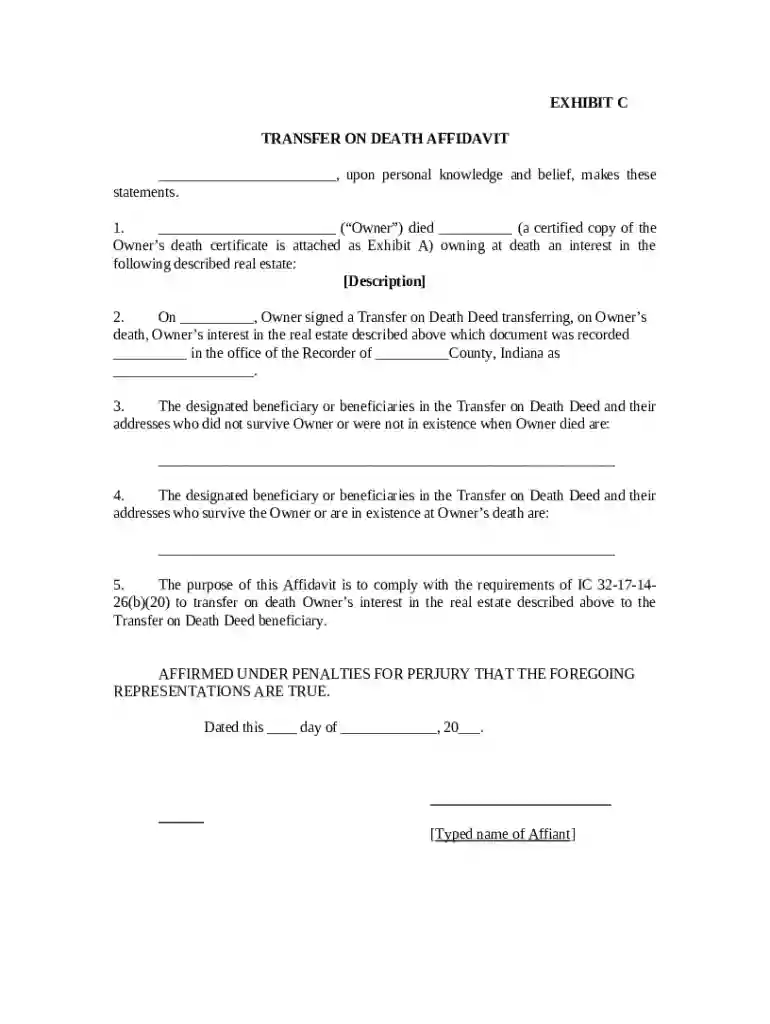
Transfer on Death Affidavit Preview on Page 1

Here's how it works

01. Edit your form online
Type text, add images, blackout confidential details, add comments, highlights and more.

02. Sign it in a few clicks
Draw your signature, type it, upload its image, or use your mobile device as a signature pad.

03. Share your form with others
Send it via email, link, or fax. You can also download it, export it or print it out.

Definition & Meaning

A Transfer on Death Affidavit is a legal document that facilitates the transfer of real estate ownership upon the death of an individual, commonly known as the "Owner." This affidavit is tied to a Transfer on Death Deed, which should have been recorded prior to the Owner's passing. It serves as a declaration that identifies the beneficiaries, ensuring they meet all legal requirements for property transfer without the need for probate proceedings. The affidavit confirms the Owner's death, the validity of the Transfer on Death Deed, and the beneficiaries entitled to the property.

Steps to Complete the Transfer on Death Affidavit

  1. Obtain the Required Form: Begin by acquiring the appropriate Transfer on Death Affidavit form from a reliable source, such as a legal website or a local government office. Ensure it is the correct version for your state, as requirements may vary.

  2. Gather Necessary Information: Collect all pertinent information about the Owner, the property, and the designated beneficiaries. This includes the property's address, deed number, and details of the Owner's death certificate.

  3. Fill Out the Affidavit Form: Complete the form by entering accurate details about the Owner, the property, and the beneficiaries. Ensure all fields are filled, as incomplete forms might lead to delays.

  4. Include Supporting Documents: Attach a copy of the Owner's death certificate and the recorded Transfer on Death Deed. These documents validate the transfer and confirm the Owner's passing.

  5. Notarize the Affidavit: Have the affidavit notarized by a registered notary public. This step officially authenticates the document, making it legally binding.

  6. File with the County Recorder: Submit the completed and notarized affidavit, along with any supporting documents, to the county recorder's office where the property is located. This final step ensures the property's title is updated to reflect the new ownership.

Who Typically Uses the Transfer on Death Affidavit

The Transfer on Death Affidavit is commonly used by:

  • Individual Property Owners: Those wishing to simplify the process of transferring real estate to their heirs upon death.
  • Estate Planners and Attorneys: Professionals advising clients on minimizing probate costs and ensuring smooth property transfers.
  • Executors and Administrators: Individuals managing the deceased's estate who require documentation to fulfill their duties efficiently and legally.
decoration image ratings of Dochub

Key Elements of the Transfer on Death Affidavit

  • Owner and Beneficiary Details: Accurate information about the Owner and intended beneficiaries is crucial for the document's validity.
  • Property Description: A precise description of the real estate involved in the transfer, including its legal address and any relevant deed information.
  • Owner's Death Details: Verification of the Owner's passing with an official death certificate is necessary for the transfer process.
  • Signatures and Notarization: Signatures of the involved parties, validated by a notary public, ensure the affidavit's authenticity.

Legal Use of the Transfer on Death Affidavit

The affidavit ensures a legally compliant transition of property ownership, bypassing the lengthy probate process. By adhering to the legal requirements, beneficiaries can quickly establish ownership rights, minimizing potential conflicts or claims against the estate. The affidavit is recognized in states that allow Transfer on Death Deeds, underlining its importance for effective estate planning.

State-Specific Rules for the Transfer on Death Affidavit

Each state has its regulations governing the use of Transfer on Death Affidavits:

  • Eligibility Criteria: States may have specific eligibility requirements for Owners and beneficiaries.
  • Filing Procedures: Variations in filing procedures and documentation requirements can occur.
  • Legal Recognition: Not all U.S. states recognize the Transfer on Death Affidavit. Consult local laws to confirm applicability.

Examples of Using the Transfer on Death Affidavit

  • Scenario 1: A widowed parent with a single property in Arizona uses the affidavit to ensure their child inherits the home seamlessly without probate involvement.
  • Scenario 2: An estate planner advises a couple in Ohio to file a Transfer on Death Affidavit for their vacation property to prevent delays in ownership transfer to their grandchildren.
  • Scenario 3: An executor in Kansas encounters multiple real estate assets as part of an estate. Using the affidavit simplifies the asset distribution process among multiple heirs.

Important Terms Related to Transfer on Death Affidavit

  • Transfer on Death Deed: A legal document recorded before the Owner's death, specifying the property transfer to beneficiaries.
  • Beneficiary: The individual or entity designated to receive the property upon the Owner's death.
  • Notary Public: An official who verifies the authenticity of signatures, ensuring the legality of the document.
  • Probate: The legal process of validating a will, often bypassed by using a Transfer on Death Affidavit.

Required Documents for the Transfer on Death Affidavit

  • Death Certificate: Provides official confirmation of the Owner's passing, a necessity for legal validation.
  • Recorded Transfer on Death Deed: Confirms the property's intended transfer upon the Owner's death.
  • Affidavit Form: Properly filled and notarized, serving as the primary document for executing the property transfer.

This comprehensive coverage ensures readers understand the importance, process, and ramifications of using a Transfer on Death Affidavit, providing valuable insights into its utility and implementation.

be ready to get more

Complete this form in 5 minutes or less

Get form

Got questions?

We have answers to the most popular questions from our customers. If you can't find an answer to your question, please contact us.
Contact us
A Transfer on Death (TOD) is a legal document that can transfer your home without a will. This means that your home will not have to go through the probate court. Going through the probate court can cost your loved ones time and money after you are gone.
Any assets held in a TOD account are included as part of the owners taxable estate. As described above, this means that these assets could make the estate subject to estate taxes.
A valid Affidavit of Death requires the affiant to have personal knowledge of the deceased. Detailed identification of the deceased, the affiants relationship with them, and the reason for the affidavits execution should be clearly stated. Validation from a Notary Public is essential to docHub its legality.
Designated beneficiaries receive the funds without having to wait for probate to conclude, which can take months. A POD or TOD account allows loved ones to get money almost immediately. Typically, all they need to provide is the death certificate and identification to the account-holding institution.
A Transfer on Death (TOD) is a legal document that can transfer your home without a will. This means that your home will not have to go through the probate court.

Security and compliance

At DocHub, your data security is our priority. We follow HIPAA, SOC2, GDPR, and other standards, so you can work on your documents with confidence.
Learn more
ccpa2
pci-dss
gdpr-compliance
hipaa
soc-compliance

People also ask

If youre thinking about ways to keep your home out of probate, and TOD deeds are an available option in your state, they are well worth considering. Unless you have a complex situation or have specific concerns, you likely wont need a lawyer to create a TOD deed.
TOD Deeds Open the Door to Unintended Consequences Without careful coordination, TOD deeds can also disinherit heirs you intended to provide for, result in unnecessary taxes, complicate matters for a surviving spouse, or cause other negative ripple effects. Once recorded, the deed is very difficult to undo.

Related links