




01. Edit your form online
Type text, add images, blackout confidential details, add comments, highlights and more.

Type text, add images, blackout confidential details, add comments, highlights and more.

Draw your signature, type it, upload its image, or use your mobile device as a signature pad.

Send it via email, link, or fax. You can also download it, export it or print it out.
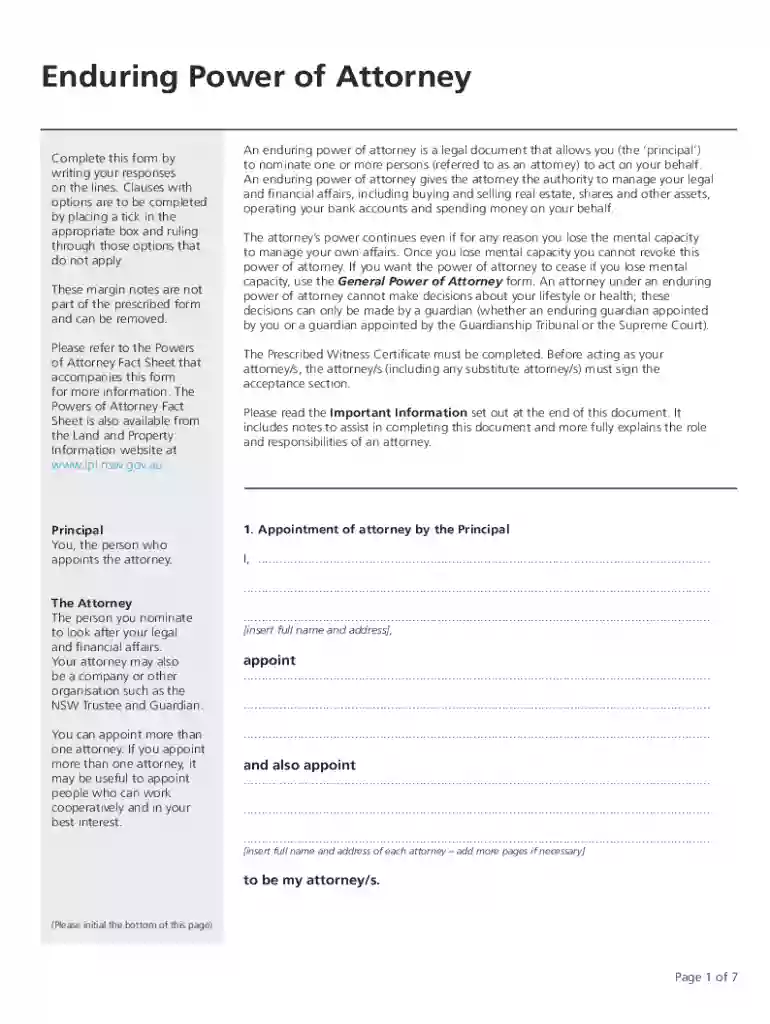
The Enduring Power of Attorney (EPA) form is a legal document that allows an individual, known as the principal, to appoint another person, called the attorney, to manage their financial and legal matters. This form is essential for individuals who wish to ensure their affairs are handled according to their preferences, particularly in the event that they lose mental capacity.
The EPA form contains several crucial components that must be completed accurately to ensure its effectiveness:
Principal and Attorney Details: This section requires the full legal names, addresses, and contact information of the principal and the appointed attorney(s). It's essential to identify clearly who is involved to avoid any future disputes.
Powers Granted: The document delineates the specific powers the principal is granting to the attorney, including handling bank transactions, managing real estate, and representing the principal in financial matters.
Limitations and Conditions: Principals can impose limitations on the attorney’s powers, such as restricting the sale of certain assets. This section is crucial for maintaining control over critical aspects of the principal’s affairs.
To effectively utilize the EPA form, it must be completed with attention to legal and procedural details:
Understand Legal Requirements: Before completing the form, familiarize yourself with the legal prerequisites in your state, as they can vary significantly.
Choose a Trustworthy Attorney: Select someone who is not only capable but also has the principal’s best interests at heart.
Complete the Form: Fill in all necessary information, keeping clarity and legibility in mind.
Legal Execution: The form typically requires signing in the presence of a notary public or witnesses, depending on state-specific laws.
Access to the EPA form can be found through various channels:
Online Resources: Many legal websites and state government portals offer downloadable versions of the form. Ensure the version accessed is compliant with your state's regulations.
Legal Offices: Visiting a legal professional, such as an attorney specializing in estate planning, ensures you receive the correct form and guidance specific to your needs.
Completing the EPA form involves several detailed steps, ensuring each section is filled accurately to withstand legal scrutiny:
Fill Out Personal Information: Start with the principal and attorney details, ensuring all provided information is current and precise.
Specify the Powers: Clearly mark which powers you wish to grant to your attorney, making use of any templates or guidance notes if available.
Consider Limitations: If desired, define any specific constraints on the attorney’s authority, considering future scenarios and personal preferences.
Sign and Witness: Execute the form in the presence of required witnesses or a notary public to validate the document legally.
When correctly executed, the EPA form allows for legitimate management and decision-making on behalf of the principal, respected across jurisdictions:
Decision Implementation: Attorneys can act on the principal's behalf to manage transactions and legal affairs as delineated.
Safeguard for Incompetency: It remains valid even if the principal becomes mentally incapacitated, providing continuity in affairs management.
State laws can significantly influence the execution and acceptance of the EPA form:
Execution Requirements: Some states mandate notarization, while others require witnesses. Familiarize yourself with your state’s regulations.
Revocation and Amendments: Different states have distinctive rules for revoking or amending an EPA, requiring a legal understanding of local procedures.
Real-life applications demonstrate the flexibility and necessity of an EPA:
Medical Emergencies: In cases where a principal suffers a sudden medical incapacity, an EPA allows the attorney to make critical financial decisions without legal obstacles.
Elderly Care: As an individual ages, having a trusted attorney can ensure their financial responsibilities are managed smoothly, avoiding potential exploitation or mismanagement.
Differing laws and requirements across states make understanding local nuances crucial when preparing an EPA:
Witness and Notary Variations: Some states may have unique witnessing requirements, or demand specific notary attestations that others do not.
Powers and Restrictions: States may have diverse regulations about what powers can be granted or any inherently restricted actions for attorneys.
Understanding these critical components and steps provides a comprehensive foundation for executing an Enduring Power of Attorney form, ensuring your interests remain protected and your wishes respected.
We've got more versions of the Enduring Power of Attorney form Enduring Power of Attorney form form. Select the right Enduring Power of Attorney form Enduring Power of Attorney form version from the list and start editing it straight away!
At DocHub, your data security is our priority. We follow HIPAA, SOC2, GDPR, and other standards, so you can work on your documents with confidence.
Jul 10, 2026 This statutory durable power of attorney form is available from the Texas Department of Health and Human Services in English and in Spanish.
This section creates the Power of Attorney and sets forth that you are authorizing another to act on your behalf.
This is a Blank or Common Durable POA Form which can be used in all States, provided your state does not require you to have a specific durable power ofRead more


