







Definition & Meaning
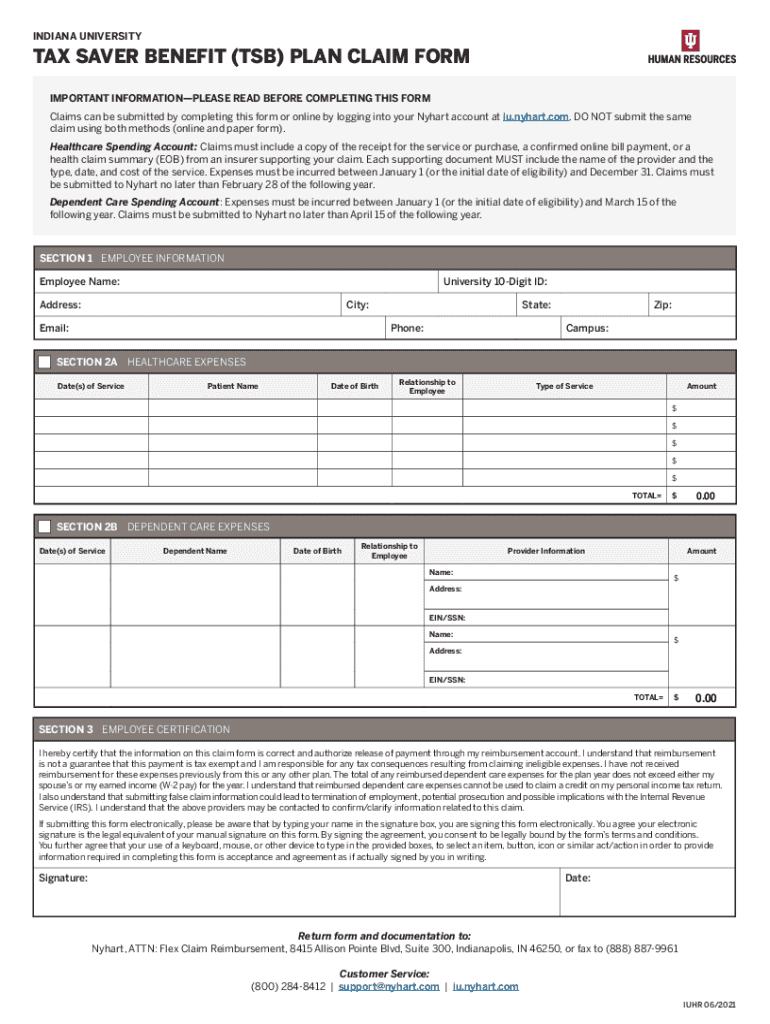
The IU Tax Saver Benefit (TSB) Plan Claim Form is an essential document for employees at Indiana University. It is used to submit claims for reimbursement of eligible healthcare and dependent care expenses under the Tax Saver Benefit Plan. This form ensures that employees can get reimbursed for out-of-pocket expenses in alignment with the plan's guidelines. The IU TSB Plan is designed to provide tax advantages by reducing an individual's taxable income, as the contributions towards these expenses are pre-tax.
Steps to Complete the IU Tax Saver Benefit (TSB) Plan Claim Form
-
Gather Required Documentation:
- Collect receipts or documentation that detail the eligible expenses incurred. Ensure they include the date, type of service, and amounts paid.
-
Fill Out Personal Information:
- Enter personal details such as your name, employee ID, and contact information to accurately identify your submission.
-
Detail the Expenses:
- List each expense separately, providing the date of service, provider, type of service, and amount. Be thorough to ensure all claimed expenses are eligible.
-
Attach Documentation:
- Securely attach all related receipts and documentation. This step is crucial to substantiate your claim and facilitate the processing of your reimbursement.
-
Sign the Certification:
- Complete any certifications required by the form, which may include acknowledging the accuracy of your claims and compliance with tax regulations.
-
Submit the Form:
- Follow the outlined submission process, which may include mailing, physical submission, or using the university’s designated digital platform.
Required Documents
-
Proof of Service:
- Receipts from healthcare providers or daycare services.
- Invoices or statements showing amounts paid.
-
Proof of Payment:
- Bank or credit card statements highlighting the transactions.
- Canceled checks may be required as additional verification.
-
Any additional forms:
- If applicable, submit any additional dependent verification forms or special provider forms requested.
IRS Guidelines
The IU Tax Saver Benefit (TSB) Plan Claim Form must comply with IRS guidelines under Section 125 plans, which govern flexible spending accounts (FSAs). Expenses claimed must be eligible under IRS definitions, typically including but not limited to medical, dental, vision, and dependent care expenses that are not covered by an insurance plan. Employees must adhere to IRS rules regarding maximum contributions and eligible expense definitions to maintain the tax advantages of the plan.
How to Obtain the IU Tax Saver Benefit (TSB) Plan Claim Form
-
Online Access:
- Download the form directly from Indiana University's official HR or benefits webpage. This is the most convenient way to access the most current version of the form.
-
Request through HR:
- Contact your HR department to request a physical copy or obtain guidance on where to find the form within the university's resources.
-
Campus Resources:
- Visit designated university offices, such as the benefits or payroll office, where printed copies may be readily available for employees.
Key Elements of the IU Tax Saver Benefit (TSB) Plan Claim Form
-
Employee Information Section:
- Includes fields for essential identification details, ensuring accurate processing.
-
Expense Documentation Section:
- Designated area for itemizing expenses, crucial for the validation of claims. Must be completed thoroughly.
-
Certification Statement:
- A mandatory compliance section where the claimant certifies the accuracy of the information and adherence to relevant guidelines.
-
Submission Instructions:
- Clearly outlined methods for form submission, critical for timely processing of reimbursement claims.
Filing Deadlines / Important Dates
-
Plan Year Cut-off:
- Generally aligns with the fiscal year. Ensure claims are submitted by the plan-specific cut-off date to avoid missing out on eligible reimbursements.
-
Grace Period:
- Many plans offer a grace period post year-end for submitting claims related to the previous year. Verify with Indiana University's specific deadline extensions.
-
Submission Timeline:
- Be aware of any mid-year cut-off dates for ongoing expenses and periodic submission intervals, often dictating eligibility for interim or annual reimbursements.
Form Submission Methods
-
Online Submission:
- Preferred for its convenience and efficiency. Utilize any online portals or systems provided by Indiana University to streamline the submission.
-
Mail Submission:
- When necessary, completed forms and related documentation can be mailed to the designated benefits office address.
-
In-Person Submission:
- Deliver the completed form directly to the HR or benefits office to ensure immediate receipt and processing, especially for urgent claims.
Penalties for Non-Compliance
-
Denial of Claims:
- Claims submitted outside prescribed guidelines, incomplete, or lacking proper documentation may be denied.
-
Tax Implications:
- Failure to comply with IRS rules can lead to the loss of tax benefits, and improper claims might trigger audits or tax penalties.
-
Reimbursement Delays:
- Incorrect claims or those missing the deadlines can result in delays, affecting timely access to funds.




