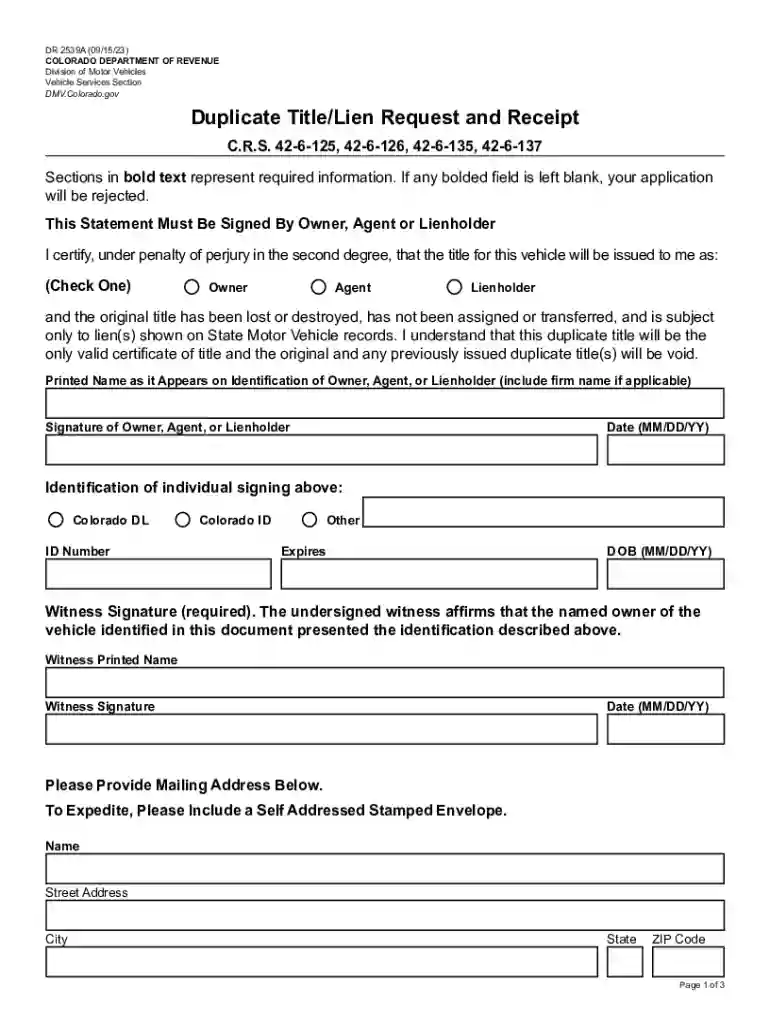
DR 2539A Duplicate Title Lien Request and Receipt If you are using a screen reader or other assistiv 2026

Get Form
DR 2539A Duplicate Title Lien Request and Receipt If you are using a screen reader or other assistiv Preview on Page 1

Here's how it works

01. Edit your form online
Type text, add images, blackout confidential details, add comments, highlights and more.

02. Sign it in a few clicks
Draw your signature, type it, upload its image, or use your mobile device as a signature pad.

03. Share your form with others
Send it via email, link, or fax. You can also download it, export it or print it out.

Definition & Meaning

The DR 2539A Duplicate Title Lien Request and Receipt is a specific form issued by the Colorado Department of Revenue. It serves the purpose of officially requesting a duplicate vehicle title or a lien release. This form is a critical document for vehicle owners or lienholders who need to obtain a replacement for a lost, damaged, or otherwise unavailable vehicle title. The form outlines the procedures and necessary information required for processing these requests effectively.

How to Use the DR 2539A Form

Utilizing the DR 2539A form is straightforward but demands careful attention to detail. Users should:

  1. Download or Obtain the Form: Access the form online or through designated Colorado Department of Revenue offices.
  2. Review Instructions: Carefully read all instructions provided with the form to ensure accurate completion.
  3. Fill Out Required Sections: Complete all mandatory fields, including vehicle details, owner information, and lienholder data if applicable.
  4. Double-Check Information: Ensure that every section is completed accurately to avoid rejection.
  5. Sign and Date the Form: Provide the necessary signatures from vehicle owners or authorized agents.

Failure to adhere to these steps can result in delays or application denials.

Obtaining the DR 2539A Form

To get the DR 2539A form, individuals have a few options:

  • Online Access: Visit the official Colorado Department of Revenue website to download the form. This option provides instant access and the ability to print directly from a computer.
  • In-Person Requests: Visit a local DMV or Department of Revenue office to collect a physical copy. This is suitable for those who prefer assistance with any questions.
  • Mail Requests: Written request for a mailed paper form is also possible, although slower.

Steps to Complete the DR 2539A Form

Completing the DR 2539A requires meticulous attention to specifics:

  1. Gather Necessary Information: Collect all vehicle identification details, owner information, and lienholder data before starting.
  2. Identify the Type of Request: Clearly specify whether the request is for a duplicate title or a lien release.
  3. Complete Each Section: Address all required sections without leaving blanks unless instructed otherwise.
  4. Provide Documentation: Attach any necessary supporting documents, such as identification or proof of ownership.
  5. Submit the Form: Follow submission guidelines for mail-in or electronic delivery, as outlined in the form’s instructions.

Ensuring each step is followed accurately reduces the risk of procedural errors.

Who Typically Uses the DR 2539A Form

The DR 2539A form is primarily used by:

  • Vehicle Owners: Individuals needing a replacement for a lost or damaged vehicle title.
  • Lienholders: Financial institutions or lienholders requiring a lien release for completed payments or transfers.
  • Authorized Agents: Representatives acting on behalf of vehicle owners or lienholders to facilitate title management.

Understanding who uses this form aids in identifying the necessary procedures specific to each user type.


decoration image ratings of Dochub

Important Terms Related to the DR 2539A Form

Understanding the terminology associated with the DR 2539A form is crucial for correct completion. Key terms include:

  • Duplicate Title: A replacement for the original vehicle title when the original is unavailable.
  • Lien Release: The formal removal of a lien claim on a vehicle, usually after the debt is repaid.
  • Owner Signature: The vehicle owner's authorization acknowledging consent for form submission.
  • Agent Authorization: Permission for an appointed representative to act on the owner’s or lienholder's behalf.

Familiarity with these terms helps users navigate the form more effectively.

Key Elements of the DR 2539A Form

The DR 2539A form contains several critical elements:

  • Owner Information: Includes name, address, and contact details of the vehicle owner.
  • Vehicle Description: Details specific to the vehicle such as VIN, make, model, and year.
  • Lienholder Information: Data on any entity holding a lien against the vehicle, including contact details.
  • Reason for Duplicate Title: An explanation of why a duplicate is essential, such as loss or damage.

Accurate completion of each element is essential for form acceptance.

State-Specific Rules for the DR 2539A Form

Understanding state-specific rules in Colorado is crucial when completing the form. Key points include:

  • Identification Requirements: Submission of valid ID to authenticate the requestor.
  • Fee Structure: Payment of designated fees as outlined by the Colorado Department of Revenue.
  • Submission Procedures: Following precise instructions for document submission, whether by mail or in-person.

Adhering to these rules ensures alignment with legal and procedural standards in Colorado.

be ready to get more

Complete this form in 5 minutes or less

Get form

Got questions?

We have answers to the most popular questions from our customers. If you can't find an answer to your question, please contact us.
Contact us
In Colorado, both the buyer and seller do not need to be present to transfer a car title, but the title must include all required signatures from the seller, buyer, and any lienholders.
A lien is a claim on property to ensure payment of a debt. When you borrow money to purchase a car, the lender files a lien on the vehicle with the state to insure that if the loan defaults, the lender can take the car. When the debt is fully repaid, a release of the lien is provided by the lender.
Once youve paid off your car loan in full, the lender also called the lienholder should contact your local Department of Motor Vehicles (DMV) to release the lien. Once the lien is released, they relinquish their right to repossess your car.
How do you get a lien removed from a car title? Once your car loan is completely paid off, obtain a car title lien release from your lender so your state BMV or DMV can put the car title in your name.
You have to request lien release documentation from your bank or whoever you had the loan through. You will then take that paperwork to the DMV and they will file it for you and remove the lien.

Security and compliance

At DocHub, your data security is our priority. We follow HIPAA, SOC2, GDPR, and other standards, so you can work on your documents with confidence.
Learn more
ccpa2
pci-dss
gdpr-compliance
hipaa
soc-compliance
be ready to get more

Complete this form in 5 minutes or less

Get form

People also ask

For liens filed in Colorado: The lienholder on the title itself must sign the lien release or may be released on a separate lien release letter. The name of the lienholder on the letter must match the name of the lienholder printed on the face of the title.
For most Americans, your lender will possess the title for the duration of the loan. When your loan is paid off, your lender will send the lien release to the DMV. The DMV or other state office will then send the updated title to you. This process can take longer than in a title-holding state.
Once you have the vehicle identification number (VIN), you can check the state Department of Motor Vehicles (DMV) records to find out who holds the title. These records tend to be searchable online. The record should indicate whether theres a lien on the car, and if so, the lienholders name.

Related links