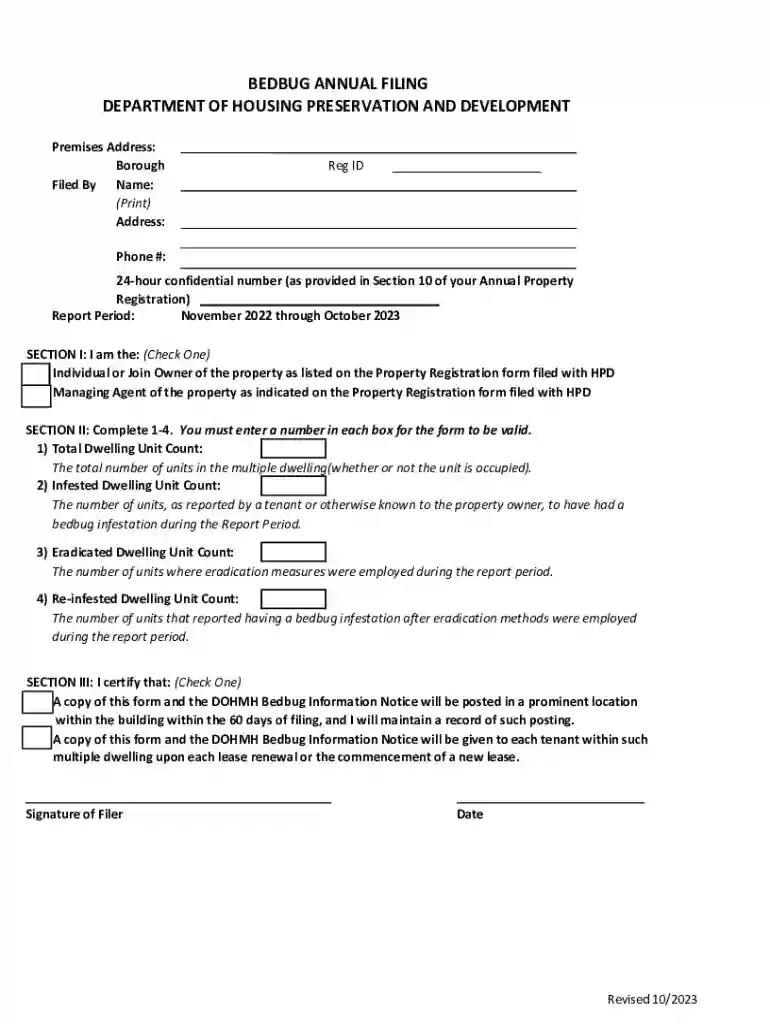
Bed Bug Reporting Requirements for New York City Landlords 2026

Get Form
Bed Bug Reporting Requirements for New York City Landlords Preview on Page 1

Here's how it works

01. Edit your form online
Type text, add images, blackout confidential details, add comments, highlights and more.

02. Sign it in a few clicks
Draw your signature, type it, upload its image, or use your mobile device as a signature pad.

03. Share your form with others
Send it via email, link, or fax. You can also download it, export it or print it out.

Definition & Meaning

The "Bed Bug Reporting Requirements for New York City Landlords" mandate that property owners of residential buildings with three or more units submit an annual report on bedbug infestations and eradications. This regulation aims to safeguard tenants' health and well-being by ensuring that landlords are proactive in tracking and managing bedbug issues.

  • The report is required to be submitted to the New York City Department of Housing Preservation and Development (HPD).
  • It includes detailed information about any infestations occurring from November to October.
  • The requirement applies uniformly, regardless of whether a building is currently bedbug-free.

Steps to Complete the Bed Bug Reporting Requirements

Filing the annual Bed Bug Report involves a series of steps designed to ensure comprehensive submissions that reflect the building's history and current pest situation.

  1. Gather Information: Landlords must first collect all necessary data on infestations and subsequent eradications from their tenants.
  2. Annual Reporting Period: Data should pertain to the period from November of the previous year to October of the current year.
  3. Online Submission: For those eligible, report submission can be completed online through the HPD website.
  4. Tenant Notification: After filing, landlords must distribute the Bedbug Information Notice to tenants, confirming the submission and outlining the report details.

Filing Deadlines / Important Dates

Timeliness is crucial when it comes to submitting the Bed Bug Report. The reporting period is strictly defined, and landlords must adhere to the following deadlines to ensure compliance:

  • Filing Window: Reports must be filed between December 1 and December 31.
  • Reporting Period: Covers the timeline from November of one year to October of the next year.

Failure to adhere to these deadlines can result in penalties and potential legal ramifications.

Legal Use of the Bed Bug Reporting Requirements

The legal framework surrounding bedbug reporting is focused on tenant safety and public health. This framework enforces a landlord's obligation to maintain habitable living conditions:

  • Non-compliance Penalties: Failing to file timely or accurately can result in fines and legal action.
  • Tenant Rights: Ensures tenants are kept informed and can take action if infestations are not adequately addressed.

Legal advisories often recommend documenting all communications and actions taken regarding bedbug management.

Key Elements of the Bed Bug Reporting Requirements

Understanding what the Bed Bug Report must include helps ensure thorough compliance:

  • Infestation Records: Documented instances of bedbugs within the reporting period must be included.
  • Eradication Efforts: Detailed descriptions of the steps taken to eliminate infestations.
  • Tenant Interactions: Records of communications with tenants regarding infestation and treatment efforts.

Landlords need to ensure all entries are accurate and honest to avoid potential disputes and legal issues.

Important Terms Related to Bed Bug Reporting

Familiarity with related terminology helps landlords navigate requirements more effectively:

  • Bedbug: A small, parasitic insect known for causing infestations in living environments.
  • HPD: The Department of Housing Preservation and Development, the body overseeing report submissions.
  • Eradication: The process of eliminating bedbug infestations, typically through professional pest control services.

Being well-versed in these terms ensures clarity in communication with both the HPD and tenants.

Who Typically Uses the Bed Bug Reporting Requirements

This form is primarily used by landlords and property managers responsible for residential buildings with more than two units:

  • Property Managers: Individuals tasked with supervising multiple rental properties.
  • Landlords: Both individual and corporate landlords engaged in property rental in New York City.
  • Legal Advisors: Consultants assisting landlords in ensuring compliance with local regulations.

Each user group relies on the requirements to safeguard both tenant welfare and their own legal standing.


decoration image ratings of Dochub

Penalties for Non-Compliance

The city enforces strict penalties for failure to comply with the reporting requirements as a deterrent against negligence:

  • Fines: Monetary penalties are levied on properties that fail to submit the Bed Bug Report on time.
  • Legal Action: Persistent non-compliance can lead to lawsuits or legal proceedings initiated by the tenants or the city.
  • Reputation Damage: Non-compliance can harm a landlord’s reputation, affecting tenant retention and property value.

By proactively addressing bedbug issues and following compliance guidelines, landlords can avoid these adverse outcomes.

Examples of Using the Bed Bug Reporting Requirements

Practical scenarios showcasing the application of the reporting requirements offer insight into real-world usage:

  • Scenario 1: A landlord of a midtown building conducts a yearly survey among tenants regarding bedbug sightings, compiles the data, and submits it online.
  • Scenario 2: An uptown property management company organizes an annual pest control inspection in October and files the results as part of the report to guarantee compliance.
be ready to get more

Complete this form in 5 minutes or less

Get form

Got questions?

We have answers to the most popular questions from our customers. If you can't find an answer to your question, please contact us.
Contact us
Starting December 22, 2024, New Yorks Real Property Law (RPL) will be amended to include requirements for residential landlords/lessors to inform their tenants of a bed bug infestation.
Tenants should report the presence of bed bugs to the property owner. If the property owner does not address the condition, file a complaint online or call 311. If the HPD inspector finds bedbugs, the property owner is issued an HPD Notice of Violation (NOV) ordering that the condition be addressed.
Report the Bed Bug Problem to Your Landlord report a possible infestation within a certain timeusually 24-48 hoursafter discovering it. reasonably cooperate with the landlords extermination efforts, and. comply with any specific control measures the landlord puts in place.
NYC311 can accept Service Requests for a wide range of issues, including over 500 complaint types. Service Requests can help you get a pothole fixed in your neighborhood, the heat turned on in your apartment, or a refund for an overpaid parking ticket.
Seek the expert advice of our bed bugs solicitors by calling 0161 813 2131 or completing the Start Your Claim form online. Bed bug bites cause itching, irritation or a rash that can be resolved in a few weeks or up to three months. Compensation for bed bug bites can range between 1,700 - 3,950, depending on severity.

Security and compliance

At DocHub, your data security is our priority. We follow HIPAA, SOC2, GDPR, and other standards, so you can work on your documents with confidence.
Learn more
ccpa2
pci-dss
gdpr-compliance
hipaa
soc-compliance
be ready to get more

Complete this form in 5 minutes or less

Get form

People also ask

The landlord must get rid of the infestation and keep the affected units from getting infested again. Property owners must provide tenants with a written bedbug history notice (PDF). This should disclose any bedbug infestations that have occurred in their building in the past year.

Related links