




01. Edit your form online
Type text, add images, blackout confidential details, add comments, highlights and more.

Type text, add images, blackout confidential details, add comments, highlights and more.

Draw your signature, type it, upload its image, or use your mobile device as a signature pad.

Send it via email, link, or fax. You can also download it, export it or print it out.
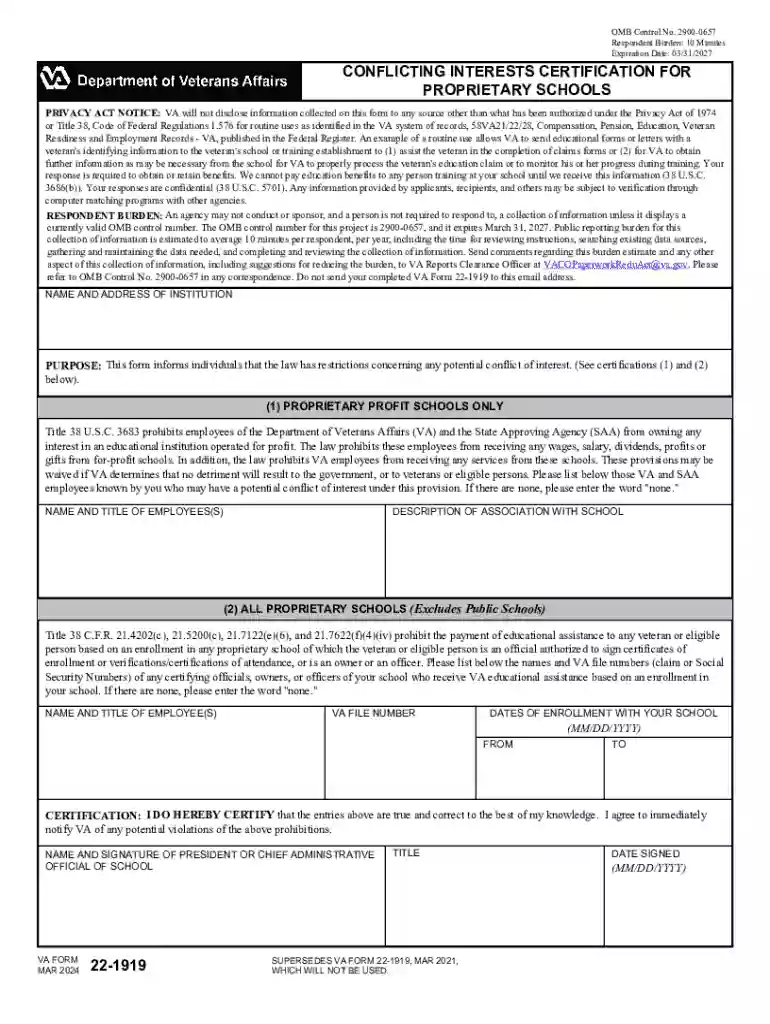
VA Form 22-1919, also known as the Conflicting Interests Certification for Proprietary Schools, is an essential document required by the Department of Veterans Affairs (VA). This form aims to prevent conflicts of interest involving VA employees and proprietary educational institutions, ensuring the integrity of educational assistance programs for veterans. Schools must disclose potential conflicts related to ownership or financial interests in their institution, aligning with federal regulations intended to maintain transparency and accountability.
The primary importance of the VA Form 22-1919 certification lies in its role in upholding ethical standards within proprietary schools that serve veterans. By completing this certification, educational institutions affirm their compliance with federal laws designed to eliminate conflicts of interest. This process helps maintain public trust in these educational programs and protects the interests of veteran students who rely on the VA's benefits for their education.
Obtaining the Form: Access the VA Form 22-1919 through the VA’s official website or request a copy from the educational institution's VA liaison.
Filling Out the Form:
Review and Signature: Ensure all provided information is accurate and complete before signing the form. The signature certifies the truthfulness of the disclosures.
Submission: Submit the completed form via mail or electronically based on the institution’s policies or VA guidelines.
Proprietary schools offering programs approved for VA education benefits are the primary users of this form. These institutions include private career colleges and trade schools, which commonly enroll veterans seeking educational advancement. School administrators and their compliance officers are typically responsible for completing and submitting the form to maintain eligibility for VA education benefits.
The legal framework for VA Form 22-1919 is established under federal regulations designed to ensure transparency and prevent undue influence by VA employees in proprietary schools. The form stipulates disclosure requirements for schools, ensuring they adhere to the conflict of interest policies mandated by law. Schools are legally obliged to complete this certification accurately to mitigate risks of non-compliance and maintain their eligibility to participate in VA programs.
Failure to properly complete and submit the VA Form 22-1919 can lead to significant repercussions. Non-compliance may result in the suspension of the institution's ability to offer VA-approved programs, affecting the school's enrollment and reputation. Additionally, fines and legal actions may be imposed to rectify any violations related to improper disclosures or failure to adhere to federal regulations.
While VA Form 22-1919 is a federally mandated document, certain state-specific educational regulations may influence how proprietary schools manage their certification processes. Some states might impose additional requirements or compliance measures that schools need to incorporate alongside the federal form. It's imperative that institutions consult both federal and state guidelines to ensure full compliance.
VA Form 22-1919 can be submitted either electronically or via traditional mail. Electronic submissions offer faster processing times and ensure immediate receipt acknowledgment, while paper submissions require more time but might be preferred in certain institutional settings where digital processes haven't been fully adopted. Schools should weigh these options considering their administrative infrastructure and VA preferences.
We've got more versions of the VA Form 22-1919 Conflicting Interests Certification for Proprietary Schools form. Select the right VA Form 22-1919 Conflicting Interests Certification for Proprietary Schools version from the list and start editing it straight away!
At DocHub, your data security is our priority. We follow HIPAA, SOC2, GDPR, and other standards, so you can work on your documents with confidence.
VA Form 22-1919 Conflicting Interests Certification for Proprietary Schools Only, During the Visit Be available to ask or answer any questions. collect current
Feb 20, 2026 For-profit schools should use VA Form 22-1919 to provide information about people who meet either of the descriptions listed here.Read more


