
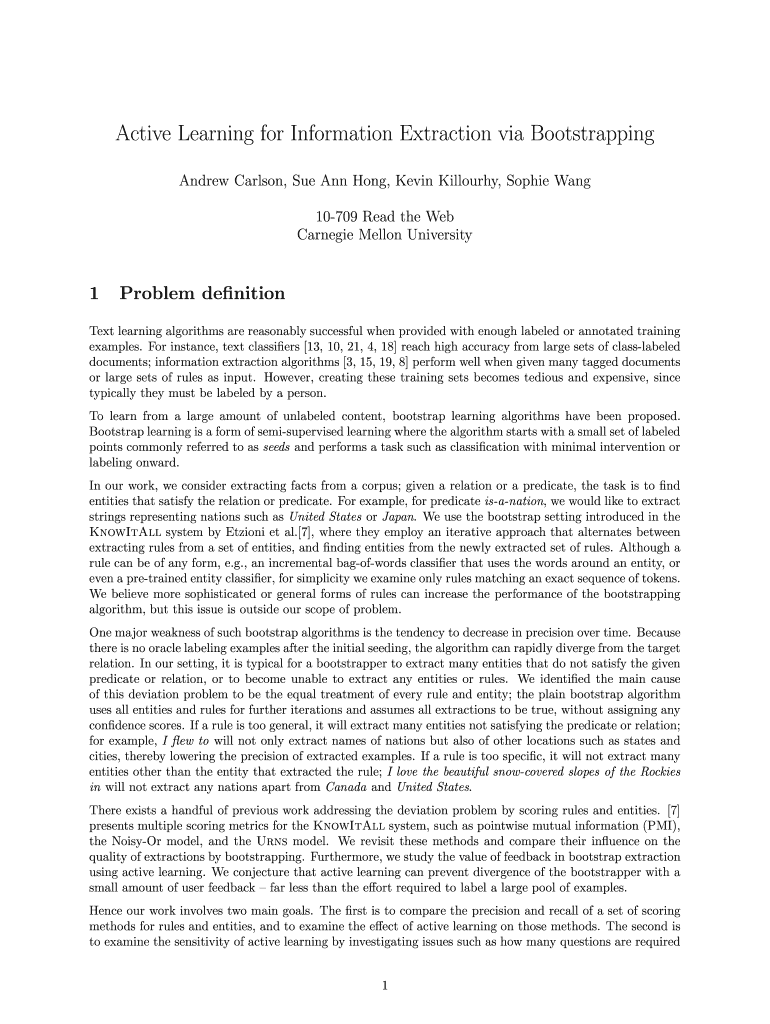







Definition and Meaning of Active Learning for Information Extraction via Bootstrapping
Active learning for information extraction via bootstrapping is a specialized machine learning methodology that combines active learning with bootstrapping techniques to enhance the efficiency and accuracy of information extraction tasks. The process begins with a small set of labeled data and uses the bootstrapping approach to iteratively develop and refine extraction rules and entities. Active learning is crucial in this method as it involves strategically selecting samples for which user feedback can most improve the model's performance, thereby ensuring more accurate extraction without significant human labeling effort. This method addresses common issues such as precision decline, which often occurs in traditional bootstrapping due to equal treatment of data elements without confidence scoring.
Key Elements of Active Learning for Information Extraction
- Bootstrapping Approach: This approach involves starting with a minimal set of labeled instances to iteratively grow a larger set of rules or patterns for information extraction. It leverages semi-supervised learning where only some data points are initially labeled.
- Active Learning Integration: Allows the model to query a user to label new data points that the model is least confident about, thereby using human input efficiently to improve learning.
- Confidence Scoring: Implements metric-based confidence scoring to weigh the reliability of rules and entities generated, minimizing precision decline.
- Feedback Mechanisms: Utilizes user feedback on selected examples to adjust extraction algorithms, ensuring adaptability and precision over time.
Steps to Implement Active Learning for Information Extraction via Bootstrapping
- Initial Data Preparation: Begin with compiling a small set of labeled examples relevant to the information extraction task.
- Bootstrapping Phase: Use these examples to create initial patterns or rules, which will form the basis for identifying similar data points in the larger dataset.
- Active Learning Cycle:
- Select samples that are least confidently understood by the model.
- Request annotations or labels from human experts for these specific cases.
- Retrain the model using the updated dataset.
- Iterative Refinement: Continuously repeat the active learning cycle, refining extraction rules and models with each iteration.
- Evaluation and Adjustment: Regularly evaluate the performance of the extraction model, focusing on recall and precision metrics, and adjust methodology as needed.
Who Typically Uses Active Learning for Information Extraction via Bootstrapping
This approach is typically leveraged by data scientists and researchers involved in natural language processing (NLP) tasks, particularly those focused on information extraction from large unstructured datasets. It is also used by software developers building machine learning models for sectors such as healthcare, finance, and legal analysis where accurate information extraction from text is critical. Organizations looking to minimize labeling costs while maintaining high data accuracy may also find this method highly beneficial.
Important Terms Related to Active Learning for Information Extraction
- Semi-Supervised Learning: An approach utilizing both labeled and unlabeled data for training to improve learning efficiency and effectiveness.
- Information Extraction (IE): The process of automatically extracting structured information from unstructured data or text.
- Confidence Score: A statistical measure indicating the reliability of an extracted piece of information or rule.
- Query Strategy: Refers to the method used in active learning to select which data points should be annotated by humans to improve the model most effectively.
Examples of Using Active Learning for Information Extraction
- Legal Document Analysis: Extracting relevant clauses or legal concepts from large volumes of contracts and statutes.
- Healthcare Record Processing: Identifying patient data and medical codes from unstructured health records for analytics or administrative purposes.
- Social Media Monitoring: Identifying trending topics or sentiments in user-generated content to inform business or marketing strategies.
Legal Use of Active Learning for Information Extraction
The use of active learning and bootstrapping in information extraction should comply with data protection regulations, such as the General Data Protection Regulation (GDPR) in Europe or the California Consumer Privacy Act (CCPA) in the U.S. When implementing these technologies, ensuring the anonymization of personal data and transparent data handling policies are critical to lawful deployment.
Software Compatibility and Integration Capabilities
Active learning through bootstrapping can integrate with several machine learning frameworks, including TensorFlow, PyTorch, and Scikit-learn, which provide libraries and tools for handling active learning queries and bootstrapping techniques. These integrations facilitate the model training and deployment processes in varied computing environments.
Versions and Alternatives to Active Learning for Information Extraction
- Traditional Bootstrapping Alone: Relies solely on iterative rule extraction without active learning components, often leading to precision issues.
- Supervised Learning Approaches: Instead of semi-supervised methods, relies entirely on labeled datasets but may require substantial labeling investment.
- Hybrid Systems: Combine various ML techniques, such as reinforcement learning, with bootstrapping and active learning for tailored solutions.




