






Definition and Meaning of Control Flow
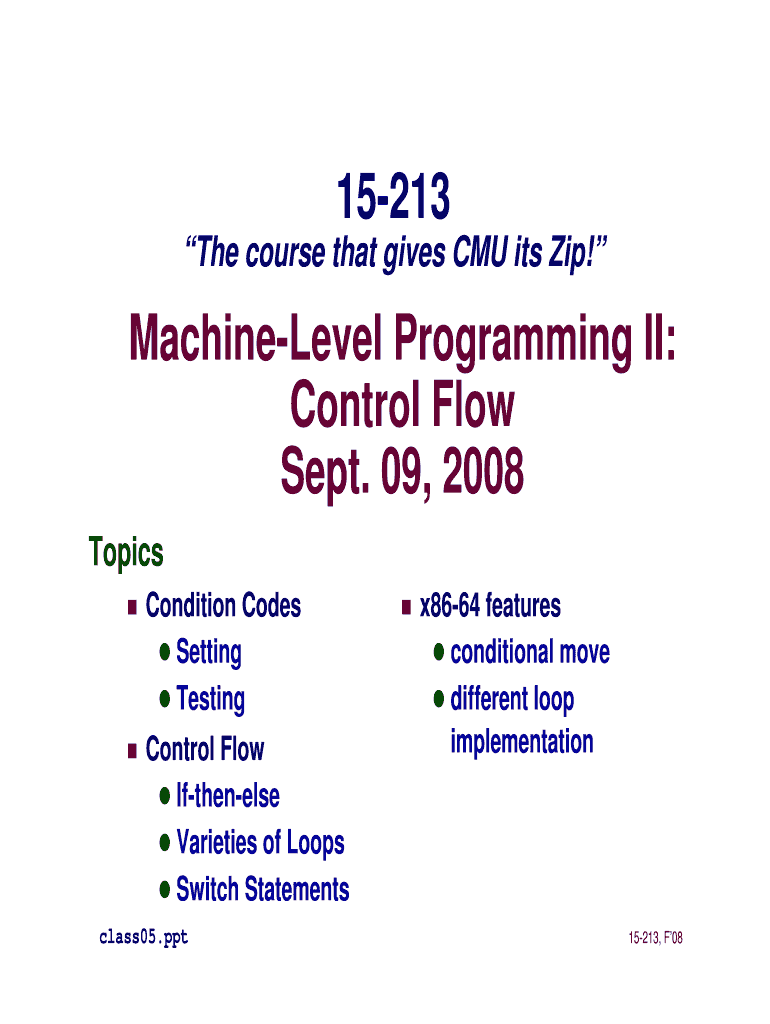
Control flow in programming refers to the order in which individual statements, instructions, or function calls are executed within a program. In the context of machine-level programming, control flow is crucial as it determines the path that the execution follows through the code. Control structures such as if-then-else, loops, and switch statements are fundamental elements that manage this flow. Understanding control flow is critical for developers, especially when working with low-level code in architectures like x86-64, where managing condition codes and implementing efficient control paths can significantly impact performance.
Condition Codes in Control Flow
Condition codes are special-purpose flags set by the Central Processing Unit (CPU) as a result of arithmetic and logical operations. These codes play a pivotal role in control flow because they influence the outcome of conditional statements. For instance, on an x86-64 architecture, condition codes determine whether a jump operation is performed. If a particular flag is set or not set, the processor may decide to execute a different portion of code, thus altering the program's control flow. Mastering the use of condition codes is imperative for optimizing machine-level operations and ensuring accurate program execution.
Key Elements of Control Flow
Control flow relies on a variety of key elements that guide the logic and decision-making processes within a program. These elements include:
- Conditional Statements: Manage decision-making through constructs like if-then-else that execute code based on certain criteria.
- Loops: Facilitate repeated execution of code blocks with constructs such as for, while, and do-while loops.
- Switch Statements: Allow multi-way branching based on the value of an expression, providing an alternative to multiple if-then-else statements.
- Function Calls: Transfer control to other parts of the program by calling defined functions, which is critical for modular program design.
Understanding and effectively utilizing these elements enable developers to create complex and dynamic applications by controlling the program's execution path.
Efficient Loop Implementations
In assembly programming, efficiently implementing loops can significantly impact the program's speed and size. Differences between IA32 and x86-64 architectures highlight the need for optimization strategies. IA32 may use shorter instructions due to its 32-bit addressing, while x86-64 uses expanded registers and instruction sets for more complex operations. Programmers must account for these architectural differences to ensure that loops execute efficiently without unnecessary overhead.
Steps to Implement Control Flow
Implementing control flow in a program involves several steps, particularly when translating high-level constructs into machine-level instructions:
- Identify Control Structures: Recognize which control structures are necessary for the task at hand, such as loops or conditional statements.
- Set Condition Codes: Use arithmetic or logical operations to alter condition codes, which will be evaluated by control structures.
- Translate High-Level Code: Convert high-level programming constructs into assembly language specific to the target architecture.
- Optimize Jump and Call Instructions: Use conditional and unconditional jumps to direct program flow efficiently while minimizing processor cycles.
- Test and Debug: Ensure the control flow behaves as expected through rigorous testing and debugging.
By following these steps, developers can leverage control flow to create programs that are both functional and efficient.
Digital vs. Paper Version of Control Flow
The discussion of control flow is not limited to digital systems but also translates into real-world scenarios where processes can be either manual (paper) or automated (digital). In programming, the digital 'flow' refers to algorithmic pathways managed by software, contrasting with older, manual processes that could be likened to 'paper workflows' in business operations.
Real-World Scenario: Document Management
In a document management system, digital control flow might imply the automatic routing of documents for approval based on predefined rules, unlike a paper system that requires manual handling and tracking. This highlights the importance of control flow in increasing efficiency, reducing errors, and speeding up processes in both digital and traditional environments.
Software Compatibility and Control Flow
Understanding control flow is vital for achieving compatibility with software tools like TurboTax and QuickBooks. These applications rely heavily on predefined control structures to process user data efficiently:
- TurboTax: Implements control flow to guide users through tax return preparation, ensuring all necessary forms are completed in the correct sequence.
- QuickBooks: Utilizes control flow to manage financial transactions and automate repetitive accounting tasks, streamlining business processes.
By effectively managing control flow, software applications can provide a seamless user experience, allowing users to focus on inputting data while the software handles procedural details.
Practical Examples of Control Flow
Practical applications of control flow are evident in various domains of software development:
- User Authentication Systems: Use control structures to permit or deny access based on credentials.
- Game Development: Employ loops and conditional statements to manage game states and player actions in real-time.
- Data Processing Pipelines: Rely on control flow to manage data transformation steps and conditional processing based on data characteristics.
These examples underscore the versatility of control flow in directing complex processes across diverse fields, facilitating robust and responsive applications.
Edge Cases and Variations
Designing control flow systems often involves accounting for edge cases and exceptions, such as handling invalid inputs or unexpected data conditions. Developers must anticipate and plan for these variations to prevent program crashes and ensure graceful failure handling.
Business Entity Types and Control Flow
Different business entity types leverage control flow in specific ways to suit their operational needs:
- LLCs and Corporations: May rely on control flow within their financial systems to automate compliance and reporting tasks.
- Partnerships: Use control flow structures to manage profit-sharing arrangements, ensuring each partner’s share is calculated and disbursed correctly.
Recognizing the unique requirements of each business entity guides the effective implementation of control flow, contributing to smoother and more effective business operations.
Benefits for Complex Organizations
For larger organizations, control flow enables integration across disparate systems, ensuring that processes are synchronized and consistent across departments. This leads to more efficient operations and higher accuracy in large-scale business environments.
Conclusion
In summary, control flow is a fundamental concept in both programming and real-world process management, serving as the backbone for decision-making and logical execution paths. Effective implementation of control flow structures allows for optimized performance, increased efficiency, and adaptability across a wide range of applications, from software development to business operations.