




01. Edit your progressive discipline flow chart online
Type text, add images, blackout confidential details, add comments, highlights and more.

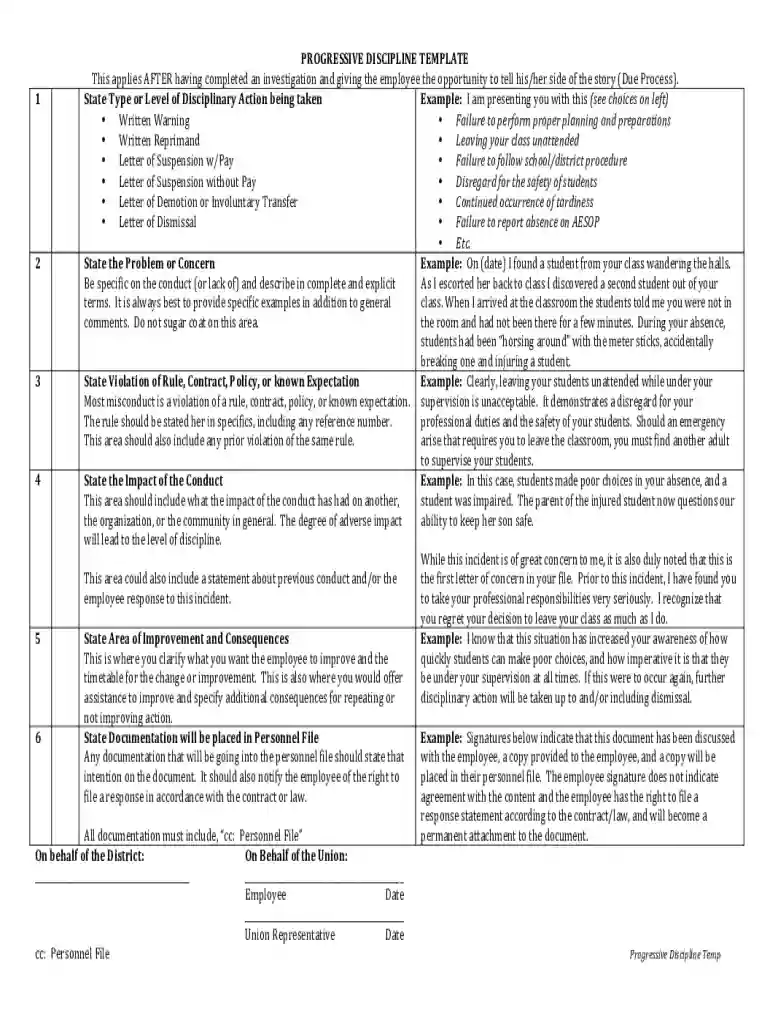
Type text, add images, blackout confidential details, add comments, highlights and more.

Draw your signature, type it, upload its image, or use your mobile device as a signature pad.

Send progressive discipline flow chart via email, link, or fax. You can also download it, export it or print it out.
The progressive discipline flow chart is a structured tool used to address employee misconduct and performance issues. This flow chart is particularly applicable in educational or corporate settings, guiding administrators and managers through a formalized process to ensure fair handling of disciplinary matters. The flow chart provides a step-by-step overview designed to maintain compliance with employment laws and organizational policies. By offering a clear framework, it helps prevent arbitrary or inconsistent disciplinary actions, ultimately promoting workplace fairness and efficiency.
Utilizing the progressive discipline flow chart involves following a series of predetermined steps to address workplace issues systematically. Initially, the process starts with documenting the employee's behavior or performance discrepancies. It's important to collect all relevant details, including dates, descriptions, and any previous informal attempts to correct the behavior. Once documentation is in place, the next step is to conduct an investigation to ascertain the facts and context surrounding the incident. This may involve interviewing witnesses, gathering evidence, and reviewing the employee's history. The flow chart will then guide you through subsequent steps, such as presenting findings to the employee, deliberating on appropriate disciplinary actions, and implementing corrective measures like warnings, reprimands, or suspension. Each step in the flow chart ensures that due process is respected and that employees are treated equitably.
Real-world scenarios where the progressive discipline flow chart proves beneficial include repeated tardiness, breaches of company policy, or unsatisfactory work performance. In cases of recurrent late arrivals, for instance, the flow chart directs managers to document each instance, discuss the issue with the employee, and agree on corrective measures, escalating the response if improvements are not observed. The consistent application of the flow chart ensures that disciplinary actions are proportional and justified.
The progressive discipline flow chart can typically be obtained through an organization's human resources or legal department. Many companies develop customized flow charts that align with their specific policies, while industry-wide templates can be found in HR management resources. It's crucial for organizations to periodically review and update their disciplinary procedures to reflect changes in employment laws and best practices.
Completing the progressive discipline flow chart involves several detailed steps, which mirror a procedural checklist.
Initiate Documentation: Begin by recording the initial infraction with sufficient detail, including time, location, and any corroborative evidence or witnesses.
Conduct an Investigation: Gather all relevant facts, testimonials, and evidence related to the employee's behavior or performance issue, ensuring a thorough assessment.
Evaluate Findings: Compare the findings against organizational policies to determine whether an infraction occurred and its severity.
Formal Discussion with Employee: Meet with the employee to communicate the findings, allowing them an opportunity to respond or provide their perspective.
Determine Disciplinary Action: Decide on an appropriate course of action based on the severity and nature of the misconduct, utilizing a corrective approach where possible.
Implement and Document Action: Prepare written records of any formal disciplinary measures, ensuring clarity and transparency in the action taken.
Monitor and Provide Feedback: After implementing the disciplinary action, continue to monitor the employee’s behavior, providing regular feedback and support to encourage improvement.
Critical components of the progressive discipline flow chart include documentation, investigation, communication, and corrective action. These elements ensure a comprehensive approach to managing behavioral issues.
In the U.S., the use of a progressive discipline flow chart must comply with labor laws and contractual obligations. Legal considerations include providing due process, avoiding discriminatory practices, and complying with the terms of union agreements if applicable. Employers must ensure the flow chart aligns with federal and state employment laws, such as the Fair Labor Standards Act (FLSA) and anti-discrimination statutes.
While the general principles of progressive discipline are consistent across different states, there may be variations in specific regulations and legal requirements. Employers need to tailor their flow charts to incorporate state laws and ensure compliance in their jurisdictions. This involves understanding local regulations related to employee rights, termination processes, and dispute resolution methods.
Alternative approaches to the progressive discipline flow chart include restorative justice models, arbitration, or mediation processes. These alternatives may focus more on conflict resolution and restoring employee relationships than on punitive measures. Employers can choose to implement these options based on the nature of the workplace culture and specific organizational goals. Each alternative may offer different advantages and should be considered within the context of the organization's values and legal obligations.
By adhering to the structure and detailed guidance provided in the progressive discipline flow chart, organizations can foster a more organized and legally compliant approach to managing employee behavior and performance, ultimately contributing to a fairer workplace.
We've got more versions of the progressive discipline flow chart form. Select the right progressive discipline flow chart version from the list and start editing it straight away!
| Versions | Form popularity | Fillable & printable |
|---|---|---|
| 2015 | 4 Satisfied (46 Votes) |
At DocHub, your data security is our priority. We follow HIPAA, SOC2, GDPR, and other standards, so you can work on your documents with confidence.


Step 1: ORAL REMINDER The oral reminder is a conversation between the supervisor and employee. During this meeting, the problem is identified along withRead more
May 31, 2020 An exemplar of a flow chart is displayed below. There are of course local differences and the national/international action is also dependant onRead more
PROGRESSIVE DISCIPLINE. APPLIES ONLY TO CLASSIFIED, PERMANENT EMPLOYEES AND ADDITIONAL REQUIREMENTS MAY APPLY FOR PEACE OFFICERS.Read more


