




01. Edit your form online
Type text, add images, blackout confidential details, add comments, highlights and more.

Type text, add images, blackout confidential details, add comments, highlights and more.

Draw your signature, type it, upload its image, or use your mobile device as a signature pad.

Send it via email, link, or fax. You can also download it, export it or print it out.
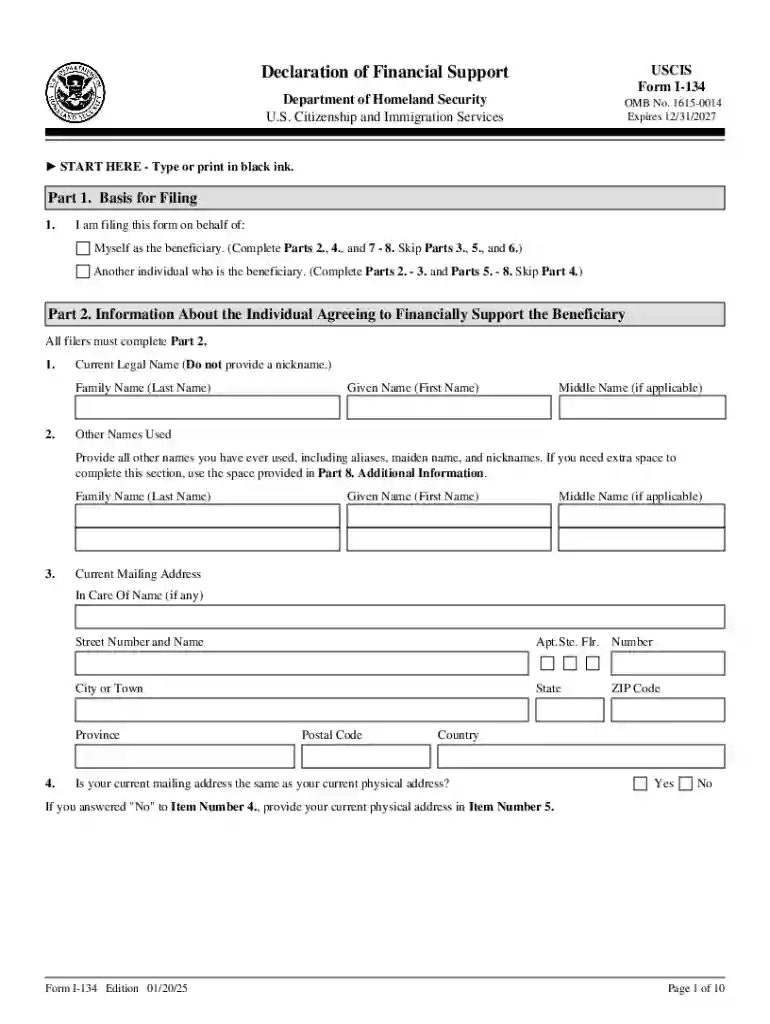
The Form I-134, Declaration of Financial Support, is a crucial document utilized in U.S. immigration processes. This form is used to demonstrate that an individual in the United States, often called the "sponsor," can financially support a non-U.S. citizen, referred to as the "beneficiary," during their stay in the country. The form helps ensure that the beneficiary will not become a public charge, thereby confirming that the U.S. government will not need to provide financial assistance to the immigrant.
Gather Personal Information: The sponsor must collect personal details about themselves and the beneficiary, such as names, addresses, and relationship.
Provide Financial Details: This includes current employment status, annual income, and detailed information on the sponsor's assets and liabilities. Documentation such as pay stubs and bank statements may be required to substantiate the financial ability to support the beneficiary.
Declare Sponsored Individuals: Sponsors need to outline other individuals or dependents they are financially responsible for, which can impact their financial capacity.
Complete Certifications: The form requires certifications regarding the accuracy of the information provided, with the sponsor signing to affirm they are aware of the legal implications of submitting false information.
Submit the Form: Once completed, the submission can normally be made directly to USCIS according to the particular immigration application's instructions with which the form is associated.
The sponsor must demonstrate sufficient income or assets to meet or exceed 125% of the U.S. Federal Poverty Guidelines, which vary based on family size and geographical location.


Using Form I-134 helps establish a financial safety net for immigration applicants. By providing a clear record of financial backing, it strengthens visa applications, decreasing the likelihood of rejection due to concerns of the potential public charge. The form serves multiple pathways within the immigration system, paving the way for varied types of admission based on its assurance of financial responsibility.
The form is often employed by U.S. citizens and permanent residents who are sponsoring family members or other close relations. It is particularly prevalent in scenarios involving tourist visas, student visas, and other non-immigrant visa applications requiring evidence of financial sponsorship. Humanitarian parole cases and other specific immigration programs may also need this form to demonstrate support.

These documents assist USCIS in verifying the sponsor's financial capacity to support the beneficiary.
Proper use of Form I-134 within legal boundaries underscores the sponsor’s responsibility and intent to financially support the beneficiary during their stay. It legally binds the sponsor to uphold the financial promises made, ensuring adherence to U.S. immigration law. Misrepresentation or failure to honor these commitments could lead to legal penalties or jeopardize the immigration case.
Form I-134 can generally be submitted as part of a broader immigration package via:
The method of submission typically relates to the specific immigration process being pursued and should align with USCIS guidelines. This flexibility ensures accessibility for various preferences and geographic considerations.
We've got more versions of the Form I-134, Declaration of Financial Support form. Select the right Form I-134, Declaration of Financial Support version from the list and start editing it straight away!
| Versions | Form popularity | Fillable & printable |
|---|---|---|
| 2025 | 4.5 Satisfied (21 Votes) | |
| 2023 | 4.6 Satisfied (43 Votes) | |
| 2023 | 4.5 Satisfied (48 Votes) | |
| 2022 | 4.8 Satisfied (38 Votes) | |
| 2019 | 4.3 Satisfied (160 Votes) | |
| 2016 | 4.4 Satisfied (424 Votes) | |
| 2014 | 4.4 Satisfied (330 Votes) | |
| 2012 | 4 Satisfied (53 Votes) | |
| 2011 | 4 Satisfied (43 Votes) | |
| 2010 | 4.3 Satisfied (35 Votes) | |
| 2008 | 4 Satisfied (54 Votes) | |
| 2007 | 4 Satisfied (33 Votes) | |
| 2004 | 4 Satisfied (44 Votes) | |
| 2000 | 4.4 Satisfied (157 Votes) |
At DocHub, your data security is our priority. We follow HIPAA, SOC2, GDPR, and other standards, so you can work on your documents with confidence.




Jun 3, 2026 Use this form to agree to provide financial support to a beneficiary of certain immigration benefits for the duration of their temporary stay
That this declaration is made by me to assure the U.S. Government that I will be able to financially support myself while in the United. States.Read more


