




01. Edit your form online
Type text, add images, blackout confidential details, add comments, highlights and more.

Type text, add images, blackout confidential details, add comments, highlights and more.

Draw your signature, type it, upload its image, or use your mobile device as a signature pad.

Send it via email, link, or fax. You can also download it, export it or print it out.
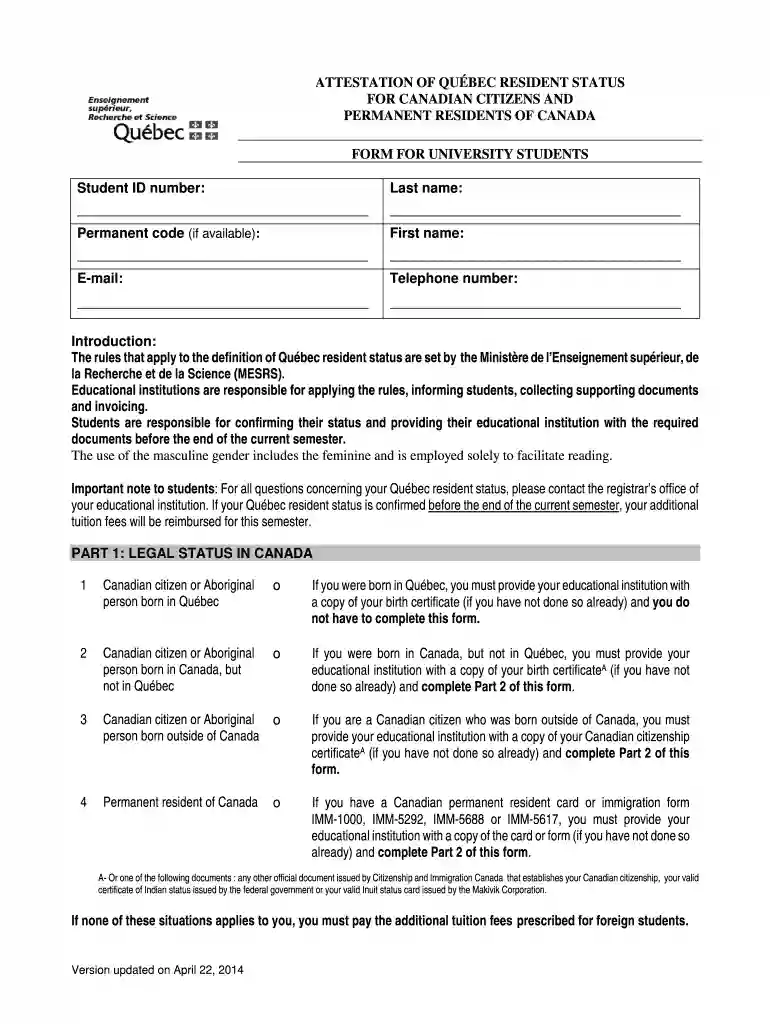
The "Attestation of Québec Resident Status" form is essential for Canadian citizens and permanent residents who need to prove their residency status in Québec for university tuition purposes. This document certifies eligibility for reduced tuition fees available to Québec residents as opposed to higher out-of-province or international rates. Understanding this form's significance helps ensure only qualifying students benefit from such discounts, reflecting a fair and accurate billing process across educational institutions.
To qualify for the Québec resident status, applicants must meet specific eligibility criteria outlined on the form. Key conditions include proof of Canadian citizenship or permanent residency, continuous residence in Québec for a set period, and supporting documentation demonstrating intent to reside in Québec. Certain exemptions or special circumstances, like family ties or employment commitments, might alter eligibility, necessitating a detailed review of the form's requirements.


When completing the form, applicants must provide several supporting documents to validate their claims. Commonly required items include a valid Canadian passport or permanent residency card, Québec health insurance card, and proof of domicile such as a lease or utility bill. Additional documents might be needed if requesting exceptions or clarifications, ensuring the submitted information fully supports the residency claim.
Successfully completing the attestation form involves several key steps. First, applicants gather necessary documentation as specified in the form. Next, they accurately fill out personal information sections, ensuring all details match their official identification. Applicants must carefully review eligibility criteria and provide documentation if claiming special circumstances. Finally, the form must be submitted by mail, online, or in person according to institutional guidelines, respecting any specific deadlines.
The form can be submitted via different methods, offering flexibility to the applicants. Institutions typically accept submissions through mail, allowing for signature verification and document attachment. Alternatively, online submission platforms might be available, streamlining the process with electronic uploads and faster processing times. In-person submission remains a choice for those seeking personalized assistance or confirmation of receipt, especially within close university proximity.
Navigating this form involves familiarity with key terminology. Understanding "domicile" refers to one's permanent home, while knowing "residency" involves the duration and intent of staying in a location, is crucial. Other important terms include "Canadian citizen," "permanent resident," and "attestation," which refers to formal verification. Clear comprehension of these terms ensures accurate completion and comprehension of the form's legal and procedural instructions.
This form holds significant legal weight, serving as an official document to certify residency status. Universities and educational bodies use it to apply reduced tuition rates accurately, ensuring compliance with provincial regulations. Misrepresentation or false information can result in penalties, including revocation of resident status, fines, and back payment of fees. Proper legal use ensures a fair and equitable system for all applicants and institutions involved.
Failure to correctly complete or submit the form by designated deadlines may result in severe consequences. Missing the deadline can lead to the imposition of higher non-resident tuition fees. Providing false information can incur penalties like being denied future residency status verification or facing legal consequences. Universities may enforce strict compliance policies to maintain integrity and conformity with provincial educational mandates.
Consider a Canadian citizen who recently moved to Québec for educational purposes — they would use this form to certify their intent and eligibility for local resident tuition rates. Similarly, a permanent resident living in Québec for years could file this form during university admissions to request reduced fees. These examples highlight its practical application in diverse scenarios typical for students enrolling in higher education institutions.
The application process involves gathering documentation, completing the form accurately, and submitting it by the deadline established by the educational institution. After submission, verification by the administration confirms eligibility and the decision is communicated to applicants. Approval times vary based on submission method and the institution’s processing speed, with in-person or electronic submissions typically offering quicker turnarounds compared to mailed forms.
While this form specifically pertains to Québec residency, variations exist concerning similar forms in other provinces due to differing educational regulations and funding models. Québec’s particular requirements emphasize documentation and residency intentions unique to provincial standards. Understanding these distinctions ensures compliance across differing regions, minimizing confusion for applicants who might move provinces or apply to multiple schools.
Opting for the digital version of the form offers conveniences like faster submission and integrated guidance tools directly in the platform, which expedites processing time. Conversely, a paper version might be preferable for those requiring in-person assistance or lacking online access. Both versions maintain the same legal validity and require the same thoroughness in completion and accompanying documents, aligning with institutional preferences for processing.
We've got more versions of the Attestation of Qu bec Resident Status for Canadian Citizens and Permanent Residents of Canada - Form form. Select the right Attestation of Qu bec Resident Status for Canadian Citizens and Permanent Residents of Canada - Form version from the list and start editing it straight away!
| Versions | Form popularity | Fillable & printable |
|---|---|---|
| 2014 | 4.8 Satisfied (80 Votes) |
At DocHub, your data security is our priority. We follow HIPAA, SOC2, GDPR, and other standards, so you can work on your documents with confidence.




Jun 5, 2026 I-407, Record of Abandonment of Lawful Permanent Resident Status. Use this form to let us know you are voluntarily abandoning your status as aRead more
Allocating permanent residency status based on decades-old caps and immigrants countries of origin, rather than the skills they bring to the United States, hasRead more


