




01. Edit your form online
Type text, add images, blackout confidential details, add comments, highlights and more.

Type text, add images, blackout confidential details, add comments, highlights and more.

Draw your signature, type it, upload its image, or use your mobile device as a signature pad.

Send it via email, link, or fax. You can also download it, export it or print it out.
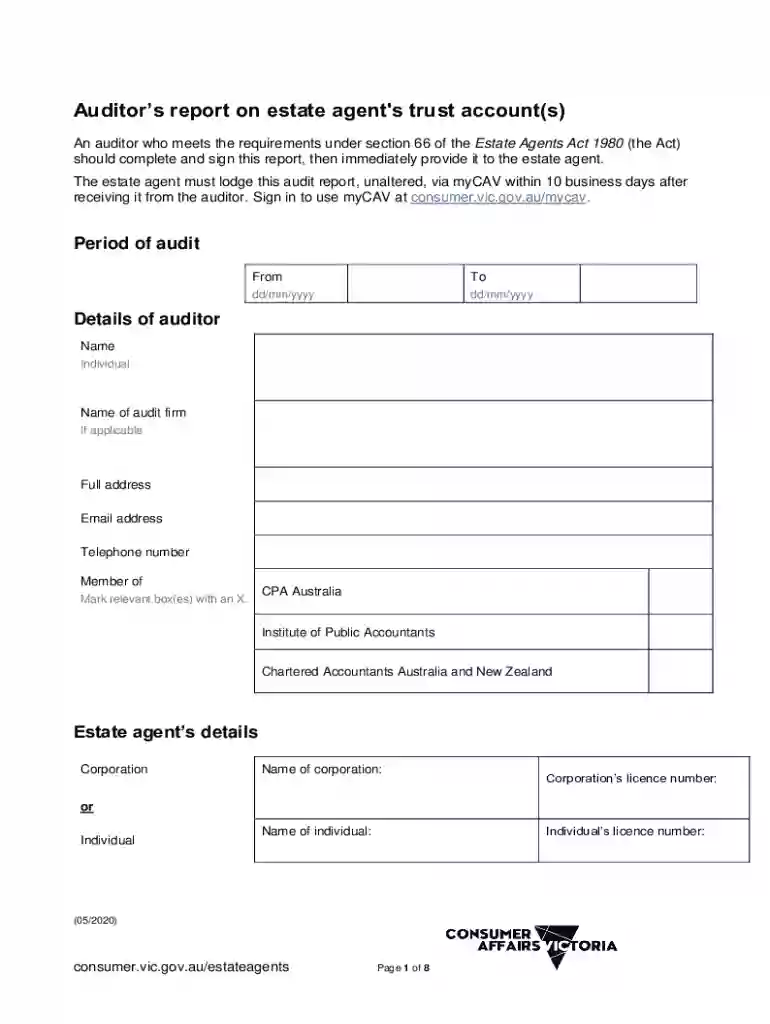
The "Auditor's Report on Estate Agent's Trust Accounts" is a specialized audit document required for estate agents to ensure compliance with trust account obligations. This document validates that an estate agent's handling of trust accounts adheres to legal and financial norms. Typically, under regulations such as the Estate Agents Act 1980, the report confirms that the financial records are accurate and that the trust accounts are free from mismanagement or fraud. Importantly, the report includes the auditor's opinion on the financial statements and a summary of any identified breaches or irregularities.
Filing an auditor's report for estate agents' trust accounts is crucial for maintaining client trust and compliance with legal standards. It serves to confirm that client funds have been managed correctly, without misuse or discrepancies. Estate agents are legally obligated to ensure that their trust accounts are audited to prevent potential legal issues and financial discrepancies. Incomplete or inaccurate reports might result in penalties and damage to the agency's reputation. Additionally, it assures clients that their transactions with the agent are handled within a secured and transparent framework.
Gather Necessary Documentation:
Identify the Audit Period:
Perform a Detailed Audit:
Identify and Report Breaches:
Finalize the Report:
Submit the Report:
Declaration of Compliance:
Summary of Findings:
Breaches and Errors:
Auditor’s Opinion:
Schedules of Audited Accounts:
The auditor's report is a legal document that confirms compliance with estate management regulations. It is essential for estate agents to comply with the Estate Agents Act and other relevant legislation. This report can be used in legal proceedings as evidence of adherence to financial regulations, safeguarding both the agent and clients from legal repercussions. It serves as a regulatory requirement, ensuring trust accounts meet statutory standards.
While the general requirements are similar, there may be state-specific rules regarding the filing of the auditor's report on estate agents' trust accounts. For instance, some states might require additional supporting documentation or impose distinct deadlines for submission. Understanding local regulations is crucial for estate agents to ensure compliance and avoid potential penalties.
Failing to complete and submit the auditor’s report can lead to severe consequences. Penalties might include fines, revocation of the estate agent's license, and potential civil liability if clients' funds are mismanaged. Furthermore, non-compliance can result in damage to the agent's professional reputation and loss of client trust.
DocHub provides a streamlined process for managing the auditor’s report digitally. The platform ensures that estate agents can easily fill out, edit, and submit their auditor’s reports online. Integrations with cloud storage and tools like Google Workspace make it efficient to track and organize the required documents. The ability to use electronic signatures further expedites the final submission process, ensuring that the report is both digital and compliant with legal standards.
We've got more versions of the Auditors report on estate agent's trust account(s) form. Select the right Auditors report on estate agent's trust account(s) version from the list and start editing it straight away!
| Versions | Form popularity | Fillable & printable |
|---|---|---|
| 2020 | 4.8 Satisfied (200 Votes) |
At DocHub, your data security is our priority. We follow HIPAA, SOC2, GDPR, and other standards, so you can work on your documents with confidence.


The University has a written conflict of interest policy that requires annual reporting by each trustee, member of senior management and key employees.Read more
Individual accounting ensures proper documentation of all trust account transactions, and more accurate auditing by the real estate trust account auditor.


