







Definition & Meaning
The "Certified Nurse Assistant and/or Home Health Aide" refers to two roles integral to the healthcare industry, particularly in providing basic patient care and assisting with daily living activities. Certified Nurse Assistants (CNAs) are trained professionals who support registered nurses and other healthcare professionals in medical settings. Home Health Aides (HHAs), on the other hand, are more commonly found in residential settings, where they assist patients with daily tasks like bathing, dressing, and maintaining hygiene. Both positions are essential in ensuring the well-being and comfort of patients, especially those with long-term care needs.
How to Obtain the Certification
To become a Certified Nurse Assistant or Home Health Aide in the United States, applicants must complete specific training programs that adhere to state and federal regulations. Generally, training involves classroom instruction combined with clinical practice. Following the completion of the program, candidates must pass a state-administered examination to earn certification. Each state has its own requirements, thus it's important for applicants to verify the specific criteria set by their state's health department.
Steps to Complete the Certification Process
-
Research State Requirements: Each state has unique regulations for CNAs and HHAs, including age requirements, education prerequisites, and background checks.
-
Enroll in an Accredited Program: Find a state-approved training program, which typically involves 75-180 hours of classroom and clinical experience.
-
Complete the Training: Successfully finish all coursework and practical training as specified by the program.
-
Apply for the Exam: Register for the certification exam through your state's relevant testing agency.
-
Pass the Examination: The test usually includes a written and a skills demonstration part.
-
Receive Certification: Upon passing, you'll be added to the state's registry of certified aides.
Important Terms Related to the Certification
- Clinical Training: Practical, hands-on training provided in a healthcare environment as part of the certification process.
- State Registry: A database maintained by state health departments listing all certified CNAs and HHAs.
- Scope of Practice: Guidelines outlining the permissible duties and tasks for CNAs and HHAs.
Key Elements of the Form
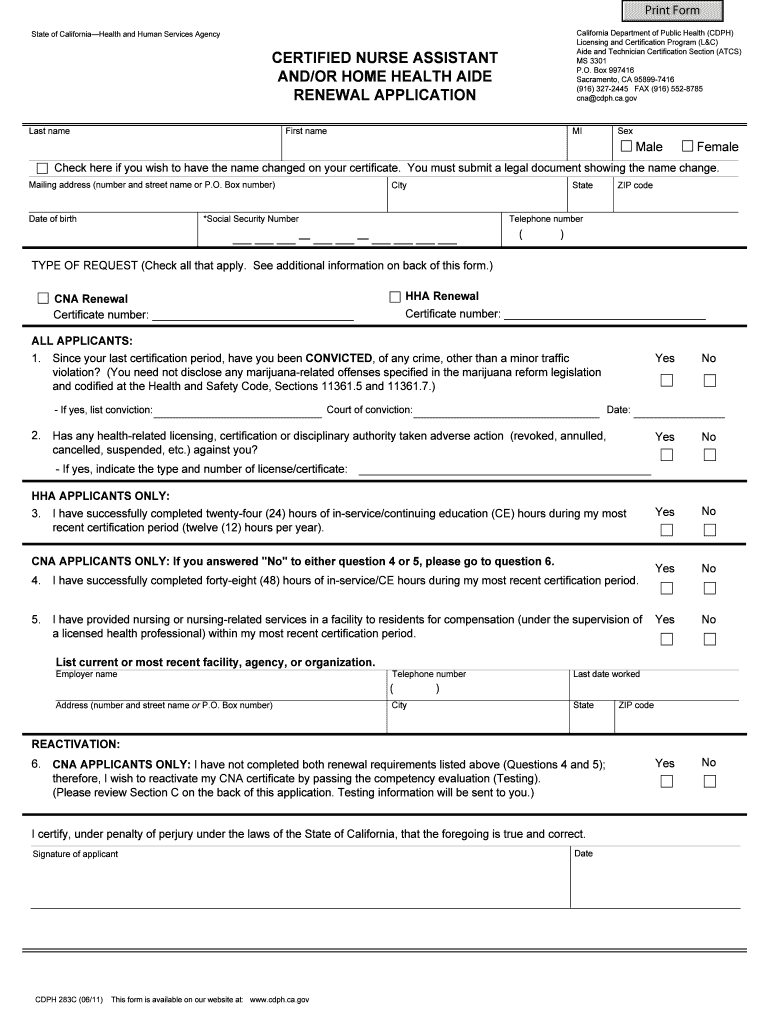
The renewal application form for Certified Nurse Assistants and Home Health Aides includes sections where applicants must provide personal information, specify the type of certification they are renewing, and disclose any criminal history. Additionally, they must detail their completed continuing education hours. The form is designed to ensure that all information is up-to-date and that the applicant meets the renewal criteria.
Required Documents
Applicants must submit various documents with their renewal application, such as:
- Proof of Completed Training Hours: Documentation of continued education required for renewal.
- Identity Verification: A government-issued ID to confirm personal details.
- Criminal Record Disclosure: If applicable, documentation or explanation of any past convictions.
State-Specific Rules for Certification
Different states have unique rules governing the certification and renewal of CNAs and HHAs. For example, the number of required training hours and processes for recertification can vary. In California, the Department of Public Health mandates specific continuing education hours for renewal, alongside the submission of a renewal form. Applicants are encouraged always to consult their state's specific regulations.
Who Issues the Form
The certification renewal form is issued by the relevant state health department. In California, it is provided by the California Department of Public Health. These institutions ensure that CNAs and HHAs maintain high standards of care through continuous education and regular certification updates.
Legal Use of the Certification
Holding an active certification as a CNA or HHA legally authorizes individuals to work in various healthcare settings throughout the state. It ensures compliance with the Nurse Aide Registry and confirms that the individual is qualified to perform tasks related to patient care. Invalid or expired certifications can result in the inability to practice as a CNA or HHA legally.
Examples of Using the Certification
Certified Nurse Assistants work in hospitals, nursing homes, and rehabilitation centers, providing fundamental care and assistance to patients. In contrast, Home Health Aides typically help individuals within their homes, focusing on daily living activities. Real-world scenarios include assisting elderly patients with mobility, supporting post-operative individuals in recovery, and managing household tasks for those with chronic illnesses.




