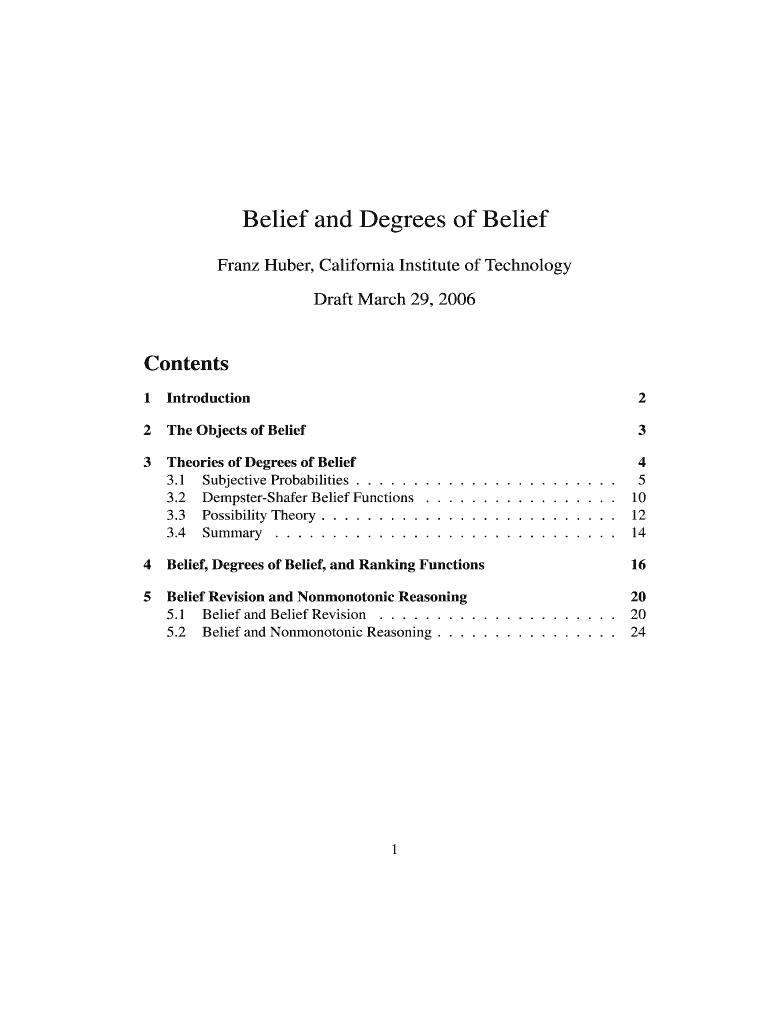







Definition and Meaning
The document "Belief and Degrees of Belief" by Franz Huber provides an in-depth exploration of concepts related to belief. It focuses on the intricate relationship between beliefs and degrees of belief, analyzing how these ideas are understood and applied in fields such as epistemology and artificial intelligence. Beliefs are often considered binary — something is either believed or not — while degrees of belief involve a level of certainty or confidence in a proposition. This distinction is vital for modeling real-world scenarios where uncertainty is a natural part of decision-making.
Beliefs vs. Degrees of Belief
- Beliefs: Typically seen as a binary state where one either accepts a proposition as true or does not.
- Degrees of Belief: Represented as a spectrum or level of confidence in a given proposition, allowing for nuanced interpretation.
Application in Artificial Intelligence
Artificial intelligence uses these concepts to simulate human-like reasoning and decision-making. Algorithms often include models of belief and degrees of belief to handle uncertainty and make informed decisions in complex environments.
How to Use "Belief and Degrees of Belief"
Understanding and implementing the principles of belief and degrees of belief can provide significant advantages in several domains. The document serves as both a theoretical framework and a practical guide for deploying these concepts in various fields.
Practical Applications
- Decision Support Systems: Enhance decision-making by incorporating the strength of belief into probabilistic models.
- Academic Research: Provide a foundation for exploring further studies in epistemology and cognitive science.
- Artificial Intelligence: Improve the robustness of AI models that require nuanced judgment.
Steps to Complete "Belief and Degrees of Belief"
To effectively engage with the content and concepts of this document, follow a series of methodical steps designed to deepen your understanding.
Steps for Engagement
- Initial Reading: Thoroughly read the entire document to grasp the primary concepts and arguments.
- Critical Analysis: Analyze the different theories presented, such as subjective probabilities, to understand their utilities and limitations.
- Application Exercise: Apply the theories to real-world problems to recognize their practical implications in decision-making processes.
- Feedback Loop: Discuss with peers or experts to refine your understanding and potentially identify any misconceptions.
Key Elements and Concepts
Several key elements are essential to the understanding of Huber's document. These elements provide the foundational concepts necessary for the analysis and application of the theories discussed.
Foundational Concepts
- Subjective Probabilities: Interpretations of probability based on personal belief about the likelihood of an event.
- Dempster-Shafer Belief Functions: Framework for modeling uncertainty without requiring precise probabilities.
- Possibility Theory: Mathematical theory for dealing with certain types of uncertainty, alternative to probability theory.
Who Typically Uses "Belief and Degrees of Belief"
The document is a valuable resource for various professionals and academics interested in advanced topics related to beliefs and their implications.
Key Users
- Epistemologists: Scholars focusing on the study of knowledge and belief.
- AI Researchers: Professionals leveraging these concepts to build sophisticated AI models.
- Cognitive Scientists: Researchers exploring how humans process information and form beliefs.
Important Terms Related to the Document
Understanding the terminology used within "Belief and Degrees of Belief" is critical for effective comprehension and application.
Essential Vocabulary
- Nonmonotonic Reasoning: A type of reasoning where the addition of new information can invalidate previous conclusions.
- Belief Revision: The process of changing beliefs in response to new evidence or information.
Legal and Ethical Considerations
Belief systems and their representation also raise significant legal and ethical considerations, particularly in the development of AI and automated decision-making systems.
Considerations
- Data Privacy: Ethical handling of personal belief data to maintain privacy.
- Bias and Fairness: Ensuring that models based on degrees of belief are free from bias and represent fair decision-making processes.
Examples and Real-World Applications
Utilizing concepts from the document can lead to innovative solutions across various industries.
Case Studies
- Medical Diagnosis: Algorithms that assess degrees of belief can improve diagnostic accuracy by incorporating multiple probabilities.
- Financial Forecasting: Utilizing subjective probabilities to weigh potential financial outcomes and minimize risk.
Alternatives and Variations
While "Belief and Degrees of Belief" provides a robust framework, researchers can explore alternative methods and models to complement or augment the concepts presented.
Alternative Frameworks
- Bayesian Networks: Graphical models that use Bayesian inference to update the degrees of belief with new evidence.
- Fuzzy Logic Systems: Systems that handle reasoning with approximate rather than fixed and exact data.
Business Types Benefiting from the Document
Certain business types can particularly benefit from integrating insights from belief and degrees of belief.
Beneficial Sectors
- Insurance Companies: Utilize models to assess risk and establish premiums based on the likelihood of events.
- Consumer Analytics Firms: Develop consumer profiles based on degrees of belief in consumer behavior predictions.
By systematically exploring these sections, a comprehensive understanding of the document "Belief and Degrees of Belief" and its applications can be achieved, providing valuable insights into the nuanced world of epistemology and its practical implications across various domains.