
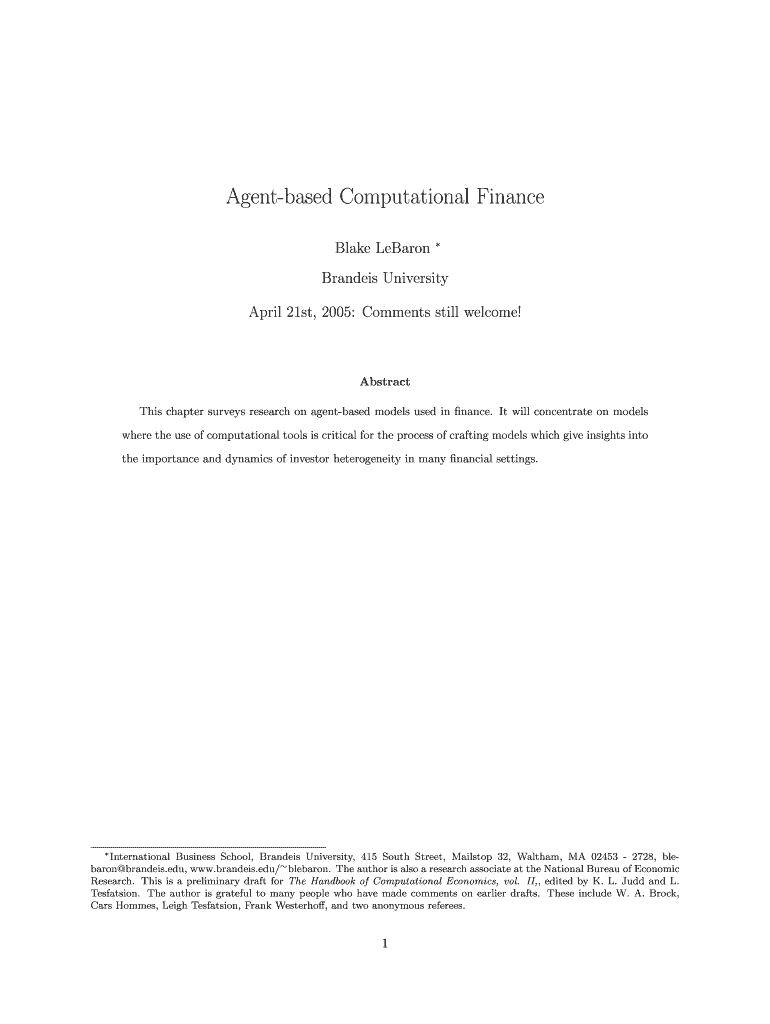







Definition and Meaning of Agent-based Computational Finance
Agent-based computational finance is a modeling approach that uses computational tools to simulate interactions among autonomous agents in financial markets. These models allow researchers to explore the heterogeneity of investors and the complex dynamics of trading environments. Rooted in agent-based models, this method deviates from traditional financial theories by focusing on individual behaviors and interactions rather than aggregate or average market behaviors. This approach is particularly useful in addressing real-world issues in market efficiency, volatility, and trading behavior.
How to Use Agent-based Computational Finance
Using agent-based computational finance involves constructing models that simulate the behavior and interactions of diverse market participants. To begin, one must identify the types of agents to model, such as individual investors, financial institutions, or algorithmic traders. Each agent is programmed with a set of rules or strategies, which can include buying, selling, holding, or reacting to market news. These agents interact within a simulated market environment, allowing researchers to observe emergent market phenomena and test various hypotheses about market behavior.
Designing the Agent Behavior
- Strategic Interaction: Define how agents make decisions based on personal strategies and external factors such as market trends.
- Adaptive Learning: Implement adaptive learning mechanisms that allow agents to modify their strategies based on past performance or changing market conditions.
Simulation Setup
- Market Environment: Set up a simulated marketplace where agents can trade financial instruments.
- Time Framework: Establish a timeline for the simulation, whether it be daily trading hours or long-term investment periods.
Key Elements of Agent-based Computational Finance
Several critical elements form the foundation of agent-based computational finance models:
- Agent Heterogeneity: Represents the differing objectives, strategies, and risk preferences of individual agents.
- Inter-agent Communication: Models how agents exchange information, including trading signals or market news.
- Market Dynamics: Captures the fluctuations and evolution of market conditions affecting agent strategies.
Examples of Practical Applications
- Market Mechanism Experiments: Exploring the effects of different trading rules or market structures on asset prices and liquidity.
- Policy Testing: Simulating the impact of regulatory changes on market stability and efficiency.
Who Typically Uses Agent-based Computational Finance
Agent-based computational finance is popular among academics, policymakers, and financial industry professionals:
- Academics: Engage in research to explore theoretical financial concepts using empirical data.
- Policy Analysts: Use the models to predict the impact of potential regulatory or policy changes on market conditions.
- Financial Institutions: Apply insights from simulations to develop new trading strategies or evaluate risk management protocols.
Steps to Complete Agent-based Computational Finance Modeling
- Define Objectives: Determine the research or business question you aim to investigate with the model.
- Identify Agents: Establish the types of agents involved in your market scenario, considering their roles and functions.
- Develop Agent Rules: Specify each agent's decision-making process and the factors influencing their behavior.
- Construct the Model: Build the computational framework using software tools like MATLAB or Python.
- Run Simulations: Execute multiple iterations of the model, adjusting parameters to explore various scenarios.
- Analyze Results: Assess the outcomes of the simulations to gain insights into market dynamics or confirm hypotheses.
Important Terms Related to Agent-based Computational Finance
Understanding key terms is essential to effectively using agent-based computational finance:
- Agent: An individual entity in the model, such as a trader or investor, with distinct behaviors and goals.
- Emergent Behavior: Complex patterns and dynamics that arise from simple rules applied to agents.
- Market Efficiency: The degree to which market prices reflect all available information and resources.
Clarifications for Technical Terms
- Heterogeneity: Refers to the diversity in agent characteristics and strategies, which impacts overall market behavior.
- Adaptation: The process through which agents adjust their strategies over time in response to market feedback.
Legal Use of Agent-based Computational Finance
Agent-based computational finance must comply with regulatory and ethical standards, especially when applied in real-world trading or predictive analytics:
- Regulatory Compliance: Ensure the models adhere to financial regulations such as the Dodd-Frank Act or the European Securities and Markets Authority guidelines.
- Ethical Considerations: Take into account the implications of using simulations in market predictions, avoiding manipulative practices.
Software and Tool Compatibility for Agent-based Computational Finance
Choosing the right software tools is crucial for effective agent-based modeling:
- Programming Languages: Python and R are often used due to their comprehensive libraries and ease of integrating machine learning techniques.
- Simulation Platforms: NetLogo and AnyLogic are popular for their user-friendly interfaces and powerful simulation capabilities.
Ensuring Software Integration
- Data Analysis Compatibility: Ensure seamless integration with data analysis and visualization tools for comprehensive post-simulation assessments.
- API Access: Use APIs to connect simulation platforms with real-time market data sources, enhancing model accuracy.




