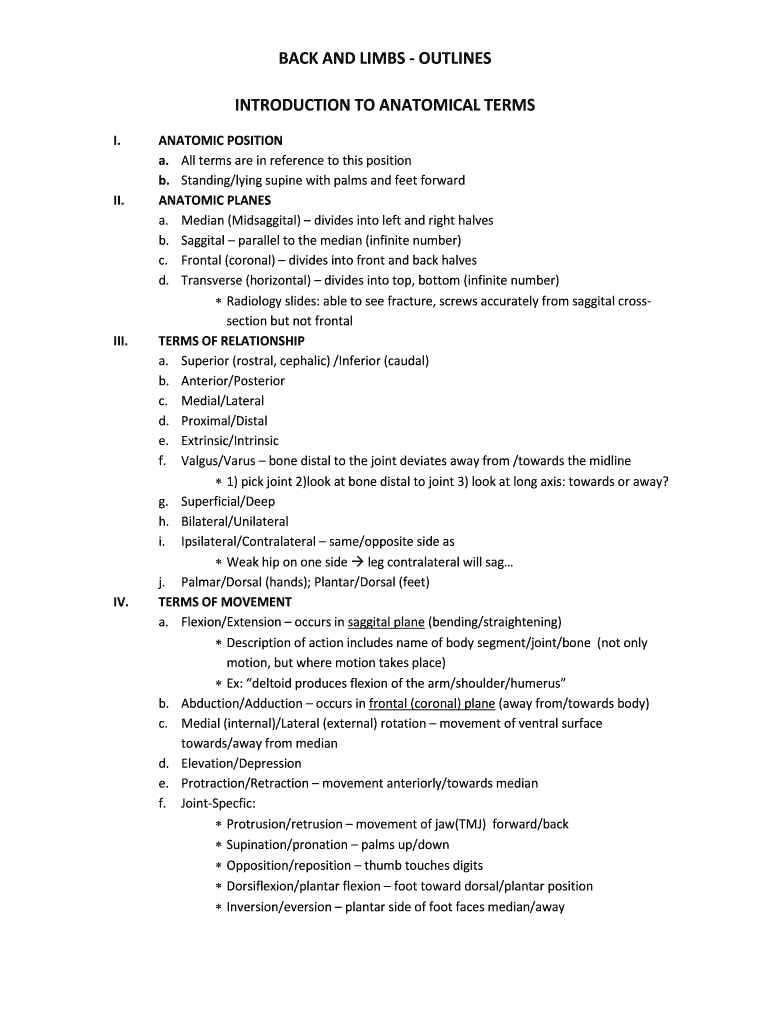







Definition and Meaning of the BACK AND LIMBS - OUTLINES
The "Back and Limbs - Outlines" refers to a structured document or template that provides essential guidelines and a framework for understanding specific anatomical or functional aspects related to the human back and limbs. It is a concentrated summary that might include visual diagrams, detailed descriptions, and structured content to outline vital elements associated with anatomy or clinical assessments. Such outlines are typically used to convey complex information in a clear and organized manner, making them useful for educational purposes, medical professionals, or anyone seeking an in-depth understanding of these body regions.
How to Use the BACK AND LIMBS - OUTLINES
Using the "Back and Limbs - Outlines" efficiently involves following a logical sequence to extract value from its organized content:
- Overview Examination: Begin by skimming through the outline to understand the overall structure and key sections.
- Reference Diagrams or Images: Utilize any visual aids provided within the outline to correlate with the textual information, enhancing comprehension.
- Section-by-Section Study: Focus on individual sections, dissecting them to understand finer details about anatomical features or functional insights.
- Annotations and Notes: Make annotations or additional notes alongside the outline for personal referencing or clarification.
- Cross-referencing: Compare information within the outline with external sources or resources for a broader understanding or validation.
Integrating these steps ensures that users can maximize the benefits of the outline in terms of educational enrichment or practical application in clinical settings.
Key Elements of the BACK AND LIMBS - OUTLINES
The "Back and Limbs - Outlines" comprises several fundamental elements that provide a comprehensive understanding of the respective topics:
- Anatomical Descriptions: Detailed narratives about the structure and function of specific body parts such as vertebrae, muscles, and nerves.
- Functional Relevance: Insights into how anatomical features contribute to movement or stability in everyday activities.
- Common Conditions and Syndromes: Information on prevalent medical conditions or disorders associated with the back and limbs, such as sciatica or carpal tunnel syndrome.
- Clinical Correlations: Examples showcasing how anatomy and physiology are linked with clinical diagnoses or intervention strategies.
- Embryological Insights: Reference to developmental origins and their impact on adult anatomical structures.
These elements work together to provide an integrated view of back and limb features, enabling detailed comprehension or clinical application.
Steps to Complete the BACK AND LIMBS - OUTLINES
To effectively complete a "Back and Limbs - Outlines," follow these precise steps:
- Identification of Resources: Gather all required materials, including anatomical books, digital references, and models.
- Initiation with Major Sections: Start by completing the outline's primary sections, which often form the backbone of understanding.
- Detailing Minor Sections: Fill in subsections that require detailed attention, focusing on specifics of anatomy and function.
- Verification of Information: Check facts and figures against reliable sources to ensure accuracy and integrity.
- Incorporation of Visuals: Add diagrams or images where applicable to complement and clarify textual descriptions.
- Review and Edit: Reassess the outline for coherence, completeness, and precision, making edits as necessary for clarity.
By adhering to this methodical approach, individuals can produce clear and informative outlines that serve educational or occupational aims.
Who Typically Uses the BACK AND LIMBS - OUTLINES
The "Back and Limbs - Outlines" is utilized by a diverse group of individuals, each deriving specific benefits from its structured information:
- Medical Students: Leverage outlines as study guides to reinforce their knowledge of anatomy and physiological processes.
- Healthcare Professionals: Use outlines for quick reference in clinical practice or patient education sessions.
- Anatomy Instructors: Rely on outlines to form the basis of lectures or instructional material for students.
- Researchers in Biomechanics: Reference outlines to support investigations related to human movement patterns and physical therapy.
This variety of users reflects the outline's broad applicability and its role as a crucial educational or professional tool.


Important Terms Related to BACK AND LIMBS - OUTLINES
Understanding key terms is essential for a comprehensive grasp of the "Back and Limbs - Outlines":
- Vertebral Column: Refers to the series of vertebrae extending from the skull to the lower back, instrumental in body structure and movement.
- Brachial Plexus: A network of nerves originating from the spine, responsible for motor and sensory functions of the upper limbs.
- Musculoskeletal Structure: A system involving bones and muscles, facilitating movement and supporting body posture.
- Embryology: The study of embryonic development, relevant in understanding the formation of anatomical structures.
Recognition of these terms within the context of the outline aids in deeper cognitive and practical connections, enhancing user engagement and understanding.
Legal Use of the BACK AND LIMBS - OUTLINES
The "Back and Limbs - Outlines" can have legal implications or applications, especially in medical or educational settings:
- Patient Documentation: Useful in creating medical reports or detailed anatomical descriptions needed for patient files.
- Medical Licensing: As part of preparatory material for exams in various healthcare licensing boards.
- Educational Certification: Instructors might use outlines as formal teaching material in validated educational environments.
Understanding these legal uses ensures that the outlines are employed appropriately, respecting academic integrity or professional standards where applicable.
Examples of Using the BACK AND LIMBS - OUTLINES
Several real-world examples showcase the utility and application of the "Back and Limbs - Outlines":
- Case Study in a Medical Class: Utilizing the outline to structure a detailed case study analysis or scenario discussion.
- Physical Therapy Sessions: Leveraging detailed outline content to illustrate and explain exercises or therapeutic interventions to patients.
- Surgical Planning: Surgeons might use anatomically accurate outlines to plan procedures or understand anatomical variations.
These practical applications demonstrate how the outlined information can be transformed into actionable insights or profound learning experiences.