




01. Edit your form online
Type text, add images, blackout confidential details, add comments, highlights and more.

Type text, add images, blackout confidential details, add comments, highlights and more.

Draw your signature, type it, upload its image, or use your mobile device as a signature pad.

Send it via email, link, or fax. You can also download it, export it or print it out.
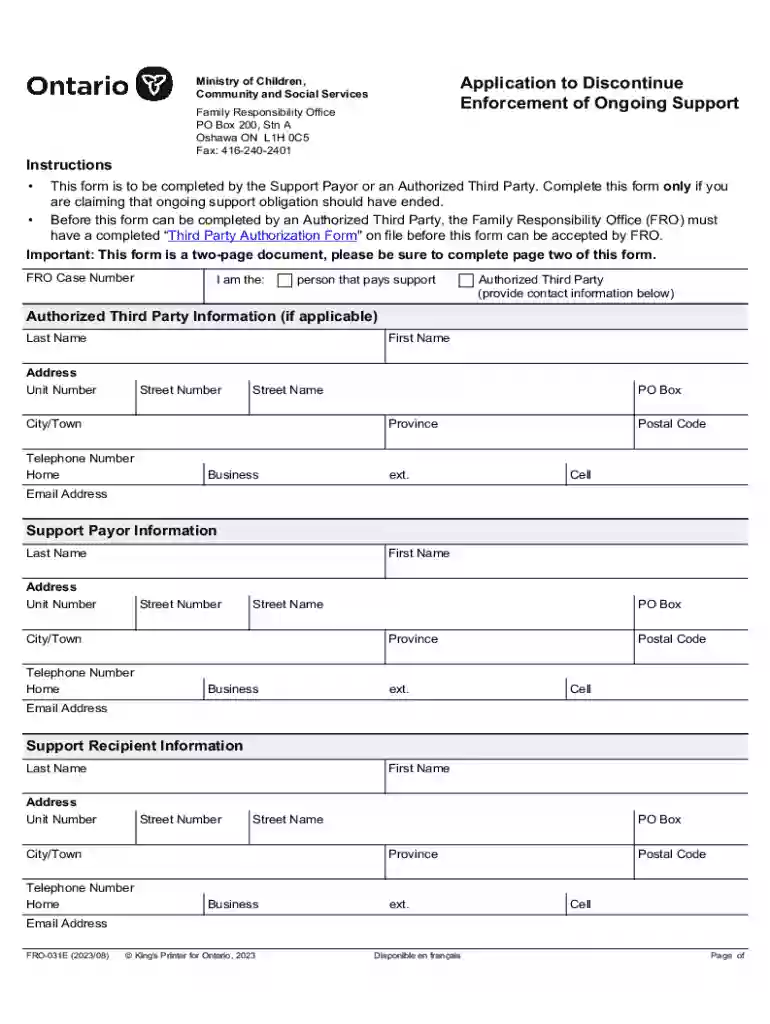
The "Application to Discontinue Enforcement of Ongoing Support" serves as a formal request for terminating the enforcement of support payments. Typically, this document is used by support payors or their authorized representatives who wish to halt the enforcement of obligations due to various reasons, such as changes in the child's circumstances or a mutual agreement between parties. Understanding the mechanics of this application is crucial for effectively navigating family law proceedings.
Gather Required Information: Begin by collecting necessary details, including the parties involved, such as the support payor and recipient names, addresses, and any related court case numbers.
Understand the Grounds for Discontinuation: Clearly outline the reasons for discontinuing support enforcement, which might include changes in the child’s status, income adjustments, or legal emancipation.
Complete the Form Sections: Fill out each section of the application accurately. This includes personal details, evidence supporting your request, and any legal documentation, like previous court orders, that may support your case.
Obtain Signatures: Ensure all necessary parties have signed the application. Depending on the jurisdiction, this might include notarial acknowledgment.
Review and Submit: Double-check for accuracy and completeness before submission. Submit through the prescribed method, which could be online, by mail, or in person, depending on local requirements.
Support Payors: Individuals obligated to make support payments who believe their obligation should no longer be enforced.
Authorized Third Parties: Legal representatives or family members who are authorized to act on behalf of the support payor.
Family Law Practitioners: Legal professionals assisting clients in modifying or discontinuing support obligations.
Understanding who uses this form helps ensure it’s filled out correctly and submitted by the appropriate party.
Applicant Information: This includes the personal and contact details of the individual requesting the discontinuation.
Recipient Information: Details about the person receiving the support and any changes in their circumstances.
Reason for Discontinuation: A detailed explanation supported by evidence, outlining why enforcement should cease.
Legal and Court Details: References to existing court orders and any legal precedents involved in the support agreement.
Compliance with the essential elements of this application is necessary to ensure its acceptance by the responsible agency.
Submitting this application carries various legal implications. It may alter the existing support agreement and impact both parties involved. This application is legally binding once approved, meaning it can change the enforcement mechanism of existing legal obligations. It's advisable to consult legal counsel to fully understand potential outcomes and ensure proper legal procedures are followed.
To support an application, certain documents are often required:
Previous Court Orders: Documentation of existing support orders or agreements.
Evidence Supporting Discontinuation: This could include proof of significant changes in financial circumstances, changes in the child’s status, or other pertinent documents.
Proof of Identity: Identification for both the applicant and recipient to ensure clarity and prevent fraud.
These documents underpin the claims made in the application and are essential for its processing.
Different jurisdictions offer various methods for submitting this application:
Online Submission: Many areas provide a digital platform where applications can be submitted electronically.
Mail: Traditional paper submissions are possible, requiring postal services for delivery.
In-Person Submission: Some jurisdictions may require or allow hand-delivery to the appropriate office.
Knowing how to submit this form correctly ensures that applications are processed without unnecessary delays.
Each state may have unique requirements and processes for this form:
Documentation Requirements: Varying from state to state, with some requiring additional forms or affidavits.
Approval Process: States may differ in their review timelines and criteria for approval.
Filing Fees: Certain states may impose fees upon application submission.
Understanding state-specific nuances is crucial for navigating the legal landscape effectively, avoiding delays, and ensuring compliance with local laws and traditions.
We've got more versions of the Application to Discontinue Enforcement of Ongoing Support Application to Discontinue Enforcement of form. Select the right Application to Discontinue Enforcement of Ongoing Support Application to Discontinue Enforcement of version from the list and start editing it straight away!
At DocHub, your data security is our priority. We follow HIPAA, SOC2, GDPR, and other standards, so you can work on your documents with confidence.

REQUEST FOR TERMINATION OF CONTINUED SUPPORT ENFORCEMENT SERVICES. The following information affects your right to receive continuing child support services.Read more
by M Ryznar 2014 Cited by 16 Congress amended the AFDC to require state welfare agencies to notify enforcement officials if a child continued to receive benefits under the program


