






Definition & Meaning
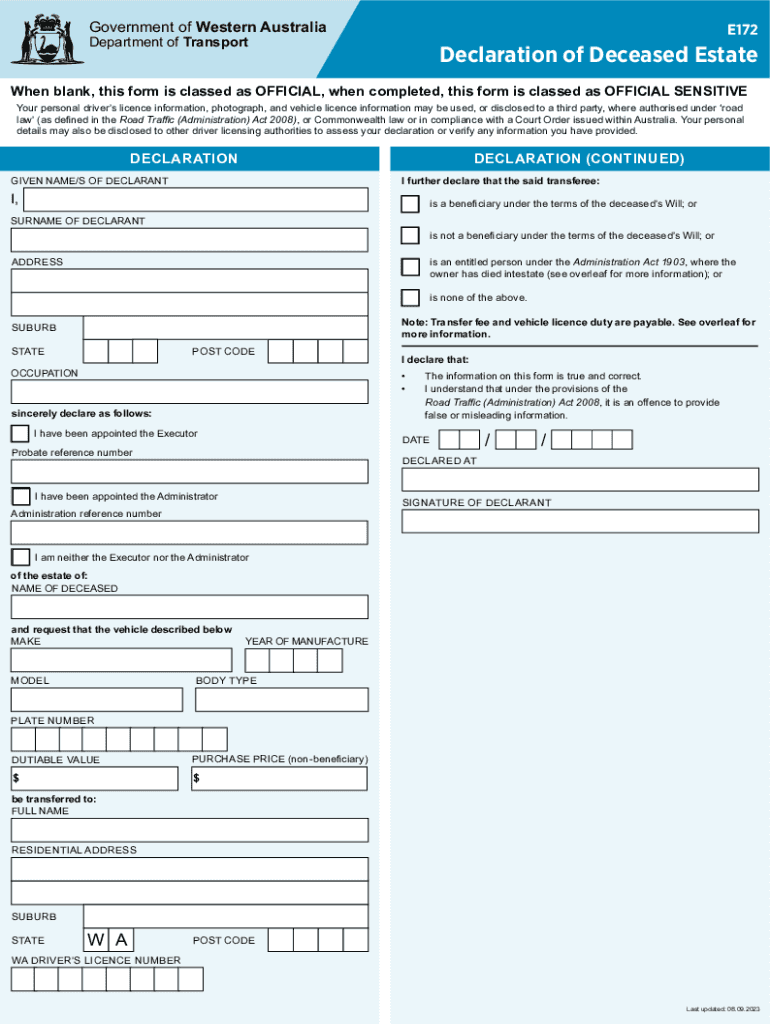
The Declaration of Deceased Estate (Form E172) is a legal document used in the Government of Western Australia, specifically by the Department of Transport, for the purpose of declaring a deceased individual's estate. It is a vital form in the process of transferring vehicle ownership after the death of the registered owner. The document serves to confirm the identity and legal standing of the declarant, who often is the executor or administrator of the deceased's estate, and provides necessary information about the deceased's vehicle that is subject to transfer.
Steps to Complete the Declaration of Deceased Estate (Form E172)
-
Gather Required Information:
- Obtain details about the deceased individual, including personal identifiers such as name, address, and date of death.
- Verify and collect any legal documents pertaining to the deceased's estate, such as a copy of the death certificate and the testamentary documents (will or probate).
-
Identify the Declarant's Role:
- Clearly define your relationship to the deceased, whether as an executor, administrator, or another authorized individual.
- Provide any legal documentation that supports your authority or right to manage the deceased estate.
-
Detail the Vehicle Information:
- Record specific details about the vehicle subject to transfer, including make, model, vehicle identification number (VIN), and registration details.
-
Complete the Form:
- Fill in all required fields accurately, ensuring no critical information is omitted. The emphasis should be on clarity and correctness to avoid any delays in processing.
-
Submit Accompanying Documents:
- Attach all required supporting documents, such as proof of identity, death certificate, will or probate documentation, and any additional documents as specified by the Department of Transport.
-
Sign and Submit the Form:
- Ensure the form is signed by the declarant or authorized officer to validate the declaration.
- Submit the completed form and accompanying documents through the specified submission methods.
How to Obtain the Declaration of Deceased Estate (Form E172)
To obtain Form E172, you can visit the official website of the Government of Western Australia's Department of Transport. The form is typically available for download in PDF format, enabling you to print it for manual completion. It's also possible to request a physical copy directly from the Department of Transport if online access is limited.
Key Elements of the Declaration of Deceased Estate (Form E172)
-
Declarant Information:
- Contains fields for personal information of the individual making the declaration, such as name, address, and contact information.
-
Deceased's Details:
- Captures essential details about the deceased including full name, last known address, and date of death.
-
Vehicle Information:
- Includes sections for inputting data about the vehicle in question, such as registration number, VIN, and any unique attributes or identifying information.
-
Legal Commitments:
- Outlines the declarant’s commitment to executing their duties truthfully and in accordance with estate management laws and practices.
Important Terms Related to Declaration of Deceased Estate (Form E172)
-
Executor:
- A person named in a will who is responsible for managing the estate of the deceased and carrying out the wishes of the deceased as specified in the will.
-
Probate:
- A legal process that involves the proving of a will. It confirms that the executor has the authority to distribute the assets of the deceased.
-
Estate:
- Represents a deceased person's total assets, including property, vehicles, bonds, and other investments that require distribution or management posthumously.
Legal Use of the Declaration of Deceased Estate (Form E172)
The form is legally necessary when executing the transfer of a vehicle that was owned by a deceased individual. It outlines the legal framework and necessary declarations required to transfer ownership in compliance with Western Australia's estate and probate laws, ensuring all processes meet legal standards. This helps prevent fraudulent transfers and protects all parties’ interests in the transaction.
Examples of Using the Declaration of Deceased Estate (Form E172)
-
Scenario 1: Executor of a Will:
- An executor uses the form to transfer the vehicle of a deceased individual, fulfilling the wishes laid out in the will.
-
Scenario 2: No Will Present:
- An administrator uses the form as part of legally mandated procedures to deal with an intestate estate (where no will is present), ensuring the equitable distribution of assets.
Who Typically Uses the Declaration of Deceased Estate (Form E172)
-
Executors and Administrators:
- Individuals named by the court or identified in a will responsible for overseeing the estate settlement process.
-
Legal Representatives:
- Professionals engaged in estate management who facilitate legal processes on behalf of a deceased individual's estate.


Eligibility Criteria
To use Form E172, you must meet certain eligibility requirements, including:
-
Proof of Authority:
- Confirming legal authority as executor or administrator is essential. This may require documentation such as court orders for probate or letters of administration.
-
Relationship to Deceased:
- Must show valid relationship to the deceased, often requiring submission of a will, official documentation of authority, or next-of-kin status if no formal will exists.

State-Specific Rules for the Declaration of Deceased Estate (Form E172)
Western Australia’s Department of Transport outlines specific guidelines and legal requirements applicable within the region’s jurisdiction. These protocols ensure that the execution of estates follows both state and federal laws, avoiding conflict or legal issues that may arise from incorrect processing.
Filing Deadlines and Important Dates
-
Probate Deadlines:
- Typically involves specific timelines dictated by the probate court to complete estate settlements.
-
Vehicle Registration Deadlines:
- Deadlines to register a vehicle in the new owner’s name post-transfer to prevent lapses in registration or potential fines.
Penalties for Non-Compliance
Failure to properly complete and submit the Declaration of Deceased Estate (Form E172) may result in delays in processing and potential legal issues, such as:
-
Administrative Fines:
- Failure to meet deadlines or inaccurate declarations can lead to fines or other administrative penalties.
-
Legal Action:
- Severe misrepresentations or fraudulent use of the form can result in legal action or criminal charges, stressing the importance of accuracy and honesty in submissions.