Lung VQ ScanNational Heart, Lung, and Blood Institute 2026

Get Form
Lung VQ ScanNational Heart, Lung, and Blood Institute Preview on Page 1

Here's how it works

01. Edit your form online
Type text, add images, blackout confidential details, add comments, highlights and more.

02. Sign it in a few clicks
Draw your signature, type it, upload its image, or use your mobile device as a signature pad.

03. Share your form with others
Send it via email, link, or fax. You can also download it, export it or print it out.

Definition and Purpose of a Lung VQ Scan

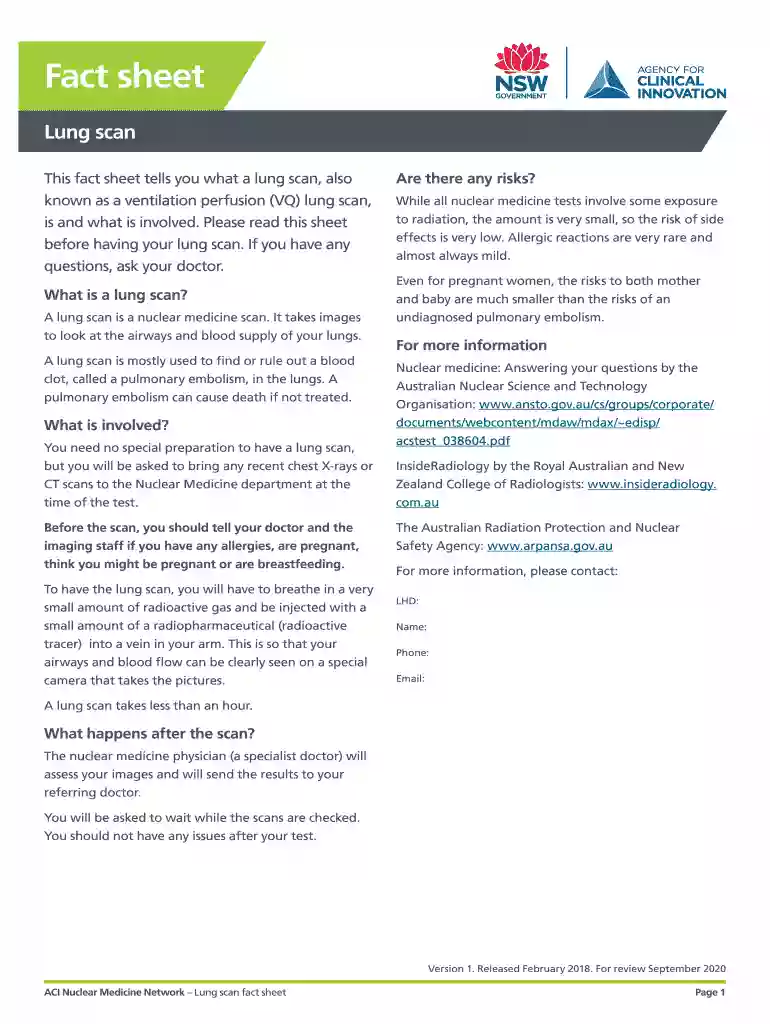
A Lung VQ Scan is a medical test designed to assess the ventilation and perfusion of a patient’s lungs. It employs a small amount of radioactive material to trace airflow and blood flow through the lungs, helping in diagnosing or ruling out pulmonary embolism. The scan consists of two parts — the ventilation scan, which evaluates the flow of air, and the perfusion scan, which examines blood flow. This combined analysis aids doctors in understanding how well the lungs are working and can pinpoint any blockages or abnormalities.

Importance of the Lung VQ Scan

  • Diagnosis: It is crucial for detecting conditions like pulmonary embolism or other lung disorders.
  • Non-invasive: Provides a relatively safe and non-invasive method compared to surgical procedures.
  • Comprehensive: Offers a detailed view of lung function by combining ventilation and perfusion data.

Preparation and Procedure for the Lung VQ Scan

Patients are typically required to follow minimal preparation instructions. It is essential to inform the medical staff of any allergies, especially to iodine, and if the patient is pregnant or lactating, as the test uses radioactive materials. During the procedure:

  1. Ventilation Scan: The patient inhales a radioactive gas or aerosol while a camera captures the airflow through the lungs.
  2. Perfusion Scan: A radioactive tracer is injected into a vein, and images are taken to trace blood flow through the lungs.

Expected Sensations and Duration

  • The procedure is generally painless, though patients might experience mild discomfort due to IV insertion.
  • The entire process typically lasts about 30 to 60 minutes, depending on individual circumstances.

Risks and Safety Measures

While the Lung VQ Scan involves exposure to a small amount of radiation, the levels are considered safe for most patients and are significantly lower than some other types of radiographic tests.

Radiation Concerns

  • Exposure Levels: Comparable to or slightly higher than a standard chest X-ray.
  • Precautionary Measures: Special precautions are taken for pregnant women, emphasizing the need for early disclosure to medical staff.

Side Effects

Most patients do not experience side effects; however, monitoring for any allergic reactions to the dye or radioactive materials used is standard.

Eligibility and Special Considerations

Not all individuals are suitable candidates for a Lung VQ Scan. Special considerations are taken for:

  • Pregnant or Nursing Women: Usually postponed unless absolutely necessary.
  • Allergy Considerations: Alternate imaging options may be considered for those with certain allergies.

Consultation and Doctor’s Assessment

A thorough consultation with a healthcare provider is necessary to determine the appropriateness of the test for each patient, taking into account medical history and current health status.

Applications for Specific Populations

Frequent Users of Lung VQ Scan

  • Patients with Prior Respiratory Issues: Especially those with a history of blood clots or embolisms.
  • Elderly Patients: More susceptible to lung-related issues and may frequently require evaluations.

Typical Health Conditions

  • Pulmonary Embolism: Primary diagnosis target using the Lung VQ Scan.
  • Chronic Obstructive Pulmonary Disease (COPD): Helpful in assessing lung function in chronic conditions.

Key Terminology in Lung VQ Scans

Understanding the terminology used in Lung VQ Scans can provide clearer insights into the procedure and results:

  • Ventilation: The process of air moving in and out of the lungs.
  • Perfusion: The flow of blood through the lung's blood vessels.
  • Tracer: A radioactive material used during the scan to visualize lung function.

Detailed Explanation of Terms

  • Radioactive Tracer: An agent used to highlight areas in the lungs on imaging tests.
  • Nuclear Medicine: A specialized area of radiology using radioactive materials to diagnose or treat diseases.

Comparisons and Alternatives to the Lung VQ Scan

There are several alternative diagnostic tests to consider alongside the Lung VQ Scan, each varying in method and application.

Alternative Procedures

  • CT Pulmonary Angiography: Provides detailed images of the pulmonary arteries but involves higher radiation exposure.
  • D-dimer Test: A blood test for ruling out clots, often used in conjunction with other diagnostics.

Advantages and Disadvantages

  • Lung VQ Scan: Lesser radiation exposure compared to CT scans; however, it provides less detailed anatomical visuals.
  • CT vs. VQ: CT scans deliver clearer anatomical details but at the expense of higher radiation doses.

Legal and Regulatory Aspects

Conducting a Lung VQ Scan entails adhering to specific legal and safety guidelines, particularly for handling and disposal of radioactive materials.

Compliance and Standards

  • Radiation Safety: Institutions conducting scans must adhere to Nuclear Regulatory Commission (NRC) regulations.
  • Patient Consent: Informed consent is mandatory, with detailed information provided about the risks and benefits of the procedure.

By understanding the detailed facets of Lung VQ Scans, from procedures to alternative options, patients and healthcare providers can make informed decisions tailored to individual health needs and circumstances.

be ready to get more

Complete this form in 5 minutes or less

Get form

Got questions?

We have answers to the most popular questions from our customers. If you can't find an answer to your question, please contact us.
Contact us
Pulmonary ventilation (V) and Perfusion (Q) scan, also known as lung V/Q scan, is a nuclear test that uses the perfusion scan to delineate the blood flow distribution and the ventilation scan to measure airflow distribution in the lungs.
Who does the VQ Scan? The VQ scan is carried out by a nuclear medicine technologist. The images taken by the technologist are reviewed by a nuclear medicine specialist doctor who provides a written report to the doctor who referred you for the VQ scan.
The test is performed in the radiology department of a hospital or in an outpatient facility. You are asked to put on a hospital gown. Once you are ready, multiple pictures of your chest are taken from different angles, using a special camera that detects the radionuclide.
Specification Test TypeLung Perfusion Scan Includes Lung Perfusion Scan (Nuclear Medicine) Preparation Reporting Within 4-6 hours* Test Price ₹ 7000 ₹ 8750
The mask used during the ventilation scan may make you feel nervous about being in a small space (claustrophobia). You must lie still during the scan. The radioisotope injection usually does not cause discomfort.

Security and compliance

At DocHub, your data security is our priority. We follow HIPAA, SOC2, GDPR, and other standards, so you can work on your documents with confidence.
Learn more
ccpa2
pci-dss
gdpr-compliance
hipaa
soc-compliance
be ready to get more

Complete this form in 5 minutes or less

Get form

People also ask

Your provider will inject the radioactive tracer into your vein through an intravenous (IV) line. The tracer will collect in the blood vessels of your lungs to show how the blood flows in your lungs. Your provider will use the scanner to take pictures of your lungs.
A CT scan uses a camera that takes pictures of a contrast dye in your body. A provider looks at the pictures to identify issues. A VQ scan is a two-part test. It uses a camera that takes pictures of radioactive particles in your body.

Related links