Reg 490 B 2026

Get Form
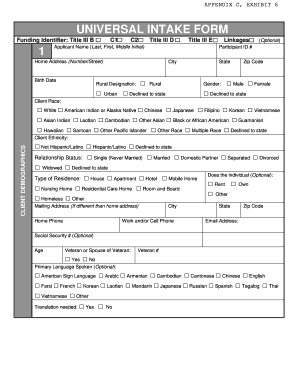
Reg 490 B Preview on Page 1

Here's how it works

01. Edit your form online
Type text, add images, blackout confidential details, add comments, highlights and more.

02. Sign it in a few clicks
Draw your signature, type it, upload its image, or use your mobile device as a signature pad.

03. Share your form with others
Send it via email, link, or fax. You can also download it, export it or print it out.

Definition and Meaning of Reg 490 B

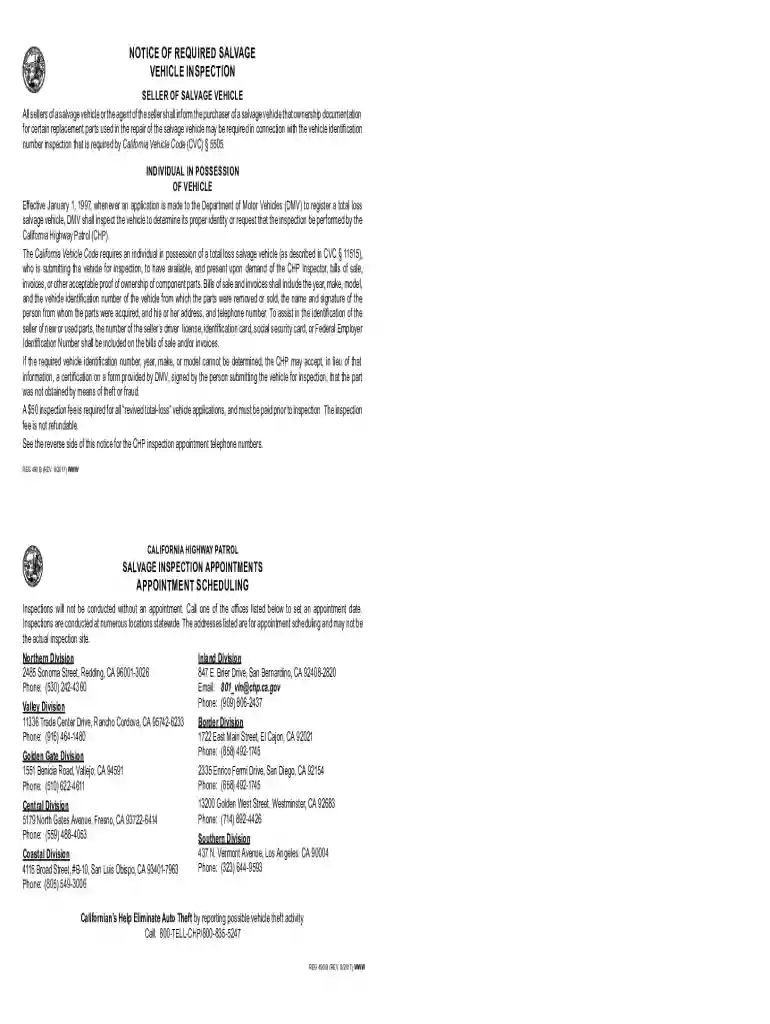
Reg 490 B pertains to the requirements for individuals and businesses involved in the sale and inspection of salvage vehicles in California. It specifically addresses the necessary documentation and procedural obligations mandated by the Department of Motor Vehicles (DMV) and the California Highway Patrol (CHP). The form is used to ensure that all legal conditions are met when a salvage vehicle is being inspected or transferred.

How to Obtain the Reg 490 B

Obtaining the Reg 490 B form involves contacting either the DMV or accessing it through their official website. It can also be provided during the scheduling of an inspection at a designated CHP office. Having this form readily available is crucial for individuals and businesses handling salvage vehicles to meet regulatory requirements effectively.

Steps to Complete the Reg 490 B

  1. Download the Form: Access the Reg 490 B through the DMV's website or collect it from a local DMV office.
  2. Fill in Personal Details: Enter necessary personal or business information, including name, address, and contact details.
  3. Vehicle Information: Provide details of the salvage vehicle, such as the vehicle identification number (VIN), make, model, and year.
  4. Ownership Proof: Attach documents proving ownership of the salvage vehicle and any replacement parts used.
  5. Signature and Date: Ensure the form is signed and dated by the individual or authorized representative responsible for the inspection.
  6. Submit the Form: Submit the completed form along with any required inspection fees at a scheduled appointment with the CHP.

Who Typically Uses the Reg 490 B

The Reg 490 B form is commonly utilized by vehicle sellers, salvage yard operators, and individuals submitting vehicles classified as a total loss for legal inspection. It is essential for those in possession of salvage vehicles to comply with state regulations, ensuring responsible and legal handling of these vehicles.


decoration image ratings of Dochub

Key Elements of the Reg 490 B

  • Owner Information: Essential details identifying the person or entity involved in the transaction.
  • Vehicle Details: Comprehensive data about the vehicle’s VIN, make, and model.
  • Ownership Documentation: Proof of legitimate ownership, including any affiliated paperwork for replacement parts.
  • Fee Submission: Inclusion of necessary fees associated with the inspection process.
  • Scheduled Inspection: Verification of a confirmed appointment with a CHP office for vehicle assessment.

Legal Use of the Reg 490 B

The Reg 490 B is used legally to ensure adherence to statutory requirements pertaining to salvage vehicles. It plays a critical role in documenting compliance with DMV and CHP inspections, safeguarding both the seller and the buyer in the transaction. Legal use also helps mitigate fraudulent activities in the sale or transfer of vehicles considered salvage or total loss.

Required Documents for Reg 490 B

  • Proof of Ownership: Title or salvage certificate indicating legitimate ownership.
  • Replacement Parts Documentation: Receipts or paperwork for parts that have been replaced on the vehicle.
  • Inspection Fee Receipt: Proof of payment for any inspection fees required as part of the form submission.
  • Appointment Confirmation: Documentation confirming the scheduled appointment at a CHP office for the vehicle’s inspection.

State-Specific Rules for Reg 490 B

California mandates specific guidelines for the Reg 490 B involving the processing and inspecting of salvage vehicles. These requirements include the presentation of ownership documents, vehicle-specific data, and scheduled appointments for inspections at certified CHP offices. Compliance with these state-specific regulations is vital to ensure lawful handling and registration of salvage vehicles.

be ready to get more

Complete this form in 5 minutes or less

Get form

Got questions?

We have answers to the most popular questions from our customers. If you can't find an answer to your question, please contact us.
Contact us
The rule will curb lung cancer, silicosis, chronic obstructive pulmonary disease and kidney disease in Americas workers by limiting their exposure to respirable crystalline silica.
The designated substances reports are an inventory of the location and condition of substances like asbestos and lead. New information may be found in these documents and must be consulted before any work or construction projects.
Most hazardous substances are covered by the WHMIS Regulation (Reg. 860) or the Control of Exposure to Biological or Chemical Agents Regulation (Reg. 833). However, there is a separate regulation for 11 chemical agents that have been classified as designated substances. The Designated Substances Regulation (Reg.
For example, in Ontario, Regulation 490/09 under the Occupational Health and Safety Act designates silica as a hazardous substance and sets a time-weighted average exposure limit (TWAEV) of 0.05 mg/m for respirable quartz.
Under the OSHA Respirable Crystalline Silica Rule, employers are responsible for ensuring workers are protected from silica. This includes controlling dust levels below the permissible exposure limit (PEL) of 50 g/m3 (micrograms of silica per cubic meter of air) as an 8-hour time weighted average.

Security and compliance

At DocHub, your data security is our priority. We follow HIPAA, SOC2, GDPR, and other standards, so you can work on your documents with confidence.
Learn more
ccpa2
pci-dss
gdpr-compliance
hipaa
soc-compliance
be ready to get more

Complete this form in 5 minutes or less

Get form

People also ask

The Respirable Crystalline Silica construction standard, 29 CFR 1926.1153, becomes enforceable on September 23, 2017. The standard establishes a new 8-hour time-weighted average (TWA) Permissible Exposure Limit (PEL) of 50 g/m3, an action level (AL) of 25 g/m3, and a host of ancillary requirements.

Related links