01. Edit your form online
Type text, add images, blackout confidential details, add comments, highlights and more.

Type text, add images, blackout confidential details, add comments, highlights and more.

Draw your signature, type it, upload its image, or use your mobile device as a signature pad.

Send it via email, link, or fax. You can also download it, export it or print it out.
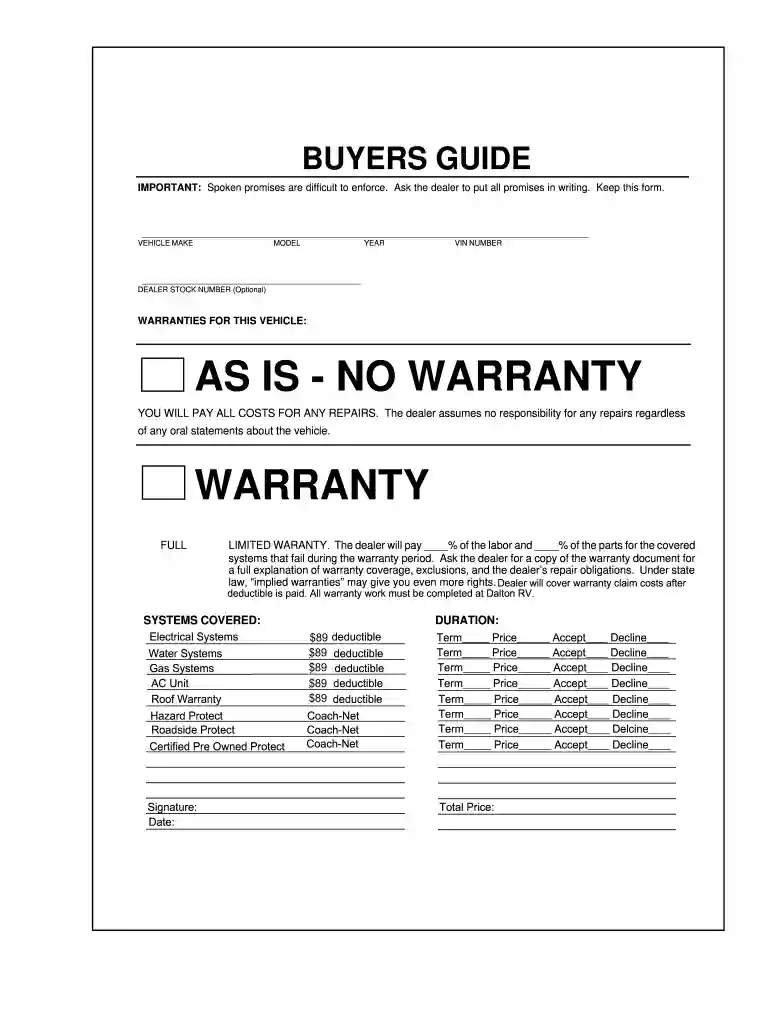
The "WARRANTIES FOR THIS VEHICLE: AS IS - NO WARRANTY WARRANTY" document defines the conditions under which a vehicle is sold without any guarantees provided by the dealer. In this context, "As Is" denotes that the buyer assumes responsibility for any repairs or defects post-purchase, as the seller will not cover any warranty. This form is a legal acknowledgment that no explicit or implicit warranties are offered. Such a document ensures both parties understand the terms of the transaction, emphasizing the buyer’s responsibility for all future vehicle maintenance.
To use the "WARRANTIES FOR THIS VEHICLE: AS IS - NO WARRANTY WARRANTY" document effectively, both the buyer and seller must carefully read and understand the terms outlined. The buyer should:
Sellers should also ensure the document is complete and signed before finalizing the transaction.
Completing the "WARRANTIES FOR THIS VEHICLE: AS IS - NO WARRANTY WARRANTY" document involves the following steps:
Ensure all information is accurately filled in and that both parties understand their responsibilities under this agreement.
Several critical elements define the "WARRANTIES FOR THIS VEHICLE: AS IS - NO WARRANTY WARRANTY":
These elements collectively ensure transparency and legal protection for both parties.
In the United States, using the "WARRANTIES FOR THIS VEHICLE: AS IS - NO WARRANTY WARRANTY" document is compliant with regulations governing vehicle sales. It effectively releases the dealer from liability for post-sale repairs or defects. Buyers should understand their purchase is independent of any future claims against the dealer for vehicle issues. The document acts as a legal acknowledgment protecting the seller under U.S. contract law.
This document is commonly used by:
These parties frequently engage in transactions where clear communication of vehicle condition is crucial.
State regulations can influence the use of the "WARRANTIES FOR THIS VEHICLE: AS IS - NO WARRANTY WARRANTY." For instance:
Always check local state laws to ensure the document's compliance with specific legal statutes and consumer protection laws.
A few key terms related to the "WARRANTIES FOR THIS VEHICLE: AS IS - NO WARRANTY WARRANTY" include:
Understanding these terms helps clarify what is not covered under the "As Is" designation, protecting both buyer and seller.
Consider these real-world scenarios:
These examples underscore the document's role in clearly delineating buyer and seller responsibilities.
At DocHub, your data security is our priority. We follow HIPAA, SOC2, GDPR, and other standards, so you can work on your documents with confidence.