







Definition & Meaning
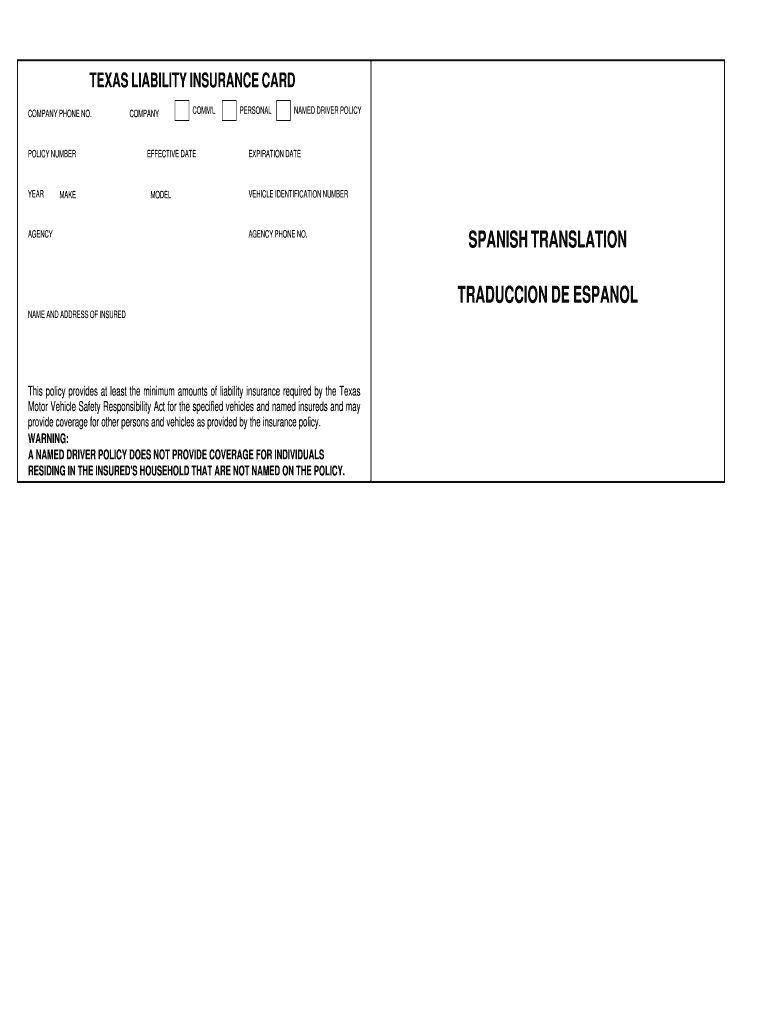
The Texas Liability Insurance Card serves as proof of compliance with the Texas Motor Vehicle Safety Responsibility Act. This act mandates that all drivers maintain a minimum level of liability insurance to operate a vehicle legally within the state. The card verifies that the vehicle owner has met the minimum insurance requirements, typically covering bodily injuries and property damage caused by vehicular accidents. Failure to carry this card when driving can result in fines and penalties, emphasizing its importance in daily vehicle operation.
Key Elements of the TEXAS LIABILITY INSURANCE CARD
The card contains critical information such as the policyholder's name, the insurance company's name, policy number, and the coverage period. It might also list the vehicle's description, including make, model, and vehicle identification number (VIN). In some cases, the card will state the insurer's contact information for ease of access during emergencies or traffic stops. These details are crucial for law enforcement officers or other authorities to confirm the validity of the insurance policy.
Legal Use of the TEXAS LIABILITY INSURANCE CARD
Legally, the Texas Liability Insurance Card must be presented upon request during vehicle registration, driver’s license renewals, and state safety inspections. If involved in an accident, exchanging insurance information with other parties is essential. The card is particularly critical when verifying financial responsibility at road checkpoints or if a driver is pulled over for a traffic violation. It also outlines that named driver policies do not cover residents in the insured's household unless explicitly mentioned.
How to Obtain the TEXAS LIABILITY INSURANCE CARD
When purchasing an auto insurance policy in Texas, the insurer provides the Texas Liability Insurance Card at no additional cost. Drivers can request additional copies if necessary for multiple vehicles or drivers within the household. It's essential to store the card in a safe, accessible location, such as the vehicle's glove compartment, to ensure it's readily available during any encounter with law enforcement or for other compliance purposes.
Who Typically Uses the TEXAS LIABILITY INSURANCE CARD
The primary users of the Texas Liability Insurance Card are vehicle owners and regular drivers in Texas, including residents and those with out-of-state vehicles registered in Texas. Other users can include business owners who operate corporate fleets within the state, as well as rental car agencies ensuring compliance with state regulations. Generally, anyone driving within Texas needs to possess this card to verify they meet the state's minimum insurance requirements.


State-Specific Rules for the TEXAS LIABILITY INSURANCE CARD
Texas law specifies that all drivers must carry proof of liability insurance. Texas has unique requirements, such as minimum coverage amounts designated primarily for bodily injuries per person, bodily injuries per accident, and property damage. Unlike some states, Texas requires drivers to show proof of insurance even if residing temporarily. The state also allows for electronic versions of the insurance card as valid proof, provided they are readily producible on a digital device.
Steps to Complete the TEXAS LIABILITY INSURANCE CARD
- Purchase a valid auto insurance policy from a Texas-authorized insurer.
- Confirm with the insurer that all necessary vehicle and driver information is correctly listed.
- Obtain the Texas Liability Insurance Card, which should accompany your policy.
- Keep the card accessible within your vehicle to ensure compliance with state laws.
It is advisable to review the card upon receipt to confirm the accuracy of all included details to prevent issues when presenting it to authorities or in the case of an accident.
Penalties for Non-Compliance
Failing to carry a Texas Liability Insurance Card can result in various penalties, including fines, vehicle impoundment, and in some cases, suspension of the driver’s license. Repeat offenses typically incur increasingly severe penalties, emphasizing the importance of maintaining up-to-date and easily accessible proof of insurance. In serious cases involving accidents without insurance, drivers may face lawsuits and financial liabilities far exceeding standard penalties.




